

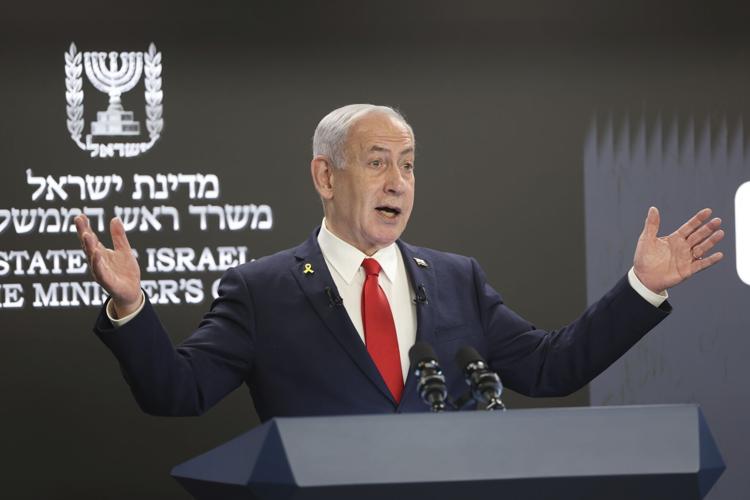
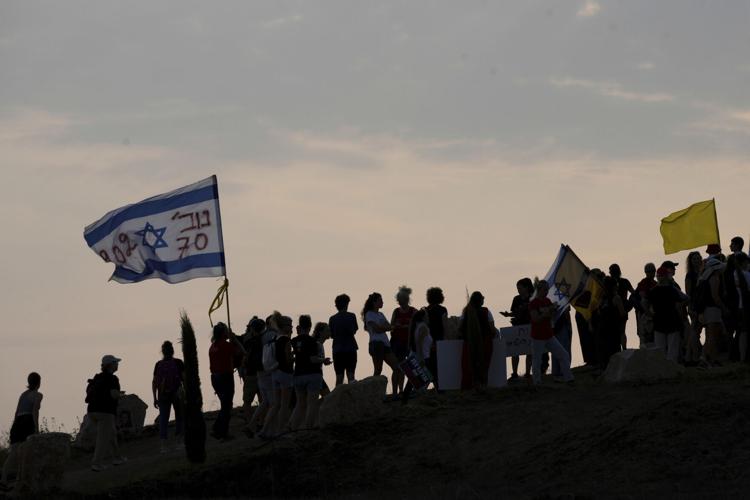
JERUSALEM — Israeli Prime Minister Benjamin Netanyahu on Sunday defended a new military offensive in Gaza that's more sweeping than previously announced, declaring in the face of growing condemnation at home and abroad that Israel “has no choice but to finish the job and complete the defeat of Hamas.”
Even as more Israelis express concern over the 22-month war, Netanyahu said the security Cabinet last week instructed the dismantling of Hamas strongholds not only in Gaza City but also in the “central camps” and Muwasi. A source familiar with the operation, who spoke on condition of anonymity because they were not authorized to talk to the media, confirmed that Israel plans it in both areas.
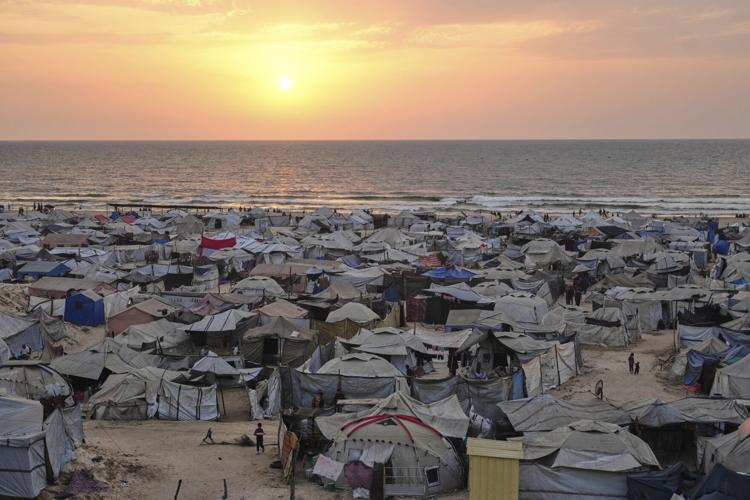
The crowded camps — sheltering well over a half-million displaced people, according to the U.N. — were not part of Israel's announcement Friday. It was not clear why, though Netanyahu faced criticism this weekend within his ruling coalition that targeting Gaza City was not enough. Netanyahu said there would be “safe zones," but such designated areas have been bombed in the past.
Late Sunday, heavy bombardment was reported in Gaza City. Shortly before midnight local time, broadcaster Al Jazeera said correspondent Anas al-Sharif was killed in a strike. Rami Mohanna, administrative director at the nearby Shifa Hospital, said the strike hit a tent for Al Jazeera journalists outside the hospital’s walls. Along with al-Sharif, three other journalists and a driver were killed.
Israel’s military confirmed it, asserting al-Sharif had “posed as a journalist” and alleging he was with Hamas. Al-Sharif denied having political affiliations. The Committee to Protect Journalists last month said it was gravely concerned for his safety and said he was “targeted by an Israeli military smear campaign.”
Netanyahu's office late Sunday said he had spoken with U.S. President Donald Trump about the plan and thanked him for his “steadfast support.”
Rejecting starvation in Gaza as well as a “global campaign of lies," Netanyahu spoke to foreign media just before an emergency meeting of the United Nations Security Council, a platform for outrage but little action on the war.
“Our goal is not to occupy Gaza, our goal is to free Gaza,” Netanyahu asserted.
Netanyahu said there is a “fairly short timetable” for next steps there, but didn’t give specifics. The goals, he said, include demilitarizing the territory, the Israeli military having “overriding security control” and a non-Israeli civilian administration in charge.
Israel wants to increase the number of aid distribution sites in Gaza, he said, but in a later briefing to local media, he asserted: “There is no hunger. There was no hunger. There was a shortage, and there was certainly no policy of starvation."
Netanyahu also said he has directed Israel’s military to “bring in more foreign journalists” — which would be a striking development, as they haven’t been allowed into Gaza beyond military embeds during the war.
He again blamed many of Gaza’s problems on the Hamas militant group, including civilian deaths, destruction and aid shortages. “Hamas still has thousands of armed terrorists," he asserted, adding that Palestinians are “begging” to be freed from them.
Hamas responded with a lengthy statement that summed up Netanyahu's remarks as “blatant lies.”
At a meeting of the U.N. Security Council, the United States defended Israel, saying it has the right to decide what’s best for its security. It called allegations of genocide in Gaza false.
The U.S. has veto power at the council and can block proposed actions there.
Other council members, and U.N. officials, expressed alarm. China called the “collective punishment” of people in Gaza unacceptable. Russia warned against a “reckless intensification of hostilities.”
“This is no longer a looming hunger crisis; this is starvation,” said Ramesh Rajasingham with the U.N. humanitarian office. “Humanitarian conditions are beyond horrific. We have frankly run out of words to describe it.”
Israel faces growing action even by its closest allies. Netanyahu said Chancellor Friedrich Merz of Germany “buckled under” the growing international criticism by stopping exports of military equipment to Israel that could be used in Gaza. Merz, for his part, told public broadcaster ARD that Germany and Israel were talking “very critically” but Berlin’s overall policies of friendship haven’t changed.
At least 31 Palestinians were killed while seeking aid in Gaza, hospitals and witnesses said. The Associated Press spoke to witnesses of gunfire in the Israeli-controlled Morag and Netzarim corridors and the Teina area in the south. All accused Israeli forces of firing at crowds trying to reach food distributions or waiting for convoys.
Fifteen people were killed while waiting for trucks near the Morag corridor that separates the southern cities of Rafah and Khan Younis, according to Nasser hospital.
The situation is a “death trap,” said Jamal al-Laweh, who said Israeli forces opened fire there. “But I have no other choice to feed the kids.”
Six were killed while waiting for aid in northern Gaza near the Zikim crossing, according to Gaza's Health Ministry and Shifa hospital.
In central Gaza, witnesses said they heard warning shots before fire was aimed toward crowds trying to reach a distribution site operated by the Israeli-backed and U.S.-funded Gaza Humanitarian Foundation. The AP could not independently confirm who fired. Awda hospital said four people were killed by Israeli gunfire.
Six other aid-seekers were killed while trying to reach GHF sites in Khan Younis and Rafah, Nasser hospital said.
The GHF sites opened in May as an alternative to the U.N.-run aid system, but operations have been marred by deaths and chaos.
Responding to AP inquiries, the GHF media office said: “There were no incidents at or near our sites today.” Israel's military said there were no incidents involving troops near central Gaza aid sites.

