


RIO DE JANEIRO — Brazilian Vice President Geraldo Alckmin said Saturday that Brazilian exported goods to the U.S. including coffee, beef and tropical fruits still would be tariffed 40%, despite President Donald Trump's decision to remove some import taxes.
On Friday, Trump scrapped levies announced in April that were intended to encourage domestic production while lifting the U.S. economy. Brazil at the time was hit with a 10% tariff.
In July, Trump imposed a further 40% tariff, citing — among other reasons — the trial of his ally, former President Jair Bolsonaro, which he called a "witch hunt." Proceedings went ahead regardless and Bolsonaro was sentenced in September to 27 years and three months in prison for attempting a coup.

Brazil's former President Jair Bolsonaro stands Sept. 2 at the entrance of his home in Brasilia, Brazil, while under house arrest.
Alckmin said some products, such as orange juice, would now have a zero tariff as they were not targeted by the additional 40%. However, that extra tariff remains in place on products including coffee, beef and tropical fruits, such as mangos and pineapples.
While Brazil's vice president welcomed Trump's latest decision, which he called "positive" and a "step in the right direction," he said there remained a "distortion that needs to be corrected."
"Everyone got 10% less, but in Brazil's case, which had 50%, we ended up with 40%, which is very high," Alckmin told journalists in the capital, Brasilia.
Alckmin said that Friday's decision means that 26% of Brazilian goods now enter the U.S. without additional tariffs. That's up from 23%.
Trump's July decision, which was overtly political as Brazil has a trade deficit with the United States, led to the worst U.S.-Brazil relations in history.


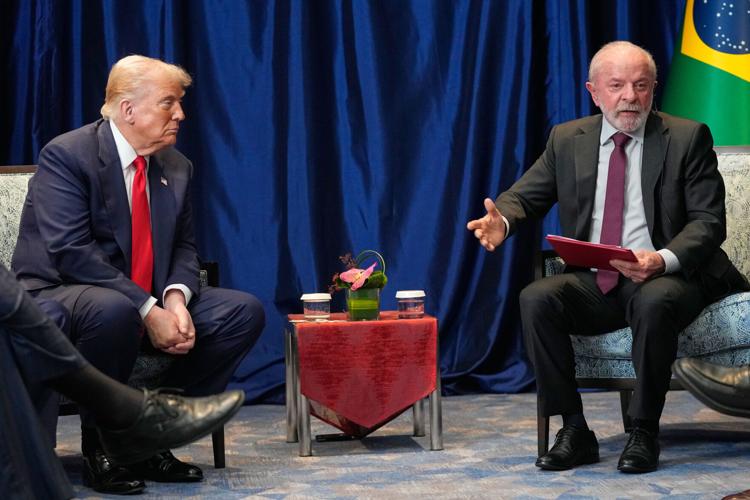
President Donald Trump meets with Brazil's President Luiz Inacio Lula da Silva on Oct. 26 on the sidelines of the ASEAN Summit in Kuala Lumpur, Malaysia.
Those relations since improved, and in October Brazilian President Luiz Inácio Lula da Silva and Trump met in Malaysia.
"President Lula's conversation with President Donald Trump was important in terms of dialogue and negotiation," Alckmin said Saturday.
After that encounter, Lula said he was confident the two countries would soon reach a trade deal.
U.S. Secretary of State Marco Rubio and Brazil's Foreign Minister Mauro Vieira met for 50 minutes this past week to further the conversation.
The Brazilian Association of the Coffee Industry said it would continue to monitor the situation. "(We) will keep working to ensure legal certainty, competitiveness, and predictability for the Brazilian coffee industry," the group's president, Pavel Cardoso, said.

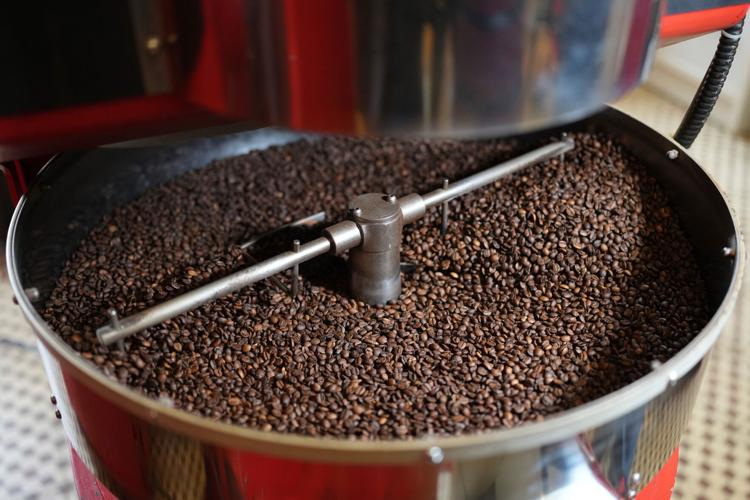
Coffee beans are prepared Aug. 4 at a farm in Braganca Paulista, Brazil.

Trump's abrupt retreat from his signature tariff policy on so many staples key to the American diet came after voters in off-year elections this month cited economic concerns as their top issue, resulting in big wins for Democrats in Virginia, New Jersey and other key races around the U.S.
The Trump administration insisted that its tariffs helped fill government coffers and weren't a major factor in higher prices at grocery stores. However, Democrats were quick to paint Friday's move as an acknowledgment that Trump's policies hurt American pocketbooks.

Inflation remains elevated. Record-high beef prices were a particular concern, and Trump said he intended to take action to try to lower them. The Republican president's tariffs on Brazil, a major beef exporter, were a factor.
The Food Industry Association, which represents retailers, producers and a variety of related industry firms and services, applauded Trump's move Friday to provide “swift tariff relief,” noting import taxes "are an important factor” in a “complex mix” of supply chain issues.
“President Trump’s proclamation to reduce tariffs on a substantial volume of food imports is a critical step ensuring continued adequate supply at prices consumers can afford,” the association said.

In explaining the tariff reductions, the White House said some of the original levies Trump imposed are no longer necessary given the trade agreements he since hammered out with key U.S. trading partners.
Indeed, the Trump administration said earlier Friday it reached framework agreements with Ecuador, Guatemala, El Salvador and Argentina meant to increase the ability of U.S. firms to sell industrial and agricultural products in those countries, while also potentially easing tariffs on agricultural products produced there.

Late Friday, Trump repeated his assertions that his administration would use revenue the federal government collected from import levies to fund $2,000 checks for many Americans. “Everybody but the rich will get this," he said, and suggested the checks could be issued in 2026. However, he also said federal tariff revenue might be used to pay down national debt.
He rejected suggestions that attempting direct payments to Americans could exacerbate inflation concerns — even as he suggested that similar checks offered during the COVID-19 pandemic and by previous administrations to stimulate the economy had that very effect.
Photos: A look at global trade

FILE - Swiss chocolate bars from the brands Favarger, Villars, Cailler and Swiss-Dream are photographed in a souvenir shop window on Thursday, April 10, 2025, in Geneva. (Martial Trezzini/Keystone via AP)

FILE - Watches in the Omega shop window at the Bahnhofsstrasse in Zuerich, Switzerland, on Thursday, April 10, 2025. (Til Buergy/Keystone via AP)

FILE - A view of Gruy're AOP cheese wheels in the Gruy're AOP maturing cellars of Fromco, part of the Emmi Group, on Tuesday, May 6, 2025 in Moudon in the canton of Vaud. (Jean-Christophe Bott/Keystone via AP)

FILE - An employee at On tidies up sports shoes from the On sports brand in the On store on Wednesday, Jan. 22, 2025, at On's headquarters in Zurich. (Gaetan Bally/Keystone via AP)

A container is loaded on a truck at the Civitavecchia Harbour, Italy, Thursday, Aug. 7, 2025. (AP Photo/Gregorio Borgia)

A man works at a leather factory at Dharavi in Mumbai, India, Thursday, Aug. 7, 2025. (AP Photo/Rajanish Kakade)

Vehicles for export are parked at a port in Pyeongtaek, South Korea, Thursday, Aug. 7, 2025. (AP Photo/Ahn Young-joon)

An Indian customer, reflected on a mirror, tries a gold necklace at a jewelry shop in Lucknow, India, Thursday, Aug. 7, 2025. (AP Photo/Rajesh Kumar Singh)

An employee sorts medicines in a medicine wholesale shop in Guwahati, India, Thursday, Aug. 7, 2025. (AP Photo/Anupam Nath)

Trucks navigate along stacks of containers at the Manila North Harbour Port in Manila, Philippines on Thursday, Aug. 7, 2025. (AP Photo/Aaron Favila)

A truck navigates along stacks of containers at the Manila North Harbour Port in Manila, Philippines on Thursday, Aug. 7, 2025. (AP Photo/Aaron Favila)

An employee holds U.S. dollar notes at a money changer in Jakarta, Indonesia, Thursday, Aug. 7, 2025. (AP Photo/Tatan Syuflana)

A man watches stock prices displayed on an electronic board at the Indonesia Stock Exchange in Jakarta, Indonesia, Thursday, Aug. 7, 2025. (AP Photo/Tatan Syuflana)

A crane works on stacks of containers at the Bangkok Port in Bangkok, Thailand, Wednesday, Aug. 6, 2025. (AP Photo/Sakchai Lalit)

A crane unloads a shipping container from a truck at IPC Container Terminal at Tanjung Priok Port in Jakarta, Indonesia, Wednesday, Aug. 6, 2025. (AP Photo/Achmad Ibrahim)

A worker waits for customers at Roopam Sarees, which sells clothing imported from India, on Thursday, July 31, 2025, in Berkeley, Calif. (AP Photo/Noah Berger)

Sen. Minority Leader Chuck Schumer of N.Y., speaks during a news conference on tariffs on Capitol Hill, Thursday, July 31, 2025, in Washington. (AP Photo/Mariam Zuhaib)

Cargo containers line a shipping terminal at the Port of Oakland on Thursday, July 31, 2025, in Oakland, Calif. (AP Photo/Noah Berger)

A worker assembles steel decking in the construction of a housing project, Thursday, July 31, 2025, in Portland, Maine. (AP Photo/Robert F. Bukaty)

A welder works on steel decking during construction of a housing project, Thursday, July 31, 2025, in Portland, Maine. (AP Photo/Robert F. Bukaty)

New cars are parked in a lot at the International Car Operators terminal in the Port of Zeebrugge, Belgium, Thursday, July 31, 2025. (AP Photo/Virginia Mayo)

The Atlantic Navigator II departs from the Port of Baltimore, Thursday, July 31, 2025, in Baltimore. (AP Photo/Stephanie Scarbrough)

A South Korean protester holds up a banner during a rally against U.S. President Donald Trump's tariffs policy on South Korea, near the U.S. Embassy in Seoul, South Korea, Wednesday, July 30, 2025. The signs at bottom read "We can't give you a penny." (AP Photo/Ahn Young-joon)

Workers prep bulk bags of sugar to be loaded on a container ship at the port of Santos, Brazil, Tuesday, July 29, 2025. (AP Photo/Andre Penner)

Workers load a truck with the last boxes filled with clothes from the empty Tzicc clothing factory following the threat of U.S.-imposed tariffs in Maseru, Lesotho, Tuesday, July 22, 2025. (AP Photo/Bram Janssen)

A sewing machine is covered by a sheet inside the empty Tzicc clothing factory following the threat of U.S.-imposed tariffs in Maseru, Lesotho, Tuesday, July 22, 2025. (AP Photo/Bram Janssen)

A woman works in a Celine shop, Monday, July 28, 2025 in Paris. (AP Photo/Thomas Padilla)

Customers and influencers try on new Korean perfume during a workshop at Senti Senti in New York on Friday, July 25, 2025. (AP Photo/Yuki Iwamura)

A worker tends to plants inside a greenhouse at the Veggie Prime tomato farm, which exports to the United States, in Ajuchitlan, Mexico, Wednesday, July 23, 2025. (AP Photo/Marco Ugarte)

FILE - President Donald Trump speaks during an event to announce new tariffs in the Rose Garden at the White House, on April 2, 2025, in Washington. (AP Photo/Mark Schiefelbein, File)

