


PHILADELPHIA — After waiting more than four decades to clear his name in a friend’s 1980 killing, Subramanyam Vedam was set to walk free from a Pennsylvania prison this month.
Vedam and Thomas Kinser were the 19-year-old children of Penn State University faculty. Vedam was the last person seen with Kinser and was twice convicted of killing him, despite a lack of witnesses or motive.

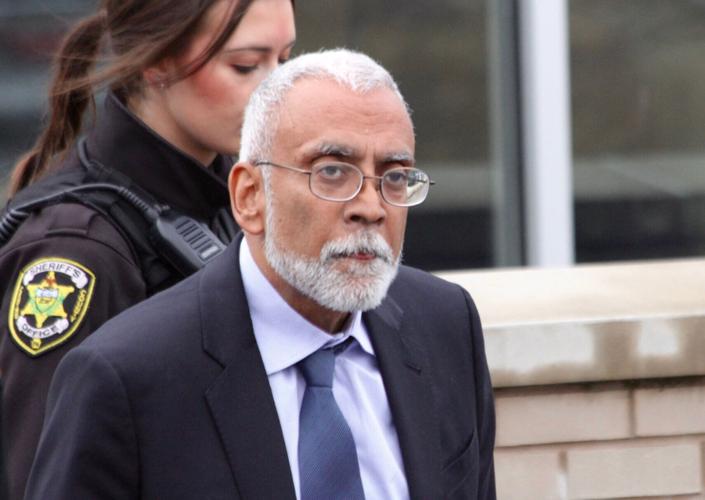
Subramanyam “Subu” Vedam walks Feb. 6 outside the Centre County Courthouse in Bellefonte, Pa., during a hearing over new evidence uncovered in his 1983 murder case.
In August, a judge threw out the conviction after Vedam’s lawyers found new ballistics evidence that prosecutors never disclosed.
As his sister prepared to bring him home Oct. 3, the thin, white-haired Vedam was instead taken into federal custody over a 1999 deportation order.
The 64-year-old, who legally came to the U.S. from India when he was 9 months old, now faces another daunting legal fight.

Amid the Trump Administration’s focus on mass deportation, Vedam’s lawyers must persuade an immigration court that a 1980s drug conviction should be outweighed by the years he wrongly spent in prison. For a time, immigration law allowed people who reformed their lives to seek such waivers. Vedam never pursued it then because of the murder conviction.
“He was someone who’s suffered a profound injustice,” said immigration lawyer Ava Benach. “(And) those 43 years aren’t a blank slate. He lived a remarkable experience in prison.”
Vedam earned several degrees behind bars, tutored hundreds of fellow inmates and went nearly half a century with just a single infraction, which involved rice brought in from the outside.
His lawyers hope immigration judges will consider the totality of his case. The administration, in a brief filed Friday, opposes the effort. So Vedam remains at an 1,800-bed U.S. Immigration and Customs Enforcement facility in central Pennsylvania.
“Criminal illegal aliens are not welcome in the U.S,” a Department of Homeland Security spokesperson said in an email about the case.

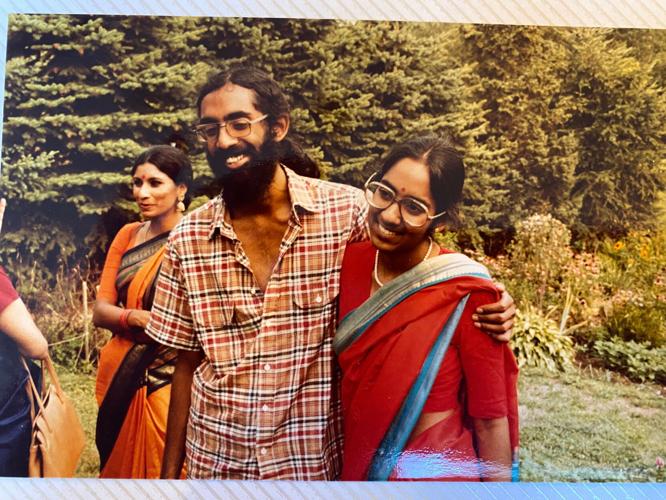
Tejaswini Rao chats with party guests while Subramanyam and Saraswathi Vedam embrace in August 1981 during their parents' wedding anniversary party in State College, Pa.
‘Mr. Vedam, where were you born?’
After his initial conviction was thrown out, Vedam faced an unusual set of questions at his 1988 retrial.
“Mr. Vedam, where were you born?” Centre County District Attorney Ray Gricar asked. “How frequently would you go back to India?”
“During your teenage years, did you ever get into meditation?”
Gopal Balachandran, the Penn State law professor who won the reversal, believes the questions were designed to alienate him from the all-white jury, which returned a second guilty verdict.

Saraswathi, 6, and Subramanyam Vedam, 2, pose for a 1963 photo in their State College, Pa., home.
The Vedams were among the first Indian families in the area known as “Happy Valley,” where his father came as a postdoctoral fellow in 1956. An older daughter was born in State College, but “Subu,” as he was known, was born when the family was back in India in 1961.
They returned to State College for good before his first birthday, and became the family that welcomed new members of the Indian diaspora to town.
“They were fully engaged. My father loved the university. My mother was a librarian, and she helped start the library,” said the sister, Saraswathi Vedam, 68, a midwifery professor in Vancouver, British Columbia.
While she left for college in Massachusetts, Subu became swept up in the counterculture of the late 1970s, growing his hair long and dabbling in drugs while taking classes at Penn State.

One day in December 1980, Vedem asked Kinser for a ride to nearby Lewisburg to buy drugs. Kinser was never seen again, though his van was found outside his apartment. Nine months later, hikers found his body in a wooded area miles away.
Vedam was detained on drug charges while police investigated, and ultimately was charged with murder. He was convicted in 1983 and sentenced to life without parole. To resolve the drug case, he pleaded no contest to four counts of selling LSD and a theft charge.
The 1988 retrial offered no reprieve from his situation.
Though the defense long questioned the ballistics evidence in the case, the jury, which heard that Vedam bought a .25-caliber gun from someone, never heard that an FBI report suggested the bullet wound was too small to have been fired from that gun. Balachandran only found that report as he dug into the case in 2023.
After hearings on the issue, a Centre County judge threw out the conviction and the district attorney decided this month not to retry the case.

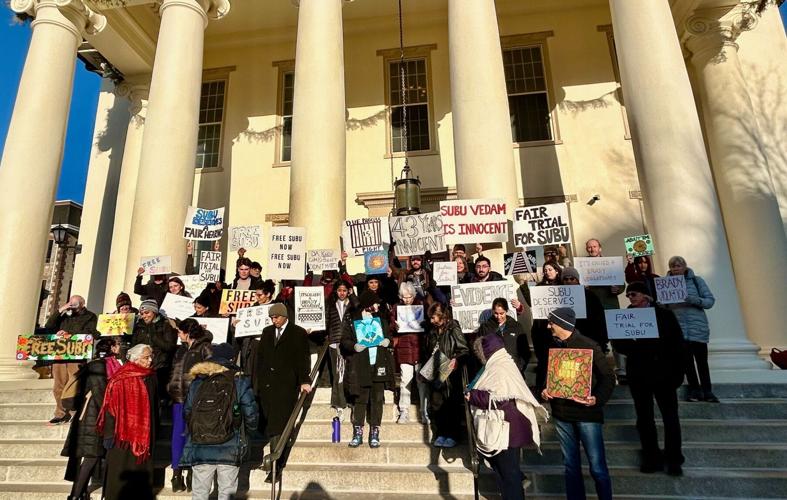
Supporters of Subramanyam “Subu” Vedam demonstrate Feb. 7 outside the Centre County Courthouse in Bellefonte, Pa., after a hearing over new evidence uncovered in his 1983 murder case.
Trump officials oppose the petition
Benach, the immigration lawyer, often represents clients trying to stay in the U.S. despite an earlier infraction. Still, she finds the Vedam case “truly extraordinary” given the constitutional violations involved.
“Forty-three years of wrongful imprisonment more than makes up for the possession with intent to distribute LSD when he was 20 years old,” she said.
Vedam could spend several more months in custody before the Board of Immigration Appeals decides whether to reopen the case. ICE officials, in a brief Friday, said the clock ran out years ago.
“He has provided no evidence nor argument to show he has been diligent in pursuing his rights as it pertains to his immigration status,” wrote Katherine B. Frisch, an assistant chief counsel.
Saraswathi Vedam is saddened by the latest delay, but said her brother remains patient.
“He, more than anybody else, knows that sometimes things don’t make sense,” she said. “You have to just stay the course and keep hoping that truth and justice and compassion and kindness will win.”
An influx of immigrants boosted Orlando's economy but many now fear detention

Luis, 30, who fled Venezuela after being an opposition political activist while at university, poses for a picture Aug. 19, 2025, in the apartment complex where he lives in Orlando, Fla. The aspiring entrepreneur with a degree in mechanical engineering requested asylum in the U.S. and received a work permit which allows him to support himself as an Amazon delivery driver as he goes through the legal asylum process.

Venezuelan asylum seeker Luis, 30, runs through the rain Aug. 19, 2025, as he delivers packages in Winter Park, Fla. Luis, who fled Venezuela after being an opposition political activist as a university student, was granted a long-term work permit that allows him to support himself as an Amazon delivery driver as he goes through the legal asylum process.

Hotels and highways are seen Aug. 22, 2025, around Universal Volcano Bay water park in Orlando, Fla. Migrants who moved to central Florida in recent years say they were drawn by warm temperatures, a large migrant community, and the ease of finding jobs in one of the United States' tourism and hospitality hot spots.

Paola Freites, who asked to be identified by her middle name and second last name to protect her family's safety, poses for a portrait Aug. 21, 2025, inside the two-bedroom mobile home in Apopka, Fla., where she lives with her husband and three children after fleeing persecution in their native Colombia.

Colombian asylum-seeker Paola Freites, 37, who asked to be identified by her middle name and second last name to protect her family's safety, points to scars Aug. 21, 2025, in Apopka, Fla. The scars were left by a brutal gang rape and torture she suffered at age 13, in which her attackers left her for dead after cutting open her abdomen.

Paola Freites, who asked to be identified by her middle name and second last name to protect her family's safety, is reflected Aug. 21, 2025, in a poster of John Wayne, whom her teenaged son is a fan of, inside the two-bedroom mobile home in Apopka, Fla., where she lives with her husband and three children after fleeing persecution in their native Colombia.

Immigrants trying to learn the English language participate in ESOL classes Aug. 19, 2025, offered by Catholic Charities of Central Florida in Orlando.

Patricia Otero writes phrases on the board Aug. 19, 2025, in Orlando as she teaches a Catholic Charities of Central Florida ESOL class to immigrants trying to learn English.

Immigrants trying to learn the English language do a workbook exercise Aug. 19, 2025, in Orlando as they participate in an ESOL class offered by Catholic Charities of Central Florida.

Irrigation sprinklers water rows of flowers and plants Aug. 21, 2025, inside a nursery in Apopka, Fla., where migrants often find work in the agricultural sector.

A worker walks past irrigation sprinklers watering flowers and plants Aug. 21, 2025, in a nursery in Apopka, Fla., where migrants often find work in the agricultural sector.

Dario Romero, right, co-owner of Venezuelan restaurant TeqaBite, greets a customer Aug. 21, 2025, in Kissimmee, Fla. Despite a big increase in the local Venezuelan population in the past several years, Romero says the restaurant recently struggled to fill job openings and business is down. An immigration crackdown under President Donald Trump led to some migrants losing their legal status and work permits, while many others still in legal processes are too fearful to venture out of the house except to go to and from work.

People wait in line Aug. 22, 2025, at a food pantry in Orlando, Fla., that provides assistance to anyone in need, including some migrants who had their legal protections and work permits terminated.

Watermelons are handed out to people waiting in line Aug. 22, 2025, at the food pantry in Orlando, Fla.

A Haitian immigrant braids another woman's hair Aug. 19, 2025, inside an Orlando, Fla., home shared by many members of a Haitian extended family.

Detamisse Janvier, 20, reacts Aug. 22, 2025, in Orlando, Fla., as she talks about the circumstances that led her to flee Haiti and seek asylum in the U.S. Her face still bears a scar from being injured while running desperately to escape an attack by an armed gang on her home in Port-au-Prince.

Blanca, a 38-year-old math teacher from Mexico who crossed the border with her three children in 2024 and applied for asylum, sits at a table Aug. 20, 2025, inside the family's rented two-bedroom duplex in Apopka, Fla.

Blanca washes dishes Aug. 20, 2025, as her three children play in Apopka, Fla.

Two of the young children of Mexican asylum-seeker Blanca hug Aug. 20, 2025, as they play inside the family's rented duplex in Apopka, Fla.

Two of Blanca's young children swing a doll that was given to them by the Catholic church they belong to, as they play Aug. 20, 2025, inside the family's rented duplex in Apopka, Fla.

A theater marquee reads "We Love America" on Aug. 20, 2025, alongside the federal government building that houses the immigration court and the Social Security Administration office in downtown Orlando, Fla.

