

Spot, the four-legged robot from Boston Dynamics Inc., is perhaps best known for its viral dance routines to songs like “Uptown Funk.” But beyond its playful antics, Spot’s ability to climb stairs and open doors signals a potentially controversial role as a policing tool.

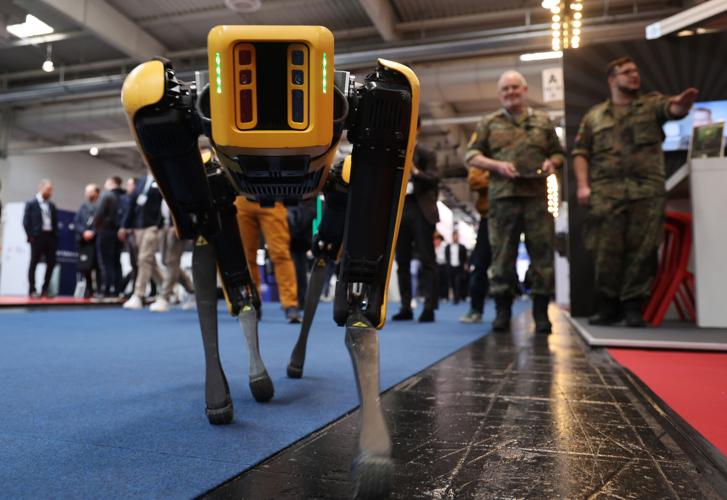
A member of the Bundeswehr, the German armed forces, remotely controls a Boston Dynamics "Spot" canine-like robot at the 2025 Hannover Messe industrial trade fair March 31 in Hanover, Germany.
Five years after its commercial debut, the 75-pound, German Shepherd-sized robot is increasingly being deployed by local law enforcement to handle armed standoffs, hostage rescues and hazardous materials incidents — situations where sending in a human or a real dog could be life-threatening.
More than 60 bomb squads and SWAT teams in the US and Canada are now using Spot, according to previously unreported data shared by Boston Dynamics with Bloomberg News.
The use of such technology raises questions about ethics, oversight and the risks of military-grade tools being deployed in civilian settings. Defense and public safety agencies are increasingly adopting cutting-edge technologies to enhance their operations. Defense tech funding has soared past $28 billion in 2025 — up 200% year over year, even as broader venture markets cooled, according to PitchBook data.
Robots in particular have been finding a home among law enforcement agencies. U.S. Immigration and Customs Enforcement, recently spent around $78,000 on a robot from Canadian tech manufacturer Icor Technology Inc. that can perform similar tasks as Spot and also deploys smoke bombs, according to contract records.

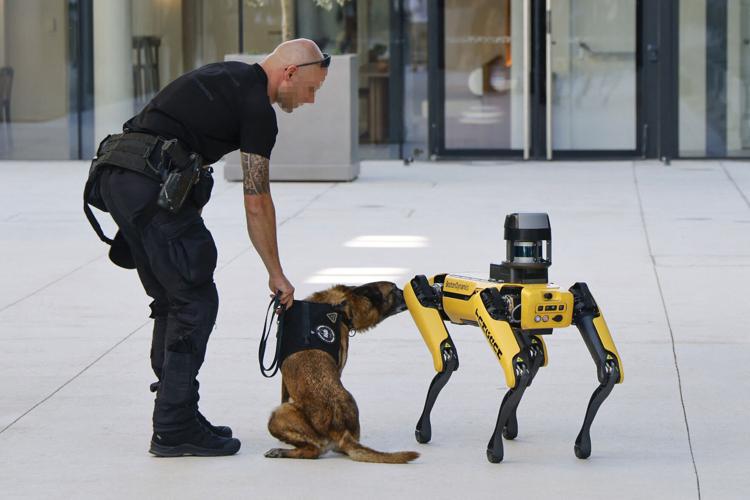
A police officer holds a police dog from the RAID French national police unit specialized in the search of explosives as it inspects a Boston Dynamics dog robot in the CMA CGM Tangram innovation and formation campus May 8, 2024, in Marseille, southern France.
Spot’s role on law enforcement teams varies. In 2022, it approached a man who had crashed a car trying to kidnap his son in St. Petersburg, Florida, to keep an eye on the situation and see if he was armed. In Massachusetts last year, in two different incidents, it helped assess a chemical waste accident at a middle school in North Andover, and it intervened when a suspect in Hyannis took his mother hostage at knifepoint and fired at officers. Spot was deployed to corner him and police eventually followed with tear gas to apprehend him.
“It did its job,” said trooper John Ragosa, a Massachusetts State Police bomb squad member and the Spot operator assigned to the hostage-rescue mission. “The suspect was stunned, thinking ‘What is this dog?’”
The robot, which starts at around $100,000, can operate autonomously in many cases — performing maintenance checks, detecting gas leaks and inspecting faulty equipment — but still relies on human operators like Ragosa for decision making. Using a tablet that resembles a video game controller, an operator guides the machine while monitoring a live video feed from its onboard camera system. Additional built-in sensors handle navigation and mapping. During high-stakes situations, officers can also view the live feed on larger nearby screens.
Spot’s technology continues to evolve. The company recently added a mode to help Spot navigate slippery spots. And it’s working to help Spot better manipulate objects in the real world.
The use of robots in emergency situations is hardly new. Police bomb squads have relied on ground robots since the 1980s, but their deployment became more widespread in the early 2000s, according to Robin Murphy, a professor emeritus of computer science and engineering at Texas A&M University. What makes Spot stand out, she said, is its four-legged design — giving it far greater agility and dexterity than traditional robots that move on tracks or wheels.
Roughly 2,000 Spot units are now in operation globally, Boston Dynamics said. The deployments include organizations such as the Dutch Ministry of Defense and Italy’s national police. While most of the company’s customers are still industrial clients, including manufacturers and utility providers, interest from law enforcement has surged over the past two years, said Brendan Schulman, Boston Dynamics’ vice president of policy and government relations.

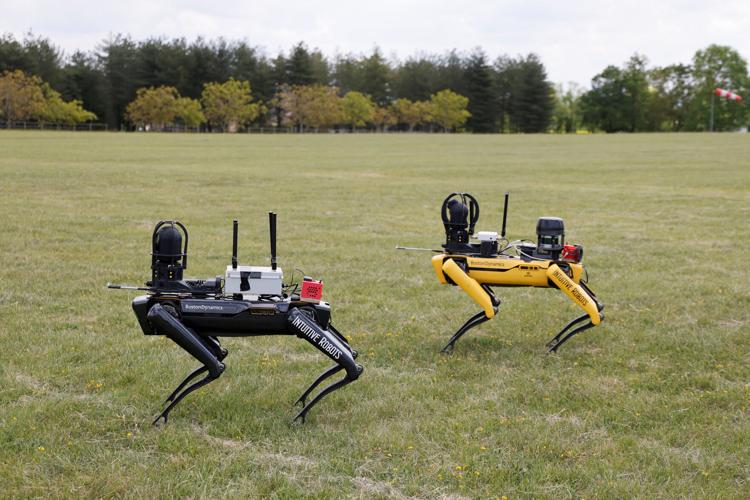
Boston Dynamics experimental robots are displayed during the CoHoMa Challenge event in a French Gendarmerie national military training camp May 6 in Beynes west of Paris.
The Massachusetts State Police owns two Spot robots — one purchased in 2020 and another in 2022 — each costing about $250,000, including add-ons, and funded primarily through state grants, Ragosa said. He said he hopes the agency will add a third unit soon. Some other major cities also have fleets: Houston operates three Spots, while Las Vegas has one, Boston Dynamics said.
Not all departments are equipped to own advanced robots, Murphy said, adding that the question is whether the high cost and complexity of four-legged robots are worth the extra mobility they provide.
Costs aren’t the only concern. Some civil liberties groups and technologists warn that using semi-autonomous robots in law enforcement could normalize a more militarized approach to policing. In 2021, the New York Police Department suspended for a time its limited use of Spot following public backlash, with critics questioning both the expense amid city budget constraints and the robot’s broader role in surveillance. The NYPD later reinstated the program and went on to purchase two of the robots, according to Boston Dynamics.
Some larger police forces also deploy military-grade robots such as PackBots, originally developed by iRobot Corp. These portable machines can be teleoperated, using actuators to handle weapons or inspect suspicious packages, and can communicate with suspects during hostage situations via an onboard audio system. They have long been used in disaster response, including at the World Trade Center site in the aftermath of the September 11 attacks, where they helped search through debris.
Boston Dynamics also says it requires its public safety customers to outline how exactly Spot will be used before they ship a unit.

