


SWANNANOA, N.C. — When Natalie Briggs visited the ruins of her home months after Hurricane Helene, she had to walk across a wooden beam to reach what was once her bedroom.
Knots of electrical wires were draped inside the skeleton of the house. Light filtered through breaks in the tarps over the windows.
"All I could think of was, 'This isn't my house,'" said Natalie, now 13, who was staying in her grandparents' basement.

Natalie Briggs looks Dec. 3 through a window of her home, which was damaged during Hurricane Helene, in Swannanoa, N.C.
Thousands of North Carolina students lost their homes a year ago when Helene hit with some of the most vicious floods, landslides and wind ever seen in the state's Appalachian region. Across the state, more than 2,500 students were identified as homeless as a direct result of Helene, according to state data.
At school, Natalie sometimes had panic attacks when she thought of her ruined home in Swannanoa. "There were some points where I just didn't want people to talk to me about the house — or just, like, talk to me at all," she said.
While storm debris mostly is cleared away, the effects of displacement lingers for the region's children. Schools reopened long before many students returned to their homes, and their learning and well-being have yet to recover.
The phenomenon is increasingly common as natural disasters disrupt U.S. communities more frequently and with more ferocity.
Many families in rural, low-income areas already deal with challenges such as food insecurity and rent affordability, said Cassandra Davis, a University of North Carolina at Chapel Hill public policy professor. "I would almost argue that they don't get the opportunity to recover," she said.

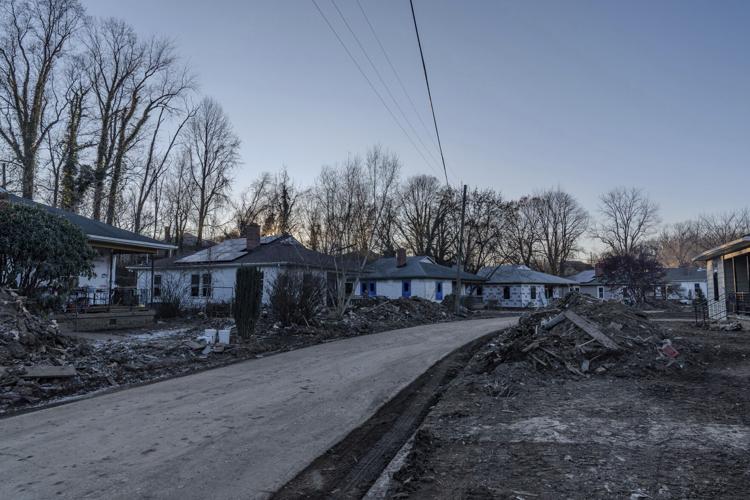
Piles of debris sit in front of storm-damaged homes Dec. 3 in Swannanoa, N.C., months after Hurricane Helene.
Finding stable housing became all-consuming
Helene damaged more than 73,000 homes, knocking out electricity and water for weeks if not months. The destruction of infrastructure also closed schools for large stretches of time, and a barrage of snow days exacerbated the time out of class even more. In rural Yancey County, which has about 18,000 residents, students missed more than two months of school last year.
After Helene flooded her rental home in Black Mountain, Bonnie Christine Goggins-Jones and her two teenage grandchildren had to leave behind nearly all their belongings.
"They lost their bed, clothes, shoes, their book bag," she said.
The family lived in a motel, a leaky donated camper and another camper before moving into a new apartment in June.
Goggins-Jones, a school bus aide at Asheville City Schools, struggled to heat the camper during winter. Her grandchildren kept going to school, but it wasn't top of mind.
The Asheville area still has a significant housing shortage a year after the storm.
The family of America Sanchez Chavez, 11, had to split up to find housing. Helene left their trailer home in Swannanoa uninhabitable, and money from the Federal Emergency Management Agency wasn't enough to cover the renovations.
America and some relatives went to stay at her grandmother's apartment, while her older brother lived at a friend's house. Eventually, America moved with her mother to a room at a Black Mountain hotel where she works.
America said she is still frightened by rain or thunder.

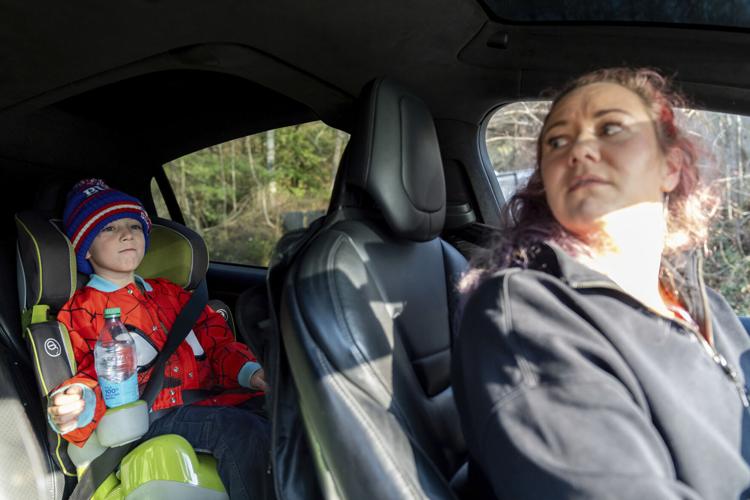
Terri Dolan, right, talks with her son, Fisher, after picking him up from school Dec. 4 in Swannanoa, N.C.
Displaced students spread across North Carolina
After natural disasters, many students live in unstable, temporary arrangements, such as sleeping on a couch, staying in a shelter or doubling up with another family, according to research from UCLA's Center for the Transformation of Schools. Those arrangements qualify students as homeless under federal law.
In Puerto Rico, more than 6,700 students were identified as homeless in Hurricane Maria's aftermath during the 2017-2018 school year, the study found. Hawaii saw a 59% increase in its homeless student population after the 2023 Maui wildfires.
After Helene, student homelessness spiked in several hard-hit counties, according to AP's analysis of data from the North Carolina Homeless Education Program.
Yancey County saw the region's highest percentage increase. The number of homeless students went from 21 in the 2023-2024 school year to 112 last school year. All but 15 were homeless because of Helene.
Some students enrolled in other school systems, at least temporarily. Others never returned.
Terri Dolan of Swannanoa sent her two young children to stay with her parents in Charlotte ahead of the storm. After seeing the extent of the devastation, Dolan had them enroll in school there. They stayed more than a month before returning home.
Some districts receive federal money for services such as transporting homeless students to their usual school buildings and providing tutoring under the McKinney-Vento Homeless Assistance Act. But districts must apply in a competitive process, and they can't request more money immediately after a natural disaster until the next application cycle. Many miss out on that funding entirely.

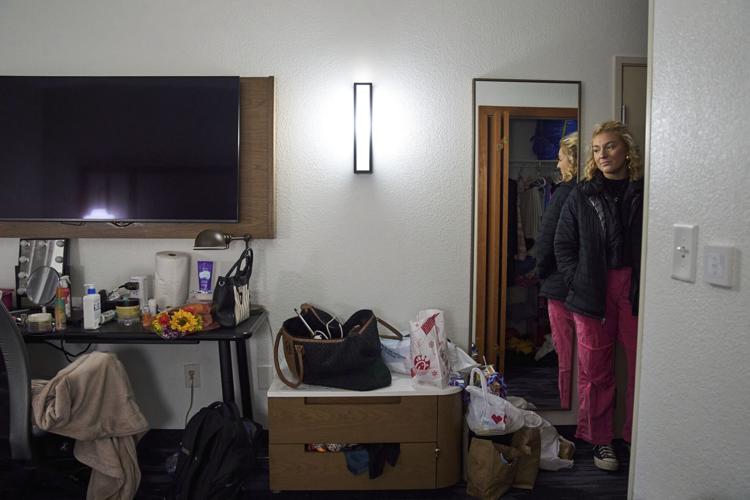
Gwendolyn Bode looks at the hotel room Dec. 5 in Boone, N.C., where she temporarily lived after she was displaced from her apartment that was damaged by Hurricane Helene.
Housing instability has a lasting impact
Gwendolyn Bode, a prelaw student at Appalachian State University, had to leave her mud-wrecked apartment complex after Helene. Told she couldn't get campus housing, she found an Airbnb where she could stay at until her FEMA housing application went through, then she moved into a hotel.
She felt like she was drowning as she tried to keep up with her classes and a part-time job.
"I can't tell you what I learned," she said. "I can't even tell you when I went to class, because (mentally) I wasn't there." She found more stability after moving into an apartment for the spring semester.
20 years after Hurricane Katrina, these then-and-now photos show the power of place
APTOPIX Katrina Photo Projections Photo Essay
Updated
This photo of a man pushing his bicycle through floodwaters near the Superdome in the aftermath of Hurricane Katrina, taken by AP photographer Eric Gay, is projected Wednesday, Aug. 20, 2025, onto the same spot in New Orleans. (AP Photo/Gerald Herbert)
APTOPIX Katrina Photo Projections Photo Essay
Updated
This photo of Leonard Thomas, 23, crying in the aftermath of Hurricane Katrina in New Orleans, taken by AP photographer Rick Bowmer, is projected Wednesday, Aug. 13, 2025, onto the flood wall in the Lower Ninth Ward, which was breached, flooding major parts of the city. (AP Photo/Gerald Herbert)
Katrina Photo Projections Photo Essay
Updated
This photo of Valerie Thomas and her nieces Shante Fletcher, 6, and Sarine Fletcher, 11, viewing the destruction of her brother’s home in the aftermath of Hurricane Katrina in the Lower Ninth Ward of New Orleans, taken by AP photographer Gerald Herbert, is projected Wednesday, Aug. 13, 2025, onto the same block, while a heat lightning storm illuminates the clouds. (AP Photo/Gerald Herbert)
APTOPIX Katrina Photo Projections Photo Essay
Updated
This photo showing flood victims sitting at the Ernest N. Morial Convention Center where they had been waiting for days to be evacuated in the aftermath of Hurricane Katrina in New Orleans, taken by AP photographer Eric Gay, is projected Tuesday, Aug. 26, 2025, along the Mississippi River behind the convention center. (AP Photo/Gerald Herbert)
Katrina Photo Projections Photo Essay
Updated
This photo of a poodle perching itself precariously upon a pile of trash while surrounded by floodwaters in the aftermath of Hurricane Katrina in New Orleans, taken by AP photographer Rick Bowmer, is projected Thursday, Aug. 21, 2025, onto a house in a neighborhood that was flooded by the storm. (AP Photo/Gerald Herbert)
Katrina Photo Projections Photo Essay
Updated
This photo of a young man wading through chest-deep floodwaters in the aftermath of Hurricane Katrina in New Orleans, taken by AP photographer Dave Martin, is projected Monday, Aug. 25, 2025, next to a mural of New Orleans music legend Allen Toussaint, below the overpass where the original photo was made. (AP Photo/Gerald Herbert)
APTOPIX Katrina Photo Projections Photo Essay
Updated
This photo of the FEMA markings indicating a deceased victim in the home of Michael Harrison, who died inside during Hurricane Katrina in Bay St. Louis, Miss., taken by AP photographer Gerald Herbert, nephew of Harrison, is projected Tuesday, Aug. 26, 2025, onto his grave in Pass Christian, Miss. (AP Photo/Gerald Herbert)
Katrina Photo Projections Photo Essay
Updated
This photo showing the body of a flood victim tied to a telephone pole in the aftermath of Hurricane Katrina in New Orleans, taken by AP photographer Steven Senne, is projected Monday, Aug. 18, 2025, onto the same spot the original photo was taken. (AP Photo/Gerald Herbert)
Katrina Photo Projections Photo Essay
Updated
This photo of receding floodwaters leaving their mark on a house and automobile on Orleans Avenue in the aftermath of Hurricane Katrina in New Orleans, taken by AP photographer Ric Francis, is projected Wednesday, Aug. 20, 2025, onto the same house. (AP Photo/Gerald Herbert)
Katrina Photo Projections Photo Essay
Updated
This photo of Milvertha Hendricks, 84, waiting in the rain with other flood victims outside the Ernest N. Morial Convention Center in New Orleans in the aftermath of Hurricane Katrina, taken by AP photographer Eric Gay, is projected Monday, Aug. 25, 2025, next to statues of the king and queen of Mardi Gras next to the center. (AP Photo/Gerald Herbert)
Katrina Photo Projections Photo Essay
Updated
This photo showing throngs of New Orleans residents gathering at a evacuation staging area along Interstate 10 in Metairie, La., in the aftermath of Hurricane Katrina, taken by AP photographer Dave Martin, is projected Wednesday, Aug. 20, 2025, onto the same roadway. (AP Photo/Gerald Herbert)
Katrina Photo Projections Photo Essay
Updated
This photo of a New Orleans resident walking through floodwaters coated with a fine layer of oil in the aftermath of Hurricane Katrina, taken by AP photographer Bill Haber, is projected Thursday, Aug. 14, 2025, in New Orleans, underneath the same overpass where photo was made. (AP Photo/Gerald Herbert)
Katrina Photo Projections Photo Essay
Updated
This photo of people taking goods from stores on Canal Street in downtown New Orleans in the aftermath of Hurricane Katrina, taken by AP photographer Eric Gay, is projected Wednesday, Aug. 20, 2025, onto a storefront in the same location. (AP Photo/Gerald Herbert)
Katrina Photo Projections Photo Essay
Updated
This photo of a makeshift tomb at a New Orleans street corner, concealing a body that had been lying on the sidewalk for days in the wake of Hurricane Katrina, taken by AP photographer Dave Martin, is projected onto the same sidewalk Tuesday, Aug. 19, 2025, in New Orleans. (AP Photo/Gerald Herbert)

