



JERUSALEM — Israel will soon halt or slow humanitarian aid into parts of northern Gaza as it expands its military offensive against Hamas, an official said Saturday, a day after Gaza City was declared a combat zone.
The decision is likely to bring more condemnation of Israel's government as frustration grows in the country and abroad over dire conditions for both Palestinians and remaining hostages in Gaza after nearly 23 months of war.
The official, who spoke on condition of anonymity because the person was not authorized to speak to the media, told The Associated Press that Israel will stop airdrops over Gaza City in coming days and reduce the number of aid trucks arriving in the north as it prepares to evacuate hundreds of thousands of people south.
Israel on Friday ended daytime pauses in fighting that allowed aid delivery, describing Gaza City as a Hamas stronghold and alleging that a tunnel network remains in use despite previous large-scale raids. The United Nations and partners said the pauses, airdrops and other measures fell far short of the 600 trucks of aid needed daily in Gaza.

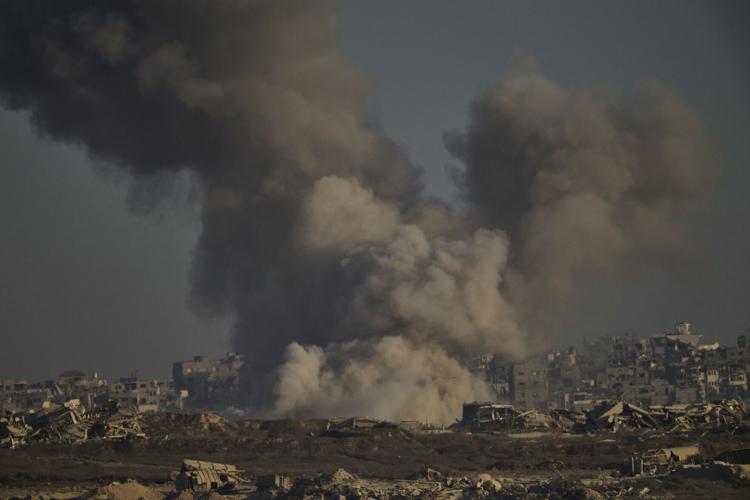
Smoke rises Saturday after an Israeli military strike in the northern Gaza Strip, seen from southern Israel.
AP video footage showed several large explosions across Gaza overnight into Saturday. Israel's military in the evening said it struck a key Hamas member in the area of Gaza City, with no details.
In recent days, Israel's military increased strikes on the outskirts of Gaza City, where famine was recently documented and declared by global food security experts.
By Saturday there were no airdrops for several days across Gaza, a break from almost daily ones. Israel's army didn't respond to a request for comment or say how it would provide aid to Palestinians during another major shift in Gaza's population of more than 2 million people.

"Such an evacuation would trigger a massive population movement that no area in the Gaza Strip can absorb, given the widespread destruction of civilian infrastructure and the extreme shortages of food, water, shelter and medical care," Mirjana Spoljaric, president of the International Committee of the Red Cross, said in a statement.
It's impossible that a mass evacuation of Gaza City can be done in a safe and dignified way, she said.

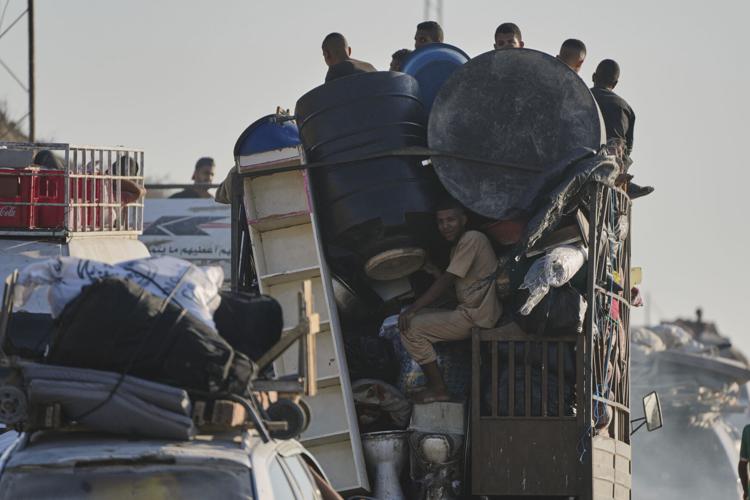
Displaced Palestinians fleeing the northern Gaza Strip move with their belongings Saturday along the Sea Road near Wadi Gaza.
Hundreds of residents began leaving Gaza City, piling their remaining possessions onto pickup trucks or donkey carts. Many have been forced to leave their homes more than once.
“We left because the area became unlivable,” Fadi Al-Daour, displaced from Gaza City, said as vehicles piled high with people and belongings rolled through a shattered landscape. “No one is searching, and there are no journalists to film. There is nothing.”
Israeli gunfire killed four people trying to get aid in central Gaza, according to health officials at Al-Awda Hospital, were the bodies were taken.
An Israeli strike on a bakery in Gaza City's Nasr neighborhood killed 12 people including six women and three children, the Shifa Hospital director told the AP, and a strike on the Rimal neighborhood killed seven.
Hamas in a statement called the strike on a residential building in Rimal a “brutal escalation against civilians.”

Protesters carry bundles marked with artificial blood, symbolizing children killed in Gaza, during a pro-Palestinian demonstration Saturday in Frankfurt, Germany.
Gaza's Health Ministry said another 10 people died as a result of starvation and malnutrition in 24 hours, including three children. It said at least 332 Palestinians died from malnutrition-related causes so far during the war, including 124 children.
At least 63,371 Palestinians were killed in Gaza during the war, said the ministry, which does not say how many are fighters or civilians but says about half were women and children. The ministry is part of the Hamas-run government and staffed by medical professionals. The U.N. and independent experts consider it the most reliable source on war casualties. Israel disputes its figures but has not provided its own.
"There is no food and even water is not available. When it is available, it is not safe to drink," said Amer Zayed, as he waited for food from a charity kitchen in Deir al-Balah on Friday.
"The suffering gets worse when there are more displaced people," he added.

People attend a rally Saturday in Tel Aviv, Israel, demanding the immediate release of all hostages held by Hamas and calling for an end of the war in the Gaza Strip.
Prime Minister Benjamin Netanyahu's office announced that the remains of a hostage that Israel said Friday were recovered in Gaza were of Idan Shtivi. He was kidnapped from the Nova music festival in the Oct. 7, 2023, Hamas-led attack that killed about 1,200 people in southern Israel and sparked the war. Israel said Friday it also recovered the remains of hostage Ilan Weiss.
Forty-eight hostages now remain in Gaza of the more than 250 seized. Israel believed 20 are still alive.
Their loved ones fear the expanding military offensive will put them in even more danger, and they rallied again Saturday to demand a ceasefire deal to bring everyone home.
“Netanyahu, if another living hostage comes back in a bag, it will not only be the hostages and their families who pay the price," Zahiro Shahar Mor, nephew of hostage Avraham Munder, said in Tel Aviv. "You will bear responsibility for premeditated murder.”
Photos: Gaza's worsening hunger crisis

Somoud Wahdan looks at the camera while she and her child wait for trucks of humanitarian aid to arrive in Gaza City, July 25, 2025. (AP Photo/Abdel Kareem Hana)

FILE - Palestinians rush to collect humanitarian aid airdropped into Zawaida in central Gaza Strip, July 31, 2025. (AP Photo/Abdel Kareem Hana, File)

FILE - Palestinians struggle to get donated food at a community kitchen in Gaza City, northern Gaza Strip, July 14, 2025. (AP Photo/Jehad Alshrafi, File)

Seven-month-old Salem Awad, suffering from severe malnutrition, lies on a mattress in his family's tent in Gaza City, July 28, 2025. (AP Photo/Jehad Alshrafi)

Palestinians carry sacks of flour taken from a humanitarian aid convoy in the outskirts of Beit Lahiya, northern Gaza Strip, Aug. 1, 2025. (AP Photo/Jehad Alshrafi)

Samah Matar poses for a photo with her sons, Yousef, 6, in her arms, and Amir, 4, affected by malnutrition and cerebral palsy, at a U.N.-run school in Gaza City, July 26, 2025. (AP Photo/Jehad Alshrafi)

FILE - Ahmad Sbeteh, 17, injured by shrapnel from a strike on a neighboring house, has lost about 15 kilograms (33 pounds), and doctors say the lack of healthy food and nutritional supplements is slowing his recovery at Shifa Hospital in Gaza City on Monday, Aug. 18, 2025. Before the shrapnel injury, he had no preexisting conditions, doctors say. (AP Photo/Abdel Kareem Hana, File)

Palestinians mourn during the funeral of people who were killed while trying to reach aid trucks entering northern Gaza through the Zikim crossing with Israel, at Shifa Hospital, in Gaza City, Saturday, July 26, 2025. (AP Photo/Abdel Kareem Hana)

Palestinians pray over the body of a person who was killed while trying to reach aid trucks entering northern Gaza through the Zikim crossing with Israel, at Shifa Hospital, in Gaza City, Saturday, July 26, 2025. (AP Photo/Abdel Kareem Hana)

Palestinians struggle to get donated food at a community kitchen, in Gaza City, northern Gaza Strip, Saturday, July 26, 2025. (AP Photo/Abdel Kareem Hana)

Palestinians struggle to get donated food at a community kitchen, in Gaza City, northern Gaza Strip, Saturday, July 26, 2025. (AP Photo/Abdel Kareem Hana)

Palestinians struggle to get donated food at a community kitchen, in Gaza City, northern Gaza Strip, Saturday, July 26, 2025. (AP Photo/Abdel Kareem Hana)

Palestinians struggle to get donated food at a community kitchen, in Gaza City, northern Gaza Strip, Saturday, July 26, 2025. (AP Photo/Abdel Kareem Hana)

Palestinians struggle to get donated food at a community kitchen, in Gaza City, northern Gaza Strip, Saturday, July 26, 2025. (AP Photo/Abdel Kareem Hana)

Palestinians pray over the body of 5-month-old baby, Zainab Abu Halib, who died from malnutrition-related causes, according to the family and the hospital, during her funeral outside the Nasser Hospital, in Khan Younis, Gaza Strip, Saturday, July 26, 2025. (AP Photo/Mariam Dagga)

Palestinians carry sacks of flour unloaded from a humanitarian aid convoy that reached Gaza City from the northern Gaza Strip, Saturday, July 26, 2025. (AP Photo/Jehad Alshrafi)

Humanitarian aid is airdropped to Palestinians over northern Gaza Strip, Sunday, July 27, 2025. (AP Photo/Abdel Kareem Hana)

Humanitarian aid is airdropped to Palestinians over Gaza City, Gaza Strip, Sunday, July 27, 2025. (AP Photo/Jehad Alshrafi)

A Palestinian youth carries a sack of aid that landed in the Mediterranean Sea after being airdropped over central Gaza, at the shore of Zawaida, Gaza Strip Tuesday, July 29, 2025. (AP Photo/Abdel Kareem Hana)

Palestinians search for aid that landed in the Mediterranean Sea after being airdropped over central Gaza, at the shore of Zawaida, Gaza Strip Tuesday, July 29, 2025. (AP Photo/Abdel Kareem Hana)

Palestinians collect aid that landed in the Mediterranean Sea after being airdropped over central Gaza, at the shore of Zawaida, Gaza Strip Tuesday, July 29, 2025. (AP Photo/Abdel Kareem Hana)

