

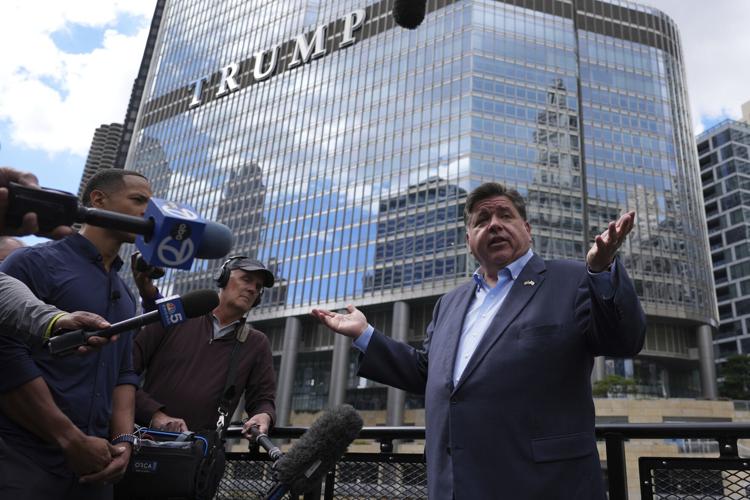
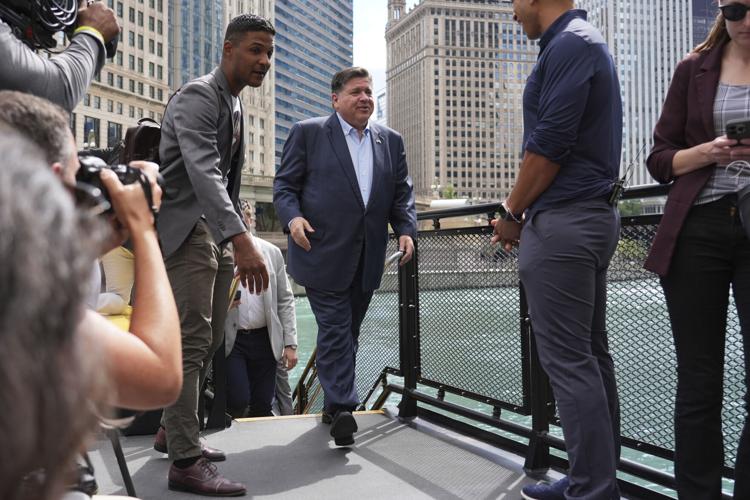
WASHINGTON — J.B. Pritzker took a water taxi along the Chicago Riverwalk, past one of Donald Trump's famous downtown towers. The gleaming and heavily trafficked tourist district was a deliberate backdrop on the day the Illinois governor directed a defiant message toward the White House: "Mr. President, do not come to Chicago. You are neither wanted here nor needed here."
After Trump's National Guard deployments to Los Angeles in June and Washington, D.C. this month, the Republican says his next targets for federal intervention may be two of the nation's most Democratic cities: Chicago and Baltimore.
Trump's possible move — targeting states whose governors are among potential White House contenders in 2028 — would be another escalation of presidential power, directly challenging the rights of states and cities to govern themselves. It also would intensify a partisan scramble for voters' trust on matters of public safety.

Illinois Governor JB Pritzker speaks at a news conference in a Chicago water taxi Monday, Aug. 25, 2025, in Chicago. (AP Photo/Nam Y. Huh)
For Trump, militarizing U.S. streets is the latest tactic to support his "law and order" branding and mass deportation agenda. It's a way to cast Democratic leaders in affected locales as weak and ineffective, even as Trump exaggerates the violence he's ostensibly trying to stop. Pritzker "should be calling me, and he should be saying 'Can you send over the troops please?'" Trump said Tuesday at the White House. "It's out of control."
Democrats see a dangerous overreach by an aspiring authoritarian and said they will challenge Trump in court if necessary. They also see in the political fight a way to persuade voters, especially moderates and independents, that Republicans bluster on crime while Democrats are better able to protect citizens and keep the peace.
"This is not about fighting crime," Pritzker said Monday, flanked by Chicago Mayor Brandon Johnson and other leaders, adding that it's more about "an arrogant little man" trying to "intimidate his political rivals."

Yet there are risks for Democrats. Though violent crime is down across the country, including Chicago, arguing over how to combat what's still happening means tussling on some of Trump's most comfortable political turf. Additionally, Trump demonstrated a willingness to block federal money for locales where elected officials opposed him.
Pritzker, who seeks a third term in 2026, is among Democrats' most vocal critics of Trump. Weeks into Trump's second administration, Pritzker compared it to the Nazi Third Reich. More recently, he welcomed Texas Democrats who fled Austin to delay Republicans' partisan redrawing of the state's congressional districts at Trump's request.

Illinois Governor JB Pritzker arrives for a news conference in a Chicago water taxi Monday, Aug. 25, 2025, in Chicago. (AP Photo/Nam Y. Huh)
On Monday, Pritzker and Johnson emphasized that Trump's administration had not reached out about its plans, first detailed in a weekend Washington Post story. The president acknowledged he hadn't talked to Illinois or Maryland officials and at one point Monday said he might not send troops unless Pritzker asked.
Pritzker's aides said his priority is to keep a federal deployment from happening. That's why Pritzker and his staff hustled to gather a cross-section of political, civic and faith leadership in a made-for-TV show of unity that Trump would surely see. Of course, it also trained cameras on Pritzker.
"I know he doesn't read … but I know he watches television," Pritzker said of Trump. "And so perhaps if somebody from Fox News or from Newsmax is here, they'll cover the fact that Chicago is in much better shape" because of what local officials are doing.

In a bit of Trumpian bravado, he added, "If you hurt my people, nothing will stop me, not time or political circumstance, from making sure that you face justice under our constitutional rule of law."
Maryland Gov. Wes Moore, another potential Democratic contender in 2028, said Trump's characterizations of Baltimore and other cities reflect a president "living in this blissful ignorance, these tropes."
Nonetheless, voters sided with Republicans on the issue.
A CNN/SSRS poll from May found that about four in 10 Americans said the GOP's views on crime and policing aligned more with their own, compared to just three in 10 who felt the same about Democrats. The rest said neither party reflected their views.
Democrats acknowledged the gap this week at a national party gathering in Minneapolis. In a presentation to Democratic National Committee members, party strategists noted Republicans spent about three times the amount of money on crime-related ads than Democrats did in recent presidential election years.
They urged Democrats not to mimic Republican "tough-on-crime" rhetoric but instead position themselves as being "serious about safety, not empty scare tactics."

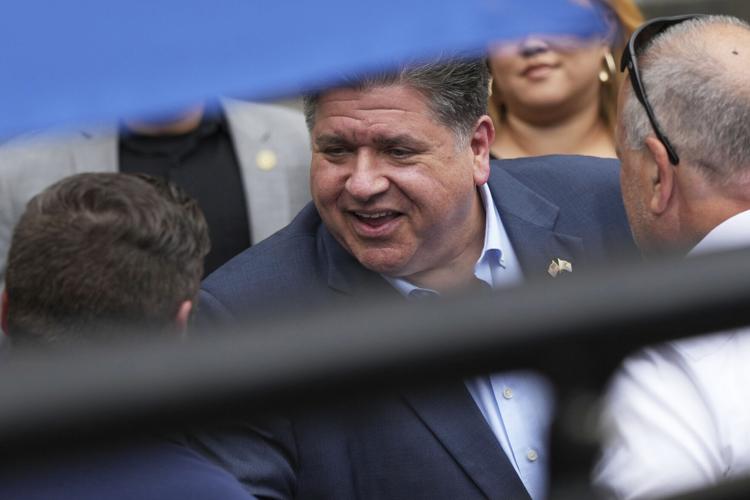
Illinois Governor JB Pritzker greets people as he walks to a news conference in a Chicago water taxi Monday, Aug. 25, 2025, in Chicago. (AP Photo/Nam Y. Huh)
Pritzker aides agreed Democrats have a chance to emphasize public safety policy choices.
A litany of speakers in Chicago cited drops — some of them considerable — in violent and property crimes in the city. They also highlighted the hundreds of millions of dollars in Trump administration cut in federal support for law enforcement, housing and other programs that Johnson called "proven solutions to crime and violence reduction."
"We cannot incarcerate our way out of violence," the mayor said.
The debate also raises questions about where Trump has not called for federal intervention. Pritzker noted that Hattiesburg, Mississippi, and Memphis, Tennessee, both in Republican-led states, have notably higher murder rates than Chicago.



