

PALM BEACH, Fla. — U.S. President Donald Trump warned Iran against rebuilding its nuclear program Monday as he welcomed Israeli Prime Minister Benjamin Netanyahu to his home in Florida for wide-ranging talks.
The warning comes after Trump insists that Tehran's nuclear capabilities were "completely and fully obliterated" by U.S. strikes on key nuclear enrichment sites in June. But Israeli officials have been quoted in local media expressing concern about Iran rebuilding its supply of long-range missiles capable of striking Israel.
"Now I hear that Iran is trying to build up again," Trump told reporters as he welcomed Netanyahu to his Mar-a-Lago estate. "And if they are, we're going to have to knock them down. We'll knock them down. We'll knock the hell out of them. But hopefully that's not happening."

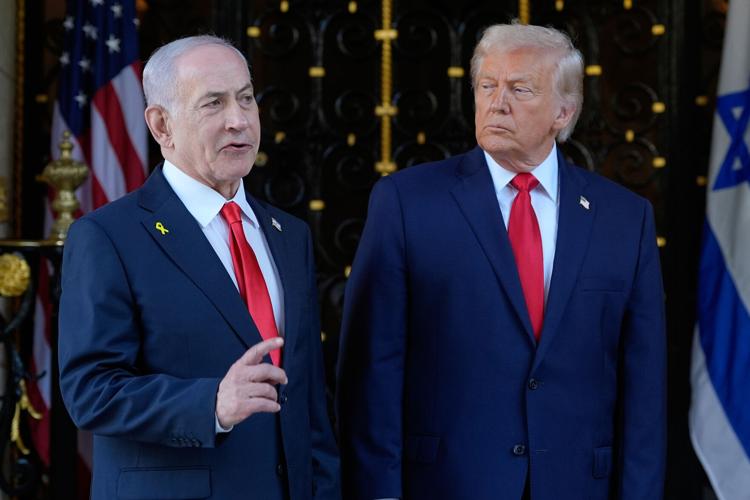
U.S. President Donald Trump listens Monday as Israeli Prime Minister Benjamin Netanyahu speaks during an arrival at his Mar-a-Lago club in Palm Beach, Fla.
Iran insists it's no longer enriching uranium at any site in the country, trying to signal to the West that it remains open to potential negotiations over its atomic program. But Netanyahu was expected to discuss with Trump the need to potentially take new military action against Tehran just months after launching a 12-day war on Iran.
Trump criticized Iran anew for not making a deal to completely disarm its nuclear program ahead of the U.S. and Israeli strikes earlier this year.
"They wish they made that deal," Trump said.
Netanyahu's visit also comes at another critical moment in Gaza as Trump looks to create fresh momentum for the U.S.-brokered Israel-Hamas ceasefire that is in danger of stalling before reaching the complicated second phase of the agreement.

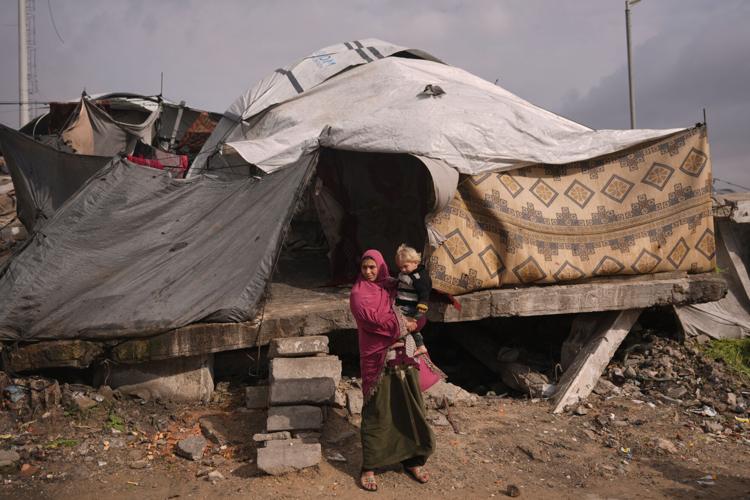
A woman holds a child Monday as they stand in front of their tent in a makeshift camp for displaced Palestinians in an area in Gaza City.
Trump, with Netanyahu by his side, said he wants to get to the second phase "as quickly as we can."
"But there has to be a disarming of Hamas," Trump added.
Before his talks with Trump, Netanyahu met separately with Secretary of State Marco Rubio and Defense Secretary Pete Hegseth.
Meanwhile, Hamas confirmed Monday that its longtime spokesman was killed after an Israeli strike in August in war-torn Gaza, the first time the Palestinian militant group publicly acknowledged the death of one of its more prominent figures.
The confirmation comes months after Israel said on Aug. 31 that its forces killed the militant group's spokesman Hudhayfa al‑Kahlout in an airstrike on Gaza. Hamas didn't say how he was killed or when.

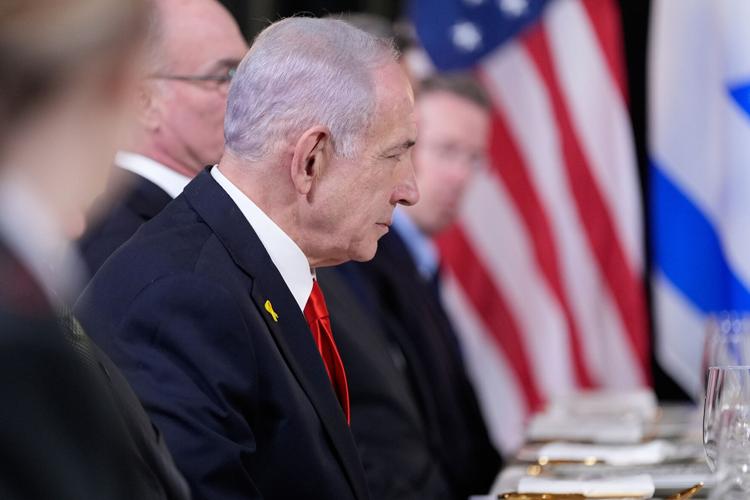
Israeli Prime Minister Benjamin Netanyahu listens as U.S. President Donald Trump speaks before a Monday luncheon at his Mar-a-Lago club in Palm Beach, Fla.
Progress slowed
The ceasefire between Israel and Hamas that Trump championed has mostly held, but progress slowed recently. Both sides accuse each other of violations, and divisions emerged among the U.S., Israel and Arab countries about the path forward.
The truce's first phase began in October, days after the two-year anniversary of the initial Hamas-led attack on Israel that killed about 1,200 people. All but one of the 251 hostages or remains have been released.
The Israeli leader signaled he is in no rush to move forward with the next phase as long as the remains of Ran Gvili are still in Gaza.
Gvili's parents met with Netanyahu as well as Rubio, U.S. envoy Steve Witkoff and the president's son-in-law, Jared Kushner, in Florida on Monday.
The family, according to the group, wants "to ensure there will be no transition to Phase 2 of the agreement until Hamas fulfills its Phase 1 commitments and returns Ran home."
Trump's 20-point plan — which was approved by the U.N. Security Council — lays out an ambitious vision for ending Hamas' rule of Gaza.

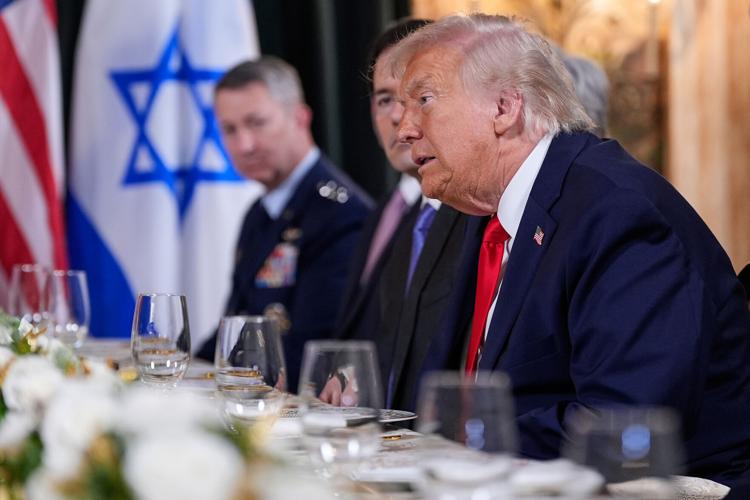
U.S. President Donald Trump speaks before a Monday luncheon with Israel's Prime Minister Benjamin Netanyahu at his Mar-a-Lago club in Palm Beach, Fla.
Next phase
The path ahead is certainly complicated.
If successful, the second phase would see the rebuilding of a demilitarized Gaza under international supervision by a group chaired by Trump and known as the Board of Peace. The Palestinians would form a "technocratic, apolitical" committee to run daily affairs in Gaza, under Board of Peace supervision.
It also calls for normalized relations between Israel and the Arab world and a possible pathway to Palestinian independence. Then there are thorny logistical and humanitarian questions, including rebuilding war-ravaged Gaza, disarming Hamas and creating a security apparatus called the International Stabilization Force.
The Board of Peace would oversee Gaza's reconstruction under a two-year, renewable U.N. mandate. Its members had been expected to be named by the end of the year and might even be revealed after Monday's meeting, but the announcement could be pushed into next month.

Much unsettled
The leaders' meeting comes after Witkoff and Kushner recently huddled in Florida with officials from Egypt, Qatar and Turkey, which are mediating the ceasefire.
Two main challenges complicated moving to the second phase, according to an official who was briefed on those meetings.
Israeli officials are taking a lot of time to vet and approve members of the Palestinian technocratic committee from a list given to them by the mediators, and Israel continues its military strikes.
Trump's plan also calls for the stabilization force, proposed as a multinational body, to maintain security. But it, too, has yet to be formed. Whether details will be forthcoming after Monday's meeting is unclear.
A Western diplomat said there is a "huge gulf" between the U.S.-Israeli understanding of the force's mandate and that of other major countries in the region, as well as European governments.

