

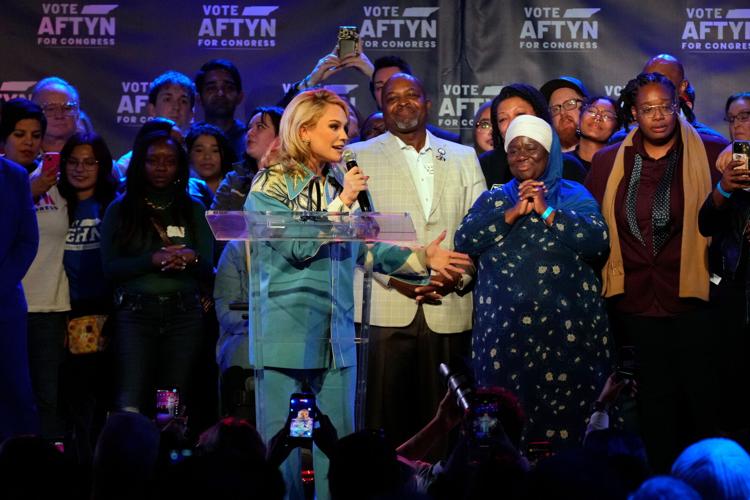
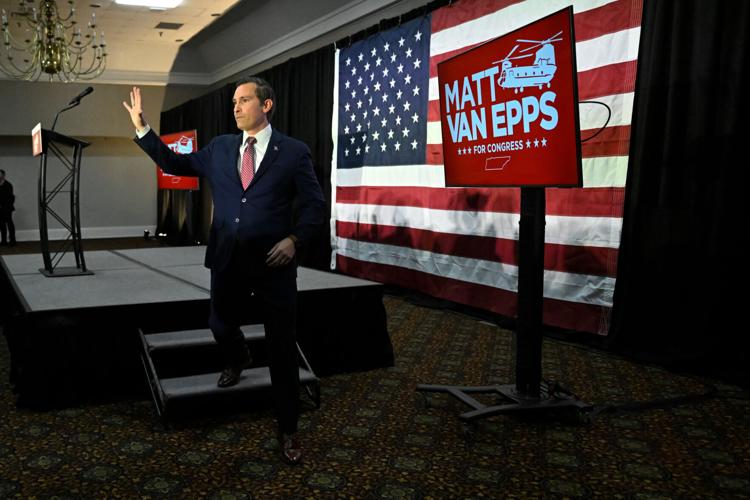

NASHVILLE, Tenn. — As a leader of the College Democrats at Vanderbilt University, Luci Wingo knew the odds of a Democrat winning one of Nashville's three U.S. House seats weren't great. Yet her hope grew as the party mounted an aggressive campaign for its candidate, Aftyn Behn, in a special election to replace a Republican who resigned.
In the end, high Democratic enthusiasm and millions of dollars in spending weren't enough.
Republican Matt Van Epps won Tuesday's vote by 9 percentage points — a closer margin than the district's last election, yet still a victory for the GOP that seemed all but certain after Republicans split the unified Democratic stronghold of Nashville into three GOP-leaning districts.
As states wage a mid-decade redistricting battle initiated by President Donald Trump, Tennessee's special election illustrates the power of manipulative mapmaking and provides a window into what lies ahead in the states that are rushing to redraw their congressional maps ahead of midterm elections next year.
Gerrymandering can help parties in power maintain and even expand their majorities, but it's also a source of frustration and anger for voters in the minority party who lose the chance to be represented by someone of their choice.
"It's a hard battle to fight because it's so intentional, it's so in your face — and it's hard to not just want to get frustrated and kind of give up," said Wingo, a college sophomore who grew up in Nashville.
She said she became accustomed to what she called "purposeful pessimism."
"We don't try to get our hopes up too much, because we kind of know the outcomes," she said, adding that Behn's campaign nevertheless created a surge of enthusiasm among local Democrats.
For Republicans, the Nashville gerrymander worked
Nashville was represented by Democratic U.S. Rep. Jim Cooper for 20 years when the Republican-controlled state Legislature decided in 2022 to use the latest census data to carve up the city in a quest to flip his seat to Republicans.
Some parts of Nashville were placed in two sprawling rural districts to the east and west, both represented by Republicans. The portion retaining Cooper's district number was redrawn to twist south into another rural Republican-leaning area.
Cooper, a moderate-leaning lawmaker, decided not to seek reelection that year, and Republicans won all three seats by comfortable margins.
Republicans carried all three districts again last year. They won by 17 percentage points in Cooper's former 5th District, by nearly 22 points in the westward 7th District — which includes downtown Nashville, well-known historically Black areas and major universities — and by 36 points in the eastward 6th District.
Van Epps' special election victory was close enough to encourage Democrats looking for momentum ahead of next year's midterms, but also showcased how the gerrymandered 7th Congressional District remains reliably Republican.
"In this case, gerrymandering worked," said John McGlennon, a longtime professor of government at the College of William & Mary in Virginia. "But it may be at the price of seats in other places in Tennessee and around the country."
Kevin Mittelmeier, who says he's in the political middle, cast his ballot for Behn. "I can just see from the outside looking in, unbiased, it's actually frustrating how it's being controlled, and how it's being dealt with, and how people of Nashville's opinions really are taken away," he said.
Maggie Tekeli brought three young children to the polls planning to vote for Behn, only to learn her Nashville home wasn't in the 7th District. "It's just discouraging from a democratic process standpoint," she said.
Gerrymandering is spreading
Trump urged mid-decade redistricting in the hopes that it will allow his party to maintain its majority in the U.S. House next year.
In Texas, the first to answer Trump's call, Republican lawmakers redrew congressional district boundaries in Dallas, Fort Worth and their suburbs to extend a Democratic seat into a Republican region far outside the metro area.
In Missouri, Republican officials approved a new U.S. House map that shaves off portions of a Democratic-held seat in Kansas City into two rural Republican-held districts and stretches the remainder of the seat east into another predominantly Republican area.
Officials in North Carolina and Ohio also approved new U.S. House maps intended to boost Republican chances of winning additional seats.
Democrats countered with their own gerrymandering in California. Voters in November approved a new Democratic-drawn congressional map that merges farming and ranching areas favoring Republicans with some of the state's wealthiest and most liberal coastal communities.
Some residents in each of those states expressed concern about being adequately represented under the new districts. But that didn't deter the politicians from drawing the maps because the stakes are so high. Democrats need a net gain of just three seats in next year's midterms to win control of the U.S. House and break a Republican grip on power that has enabled Trump to advance his agenda.
Republicans hold seven of Indiana's nine U.S. House seats but a proposal in the Republican-led state General Assembly would give the GOP a shot at winning all nine seats.
Under the plan, a congressional district for the state's largest city, Indianapolis, would be split up and grafted onto four Republican-leaning districts. The district was represented for the past 17 years by Democratic Rep. André Carson, the state's lone Black member of Congress.
His district would be stretched southeast to the border with Kentucky and Ohio, combining residents of the state's largest city with those in its least populated county. Another district would span westward to the Illinois border.
During a public hearing this week, Democratic state Rep. Robin Shackleford warned colleagues that the redrawn congressional districts would "be crippling" for her Indianapolis constituents.
"These maps crack apart historic Black neighborhoods, weakening our voting power and silencing the voices of the very people who are already fighting the hardest for economic stability, safer streets, better schools and access to affordable health care," she said.
Yet the revised districts, if approved, appear likely to accomplish their purpose of boosting Republican representation in Congress.
Laura Merrifield Wilson, a political scientist at the University of Indianapolis, said she had no doubt that there will be enough Republicans in the newly drawn congressional districts to overwhelm the Democratic vote in future elections.
But she added: "When you're connecting some of Indianapolis to some of those very rural areas, both groups are ultimately going to lose out."

