

WASHINGTON — Senate Democrats kept their promise to reject any Republican spending bill that didn't extend or restore health care benefits, choosing instead to force a government shutdown. Now they have to figure out how to get out of it.
Just hours after the shutdown began, Senate Democratic Leader Chuck Schumer said that if the Republicans work with them, "the shutdown could go away very quickly."

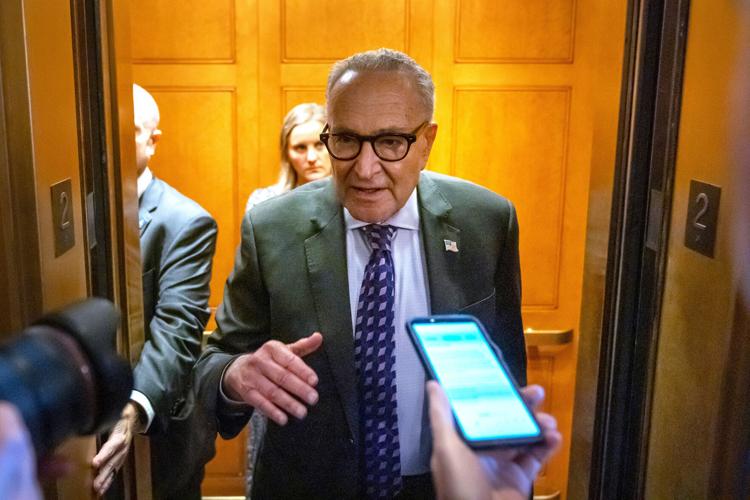
Senate Minority Leader Chuck Schumer, D-N.Y., speaks to reporters Wednesday at the Capitol in Washington.
Republican leaders — Senate Majority Leader John Thune, House Speaker Mike Johnson and President Donald Trump — say they won't negotiate or be "held hostage " by Democrats demanding concessions to reopen the government.
While that uncompromising Republican position may not last long — there were some early, informal talks on the Senate floor Wednesday — reaching a deal would be difficult. It's deeply uncertain, for now, if the two sides can find common ground on health care policy or sow enough trust for the Democrats to change their position.
At the same time, an extended shutdown could be increasingly painful for Democrats. The Trump administration threatened to lay off thousands of workers and target Democratic-leaning states. On Wednesday, the White House announced it put a hold on subway and tunnel projects in Schumer's home state of New York.

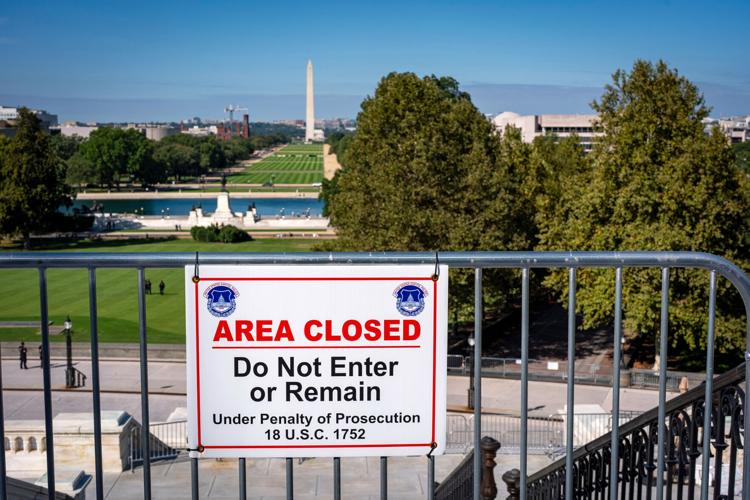
The West Lawn of the Capitol and the National Mall stretch into the distance Wednesday on the first day of a government shutdown at the Capitol in Washington.
Some wavering
Republicans were encouraged Tuesday evening when three Democrats voted with them to keep the government open — Democratic Sens. John Fetterman of Pennsylvania and Catherine Cortez Masto of Nevada and Independent Sen. Angus King of Maine.
Republicans, who hold the majority, need eight Democrats to win the 60 votes needed for passage in the 53-47 Senate. Kentucky Sen. Rand Paul was the only Republican to vote with Democrats against the measure.
Thune scheduled repeated votes on the measure, which failed 55-45 on Tuesday night and again Wednesday morning.
Republicans are eyeing several moderate Democrats who appeared to waver before casting "no" votes Tuesday night, including Sens. Jeanne Shaheen of New Hampshire and Gary Peters of Michigan. Both voted to keep the government open in March, along with Schumer, while many of their colleagues voted for a shutdown.
But Shaheen and Peters each voted no on Tuesday after extensive negotiations with colleagues in both parties on the floor. Shaheen said afterward that "I have been in intensive conversations with colleagues from both sides of the aisle on how to find a path forward and I'm eager to work with my Republican colleagues to find common ground."

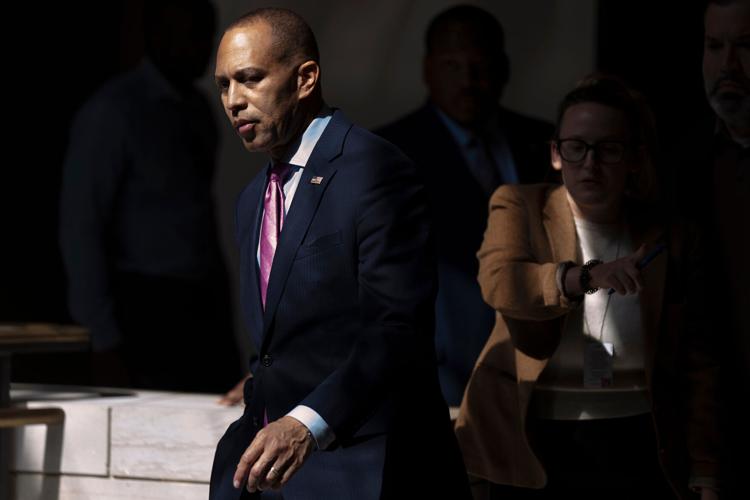
House Minority Leader Hakeem Jeffries, D-N.Y., walks to a news conference Wednesday on Capitol Hill in Washington.
At a crossroad
As some Democrats are already looking for a way out, others say they need to dig in and fight.
"As Donald Trump's lawlessness grows during this shutdown, our spines should stiffen, not bend," Sen. Chris Murphy of Connecticut said in a social media post on Wednesday. "Let's stand for something. The American people don't want us to fund the destruction of their health care and the destruction of our democracy."
The divisions in the caucus pose a dilemma for Schumer, who was blasted by base voters and activists in March when he voted with Republicans to keep the government open. Many Democrats in the House and Senate suggested shutting down the government is their only leverage to fight Trump and push back on his policies, including health care and spending cuts.


Health care
Democrats demanded that Republicans immediately extend health care subsidies for people who purchase coverage through the Affordable Care Act marketplaces. The expanded subsidies first put in place in 2021 during the COVID-19 pandemic are scheduled to expire at the end of the year, raising premium costs for millions of people.
Many Republicans say they're open to an extension, but they want to see changes. Other Republicans — especially in the House — see it as an unacceptable expansion of President Barack Obama's signature health care law, which Republicans tried to eliminate or cut back since it was enacted 15 years ago.
Johnson has not committed to talks on the issue and said, "There has to be reform."
Thune repeatedly said Republicans are willing to negotiate on the issue once the government reopens.
Even so, some Republicans began informal talks with Democrats on the Senate floor Wednesday about potentially extending the expanded subsidies for a year and then eventually phasing them out.

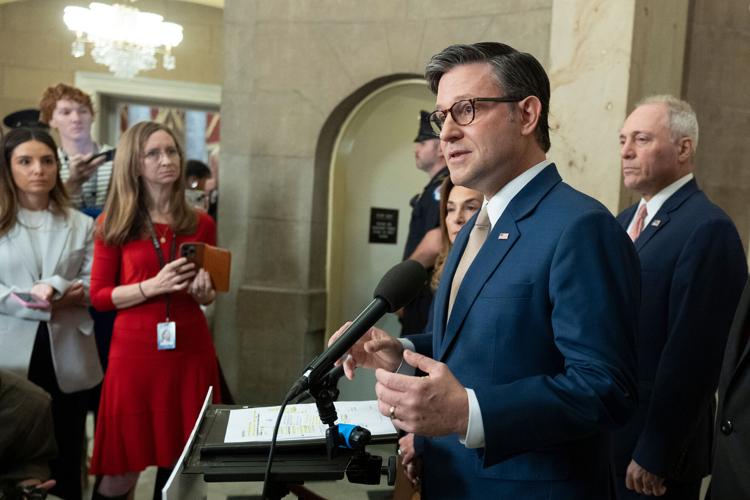
House Speaker Mike Johnson, R-La., front, with House Majority Leader Steve Scalise, R-La., right, and House Republican Conference Chair Lisa McClain, R-Mich., speaks during a news conference Thursday at the Capitol in Washington.
Lessons from the past
Past shutdowns show that it's hard to win major concessions by closing the government.
In 2018, the government shut down for three days as Democrats, led by Schumer, insisted that any budget measure come with protections for young immigrants known as "Dreamers" under the Obama-era Deferred Action for Childhood Arrivals program. They voted to reopen after then-Majority Leader Mitch McConnell promised only a vote on the issue.
Later that year, Trump forced a shutdown over funding for his border wall and retreated after 35 days as intensifying delays at the nation's airports and missed paydays for hundreds of thousands of federal workers.
Sen. Ted Cruz, R-Texas, and House Republicans triggered a shutdown in 2013 over Obama's health care law. Bipartisan negotiations in the Senate finally ended the shutdown after 16 days, and Republicans did not win any major concessions on health care.
From Florida's Everglades to California's Golden Gate Bridge, the shutdown in photos

National Park Service law enforcement ranger Greg Freeman opens a locked gate closing vehicle access to the Shark Valley section of Florida's Everglades National Park on Wednesday, Oct. 1, 2025, as he drives into the park. The U.S. government shutdown began after President Trump and Congress failed to reach a funding deal by Wednesday’s deadline. Hundreds of thousands of federal workers face furloughs and many offices closed. Congress is at an impasse, with Democrats demanding funding to save health care subsidies that are expiring and will send insurance costs soaring, while Republicans say a stop-gap government funding measure is a greater priority. This is a photo gallery curated by AP photo editors.

Sen. John Barrasso, R-Wyo., the Senate GOP whip, left, and Speaker of the House Mike Johnson, R-La., right, arrive for a news conference with top Republicans on the government shutdown Wednesday, Oct. 1, 2025, at the Capitol in Washington.

A tourist stops to read a sign announcing that the Washington Monument is closed Wednesday, Oct. 1, 2025, the first day of a partial government shutdown, in Washington.

People look through fence Wednesday, Oct. 1, 2025, to get a glance at the Statue of Liberty in New York.

House Minority Leader Hakeem Jeffries of New York walks to a news conference Wednesday, Oct. 1, 2025, on Capitol Hill in Washington.

People take photos Wednesday, Oct. 1, 2025, with a sign announcing that the Library of Congress in Washington is closed on the first day of a partial government shutdown.

People look at the Golden Gate Bridge outside the Fort Point National Historic Site, which is closed because of a government shutdown, on Wednesday, Oct. 1, 2025, in San Francisco.

A sign alerting visitors that the Royal Palm Visitor Center is closed hangs in a display case reflecting the landscape Wednesday, Oct. 1, 2025, inside Florida's Everglades National Park.

Tourist view Independence Hall on Wednesday, Oct. 1, 2025, from outside a barricade in Philadelphia.

Christy Lock and Curt Rohrman of Houston get a phone call Wednesday, Oct. 1, 2025, informing them their tickets for a tram ride to the top of Gateway Arch in St. Louis are canceled because of the federal government shutdown and that they will receive a refund.

American flags fly at sunrise Wednesday, Oct. 1, 2025, in front of the U.S. Capitol in Washington.

Kaitlin and Kurt Wilhelm of Sandusky, Ohio, foreground, and others gather Wednesday, Oct. 1, 2025, on the rocky coast in Acadia National Park, Maine, to watch the sunrise.

Rep. Alexandria Ocasio-Cortez, D-N.Y., gives a tour of the Capitol to a group of students from New York on Wednesday, Oct. 1, 2025, in Washington after their previously scheduled tour was canceled because of the government shutdown.

A visitor walks at sunrise on Wednesday, Oct. 1, 2025, at the Lincoln Memorial in Washington.

House Minority Leader Hakeem Jeffries, D-N.Y., center, flanked by Rep. Pete Aguilar, D-Calif., left, and Rep. Katherine Clark, D-Mass., speaks Tuesday, Sept. 30, 2025, on the steps of the Capitol in Washington to insist that Republicans include an extension of expiring health care benefits as part of a government funding compromise.

The sun sets Tuesday, Sept. 30, 2025, behind the Capitol and Washington Monument in Washington, seen from inside the Capitol as a government funding vote fails in the Senate.

Senate Majority Leader John Thune, R-S.D., speaks to reporters Tuesday, Sept. 30, 2025, at the U.S. Capitol in Washington as the U.S. government was on the brink of the first federal government shutdown in almost seven years.

Layne Morrison, left, of Washington and Courtney Creek of Silver Spring, Md., who were let go from their jobs with the Education Department and a USAID funded grant respectively, hold signs about the looming government shutdown Tuesday, Sept. 30, 2025, during a rally with former federal employees on Capitol Hill in Washington.

Senate Minority Leader Chuck Schumer of New York listens Tuesday, Sept. 30, 2025, as he speaks with reporters at the U.S. Capitol in Washington.

Visitors tour the Capitol Rotunda on Tuesday, Sept. 30, 2025, in Washington as the government lurched toward a shutdown.

Stairs lead to the Capitol Visitors Center in Washington on Wednesday, Sept. 24, 2025, just days before federal money ran out with the end of the fiscal year.

President Donald Trump walks from Marine One on Tuesday, Sept. 30, 2025, after arriving on the South Lawn of the White House in Washington.

The U.S. Capitol is seen at sunrise Wednesday, Oct. 1, 2025, as cars drive on Pennsylvania Avenue in Washington during rush hour traffic.

A sign announces that the U.S. Capitol Visitor Center in Washington is closed Wednesday, Oct. 1, 2025, the first day of a partial government shutdown.

