

WASHINGTON — President Donald Trump wants to counter the threats drones pose to national security, while also aiming to make it possible for Americans to fly faster than the speed of sound and expedite the development of the flying cars of the future.
The three new executive orders encourage the Federal Aviation Administration to expedite rules to allow companies to use drones beyond their operators’ line of sight, while also imposing restrictions meant to help protect against terrorism, espionage and public safety threats.
Drones already are used in a variety of ways, including bolstering search and rescue operations, applying fertilizer, inspecting power lines and railroad bridges, and even delivering packages.
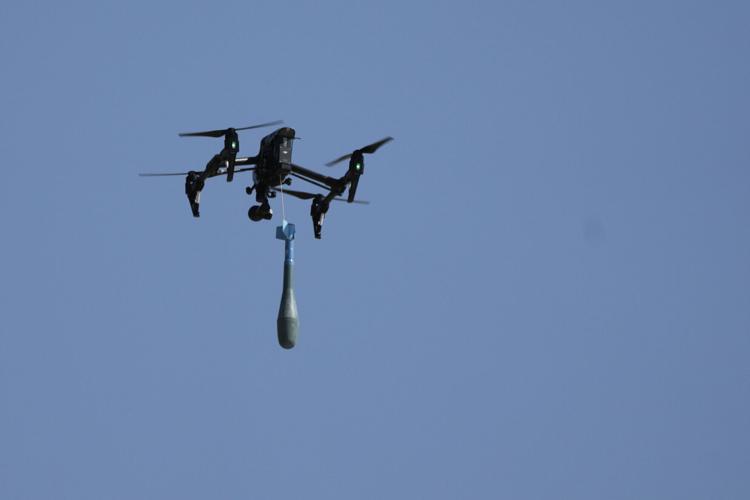
The war in Ukraine highlighted how drones could be used in a military or terrorist attack — a concern as the World Cup and Olympics approach in the U.S.
There also were espionage cases where drones were used to surveil sensitive sites. White House officials said drones also are used to smuggle drugs over the border, and there are concerns about the potential for a disastrous collision between a drone and an airliner near an airport.
“These orders also address the growing threat of criminal, terrorist and foreign misuse of drones in U.S. airspace. We have a responsibility to protect and restore airspace sovereignty,” said Michael Kratsios, assistant to the president and director of the White House Office of Science and Technology Policy.
With major events like the World Cup scheduled in the U.S. next year, Sebastian Gorka, senior director for counterterrorism on the National Security Council, said it’s crucial to protect the airspace above large public events. A federal task force will be created to review drone threats and existing terrorism task forces will look at drones.
“Drones are a disruptive technology. They have an amazing potential for both good and ill,” Gorka said. “We will increase the enforcement of current laws to deter two types of individuals: evildoers and idiots — the clueless and the careless.”
The orders direct the FAA to expedite a new rule restricting drone flights over sensitive sites and work with the Departments of Justice and Homeland Security to better enforce laws on illegal drone use.
The FAA tested systems to detect and counter drones that the White House would like to expand to deal with threats to public safety and national security. Among the methods examined: Using radio signals to jam drones or force them to land. Authorities are weighing whether to deploy high-powered microwaves or laser beams to disable the devices.
The orders will allow state and local authorities to be trained to respond to unauthorized drones, and expand the government’s ability to counter them. The NFL praised that move because all of the league’s games outside the Super Bowl are protected only by local and state officials, and an increasing number of drones violated their airspace.
Law enforcement agencies also may receive additional training on how to use drones themselves to ensure safety around major events.
One of Trump’s orders directs the FAA to eliminate the 1973 speed restriction that prohibits flights over Mach 1 and replace it with a noise standard.
New technology in supersonic aircraft can allow aircraft to fly faster than the speed of sound without a disruptive sonic boom being heard on the ground, but the regulations still ban those flights over land. A plane developed by Boom Supersonic became the first independently funded jet to break the sound barrier this year.
“The reality is that Americans should be able to fly from New York to LA in under four hours,” Kratsios said. “Advances in aerospace engineering, material science and noise reduction now make overland supersonic flight not just possible, but safe, sustainable and commercially viable.”

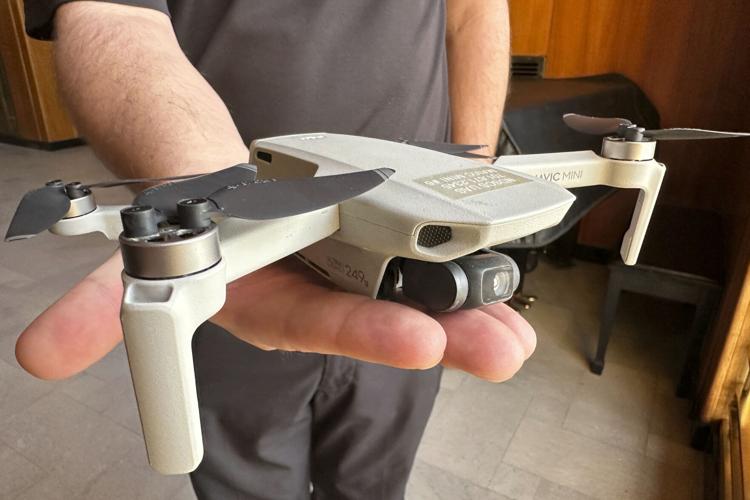
Seth Simonson, assistant professor/UAS curriculum lead for the North Dakota State College of Science, holds a Chinese-manufactured drone Jan. 15 at the state Capitol in Bismarck, N.D. The college mainly uses it for pilot training and photo and video collecting by students.
Concerns grow in the U.S. about Chinese drones
The executive orders don’t ban Chinese-made drones, including those by DJI that are popular in the U.S., but the Trump administration said it will
prioritize American-made dronesin federal procurement programs and open up grants to help state and local first responders buy U.S. drones.
The White House said it would seek to reduce the U.S. reliance on foreign-made drones and restrict foreign devices in sensitive areas. The administration also mandated national security reviews of some Chinese drone makers.
The orders also tighten rules on wireless transmission tech, which Craig Singleton, a senior China fellow at the Washington-based think tank Foundation for Defense of Democracies, said would disrupt the ability of Chinese drones to transmit data back to Beijing.
States and the federal government are increasingly wary about Chinese technology. At least six states and Congress passed laws to restrict government purchases of Chinese drones because of concerns about spying.
That’s part of a slew of more than 240 anti-China measures state legislatures considered this year.
But most commercial drones sold in the United States are made in China, and many Americans have come to rely on them. The Chinese models are widely known for their high performance and are generally significantly cheaper than American-made drones.
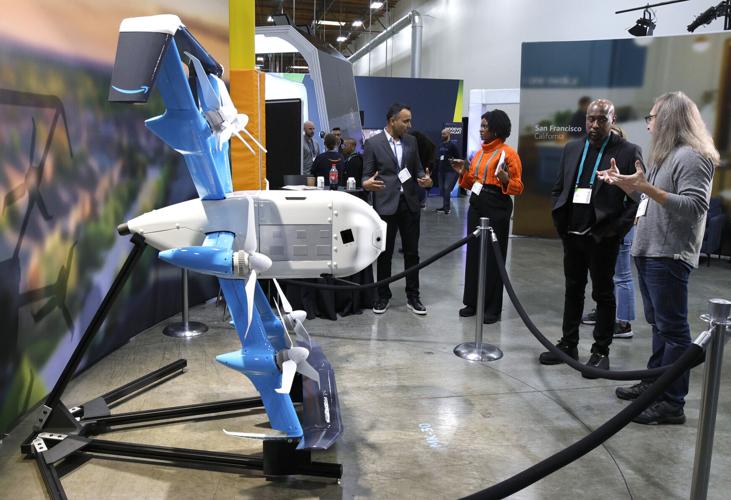
The FAA generally prohibited drones from operating outside operators’ line of sight because of safety concerns, but the agency granted hundreds of waivers to Amazon and some other companies, including utilities and railroads, to use drones farther away.
Drone manufacturers and users long wanted rules that spell out the framework for such flights because they see that as a natural next step to unlock the technology’s potential.
On Friday, Michael Robbins, chief executive officer of Association for Uncrewed Vehicle Systems International, applauded the Trump administration for advancing policies that he said would ensure U.S. leadership in drone innovation, security, operation and manufacturing.

