

FORT LAUDERDALE, Fla. — Top administration officials said Sunday that more than 50 countries targeted by President Donald Trump’s new tariffs have reached out to begin negotiations over the sweeping import taxes that have sent financial markets reeling, raised fears of a recession and upended the global trading system.

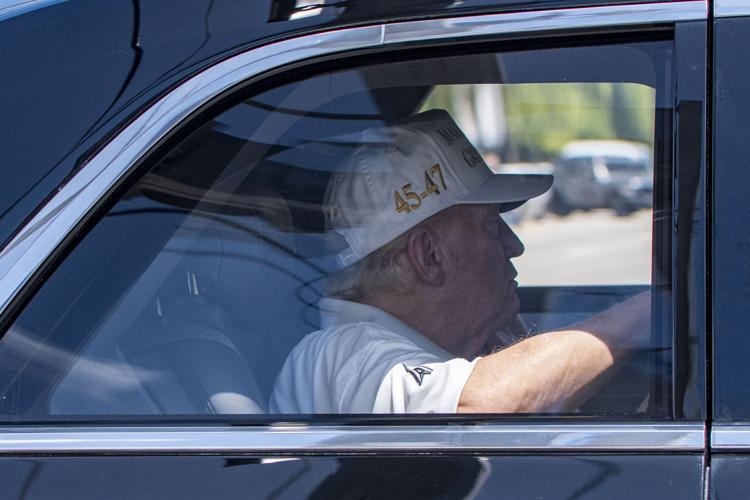
President Donald Trump returns to his Mar-a-Lago club from Trump National Golf Club on Sunday in West Palm Beach, Fla.
The higher rates are set to be collected beginning Wednesday, ushering in a new era of economic uncertainty with no clear end in sight. Treasury Secretary Scott Bessent said unfair trade practices are not “the kind of thing you can negotiate away in days or weeks.” The United States, he said, must see “what the countries offer and whether it’s believable.”
Trump, who spent the weekend in Florida playing golf, posted online that “WE WILL WIN. HANG TOUGH, it won’t be easy.” His Cabinet members and economic advisers were out in force Sunday defending the tariffs and downplaying the consequences for the global economy.
“There doesn’t have to be a recession. Who knows how the market is going to react in a day, in a week?” Bessent said. “What we are looking at is building the long-term economic fundamentals for prosperity.”

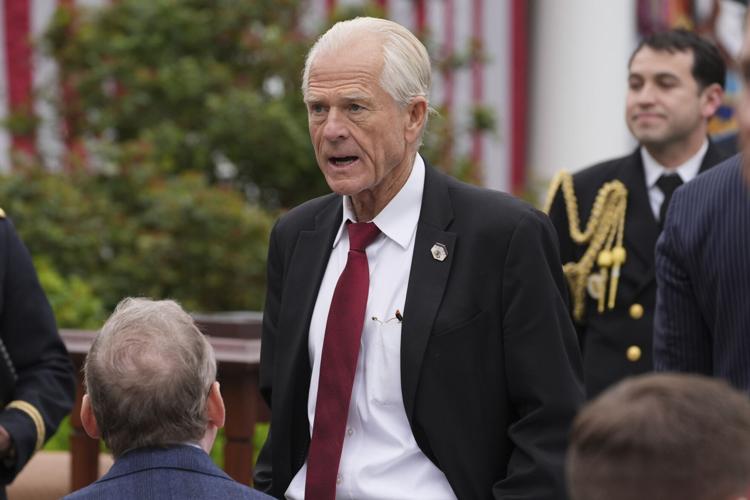
White House trade adviser Peter Navarro arrives before President Donald Trump speaks during an event to announce new tariffs Wednesday in the Rose Garden of the White House.
U.S. stock futures dropped on Sunday evening as the tariffs continued to roil the markets. Dow Jones Industrial Average and S&P 500 futures fell nearly 4% while Nasdaq futures were down nearly 5%. Even the price of bitcoin, which held relatively stable last week, fell nearly 6% Sunday.
Trump’s tariff blitz, announced April 2, fulfilled a key campaign promise as he acted without Congress to redraw the rules of global trade. It was a move decades in the making for Trump, who has long denounced foreign trade deals as unfair to the U.S. He is gambling that voters will be willing to endure higher prices for everyday items to enact his economic vision.
Countries are scrambling to figure out how to respond to the tariffs, with China and others retaliating quickly.
Top White House economic adviser Kevin Hassett acknowledged that other countries are “angry and retaliating,” and, he said, “by the way, coming to the table.” He cited the Office of the U.S. Trade Representative as reporting that more than 50 nations had reached out to the White House to begin talks.
Adding to the turmoil, the new tariffs are hitting American allies and adversaries alike, including Israel, which is facing a 17% tariff. Israeli Prime Minister Benjamin Netanyahu is set to visit the White House Monday, with his office saying the tariffs would be a point of discussion with Trump along with the war in Gaza and other issues.
Another American ally, Vietnam, a major manufacturing center for clothing, has also been in touch with the administration about the tariffs. Trump said Vietnam’s leader said in a telephone call that his country “wants to cut their Tariffs down to ZERO if they are able to make an agreement with the U.S.” And a key European partner, Italian Premier Giorgia Meloni, said she disagreed with Trump’s move but was “ready to deploy all the tools — negotiating and economic — necessary to support our businesses and our sectors that may be penalized.”

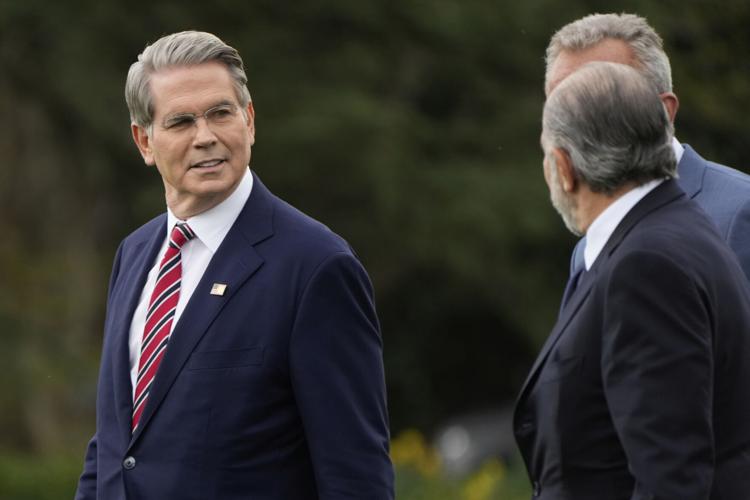
From left, Treasury Secretary Scott Bessent, Health and Human Services Secretary Robert F. Kennedy Jr. and Commerce Secretary Howard Lutnick follow President Donald Trump to board Marine One on the South Lawn of the White House en route to Florida on March 28 in Washington.
Commerce Secretary Howard Lutnick made clear there was no postponing tariffs that are days away.
“The tariffs are coming. Of course they are,” he said, adding that Trump needed to reset global trade. But he committed only to having them “definitely” remain “for days and weeks.”
In Congress, where Trump’s Republican Party has long championed free trade, the tariff regiment has been met with applause but also significant unease.
Several Republican senators have already signed onto a new bipartisan bill that would require presidents to justify new tariffs to Congress. Lawmakers would then have to approve the tariffs within 60 days, or they would expire. Nebraska GOP Rep. Don Bacon said Sunday that he would introduce a House version of the bill, saying that Congress needs to restores its powers over tariffs.
“We gave some of that power to the executive branch. I think, in hindsight, that was a mistake,” said Bacon, adding that getting a measure passed would be challenging unless the financial markets continue to react negatively and other indicators such as inflation and unemployment shift.
Wyoming’s John Barrasso, the No. 2 member of the Senate’s GOP leadership, said Trump is “doing what he has every right to do.” But, he acknowledged, “there is concern, and there’s concern across the country. People are watching the markets.”
“There’ll be a discussion in the Senate,” Barrasso said of the tariffs. “We’ll see which way the discussion goes.”
Trump’s government cost-cutting guru, billionaire businessman Elon Musk, had been relatively silent on Trump’s tariffs, but said at a weekend event in Italy that he would like to see the U.S. and Europe move to “a zero-tariff situation.” The comment from the Tesla owner who leads Trump’s Department of Government Efficiency drew a rebuke from White House trade adviser Peter Navarro.
“Elon, when he is on his DOGE lane, is great. But we understand what’s going on here. We just have to understand. Elon sells cars,” Navarro said. He added: “He’s simply protecting his own interest as any business person would do.”
Lawrence Summers, an economist who was treasury secretary under Democratic President Bill Clinton, said Trump and his economic team are sending contradictory messages if they say they are interested in reviving manufacturing while still being open to negotiating with trade partners.
If other countries eliminate their tariffs, and the U.S, does, too, he said, “it’s just making a deal, then we don’t raise any revenue nor do we get any businesses to relocate to the United States. If it’s a permanent revenue source and trying to get businesses to relocate to the United States, then we’re going to have these tariffs permanently. So the president can’t have it both ways.”
Bessent was on NBC’s “Meet the Press,” Hassett and Summers appeared on ABC’s “This Week,” Lutnick and Barrasso were on CBS’ “Face the Nation” and Navarro was interviewed on Fox News Channel’s “Sunday Morning Futures.”
Tariff whiplash and HUD cuts could cripple affordable housing development
Tariff whiplash and HUD cuts could cripple affordable housing development
Updated
President Donald Trump's sweeping tariffs on foreign goods have affordable housing developers staring down the barrel of a gun. Not only have existing tariffs on steel, aluminum, lumber, home appliances, and other construction materials prompted fears of a recession, but threats of new tariffs have made an already-hurting housing market much more uncertain to navigate.
For the past decade, Monica Martinez has led the Fax Partnership in Denver, a community development nonprofit that builds affordable housing along the rapidly gentrifying East Colfax corridor.
The Fax currently owns 40 motel units that have been converted into shelter options for people experiencing homelessness. The nonprofit plans to redevelop the property into affordable housing once a billboard lease expires in 2028. Martinez says the organization is also working on a proforma for a 110-unit workforce housing development in the neighborhood.
But finalizing those plans has become increasingly difficult because of the uncertainty caused by Trump's tariffs and extreme cuts to the Department of Housing and Urban Development.
"The challenges to make these deals economically viable are already numerous, including construction and labor costs, in addition to permitting and the escalating cost of insurance," Martinez tells Next City. "As a result, many units will not be built despite the acute need for units."
For instance, nonprofit developers like The Fax need to apply for state and federal tax credits to financially support building affordable housing. Those tax credits have become more important as the cost of labor and materials have increased in recent years. However, the amount of uncertainty created by the tariffs and HUD cuts has jeopardized many affordable housing deals.
"There are very little margins to make these deals pencil, despite the great demand for affordable units," Martinez says. "Increased costs to wood could result in deals not being viable, resulting in reduced affordable housing development."
The Fax Partnership's struggles illustrate how the uncertainty created by Trump's whiplash over tariffs and the cuts to HUD are impacting affordable housing. While almost no part of the U.S. economy has been spared from the uncertainty, experts like Martinez are concerned that Trump's actions could upend the progress made to address America's affordable housing crisis.
The federal government has played an important part in developing affordable housing for decades. Not only does it provide grants and loans for subsidized affordable housing, the government also has multiple programs to preserve and maintain affordable units.
Depending on who you ask, the U.S. faces a shortage of between 4 million and 7 million affordable homes. Addressing this gap was one of the key policy concerns for former president Joe Biden's administration. Under Biden, HUD invested $5.5 billion in 1,200 communities to build more affordable housing, preserved more than 30,000 affordable units through the Green and Resilient Retrofit Program, and allocated more than $100 billion in rental assistance to 2,100 public housing agencies.
However, the Trump administration is reversing course. The administration has proposed gutting HUD's staff by 50% with deep cuts to the offices that oversee the Housing Choice Voucher program and enforce fair housing laws. Trump has also threatened to impose tariffs on trading partners like Canada and Mexico, which supply important homebuilding materials like steel, wood and aluminum.
Tariff damages
Trump imposed 25% tariffs on imports from Canada and Mexico and an additional 10% tariff on raw materials from China on March 3. He delayed those tariffs until April 2 after the markets soured. A week later, Trump raised tariffs on steel and aluminum imports from Canada and Europe to 25%, a move that caused both countries to place reciprocal tariffs on goods exported from America.
Already, the National Association of Home Builders says some of its members have estimated that the tariffs on building materials could raise the average price of a new home by $7,500 to $10,000.
While the financial impact of the tariffs has yet to be felt by American consumers, they have created a lot of uncertainty among investors. Metropolitan State University economist Alexandre Padilla tells Next City that uncertainty is the most damaging aspect of the tariff whiplash.
"In essence, these trade agreements are not being supported, and the investors are just going to pull their money away," Padilla says. "And that's what we observed in the market."
Trump has consistently defended the tariffs as a way to protect American industries. But Padilla says the way Trump has described the tariffs is not accurate.
Padilla says it is a good thing that countries can import goods like lumber, aluminum and steel into the U.S. at a lower cost than they can be produced domestically. Those lower costs benefit both businesses and consumers, he adds.
"We should embrace the fact that some countries subsidize the production of sales and sell us lumber and all those things necessary to build housing at a lower price," Padilla says.
Outside of the cost of materials, Trump's tariffs have also created uncertainty among U.S. trade partners. The U.S. imports roughly 30% of the wood used in residential and commercial construction from Canada. Mexico supplies about 71% of all gypsum imports, a material that is used to make drywall. Placing additional tariffs on these materials could increase construction costs for new homes by between $17,000 and $22,000 over the next year, according to a report from property analytics firm CoreLogic.
"These haphazard executive actions will cause serious economic impacts and injuries that will undermine our already fragile housing market," Nikitra Bailey, executive vice president of the National Fair Housing Alliance, told the House Financial Services Committee during a hearing on March 4.
Affordable housing crunch
The cuts to HUD also threaten the amount of financing available for affordable housing developments. For instance, HUD has paused more than $1 billion in grants under the Green and Resilient Retrofit Program and canceled nonprofit capacity-building grants—also known as Section 4 grants—for several prominent housing developers, including Enterprise Community Partners and Local Initiatives Support Corp.
GRRP grants were designed to help affordable housing providers upgrade their properties with green energy technology. Section 4 grants support the building of affordable homes in rural and Tribal communities as well as senior housing and child care centers. Approximately $60 million in Section 4 funding was taken off the table because of the move.
Over the past decade, Enterprise has deployed Section 4 grants in about 700 communities, resulting in the construction or preservation of 45,000 affordable homes.
In California alone, cutting Section 4 and other funding sources could disrupt 44,000 planned housing units that are waiting on final approvals, according to Enterprise.
Enterprise CEO Shaun Donovan said in a statement that the decision will "raise costs for families, hobble the creation of affordable homes, sacrifice local jobs, and sap opportunity from thousands of communities in all 50 states."
Several housing organizations sent a letter to Congressional leaders describing the devastating impact the HUD staff cuts will have on affordable housing.
"Rather than improving efficiency, such drastic staffing cuts at HUD will cause significant, harmful, and costly delays and will worsen America's affordable housing and homelessness crisis, as well as its significant disaster recovery needs," the letter reads in part.

This story was produced by Next City, a nonprofit newsroom covering solutions for equitable cities, and reviewed and distributed by Stacker.

