

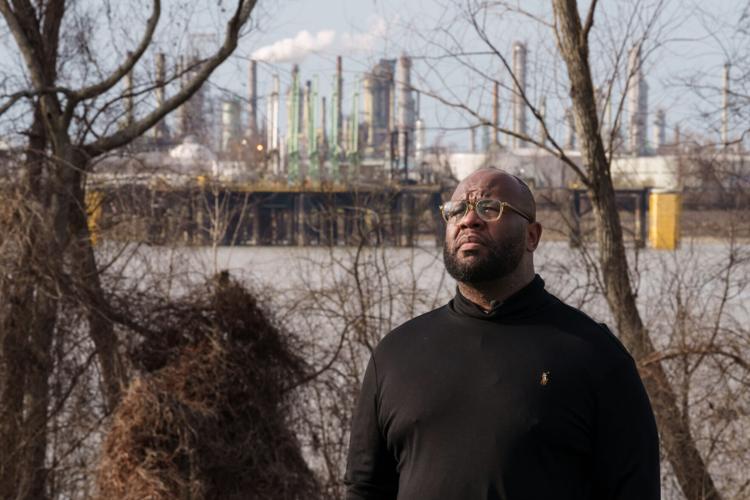

Gary C. Watson Jr., who was born and raised in St. John the Baptist Parish, poses for a photo Feb. 18 in Edgard, La., across the river from a Marathon Petroleum Refinery.
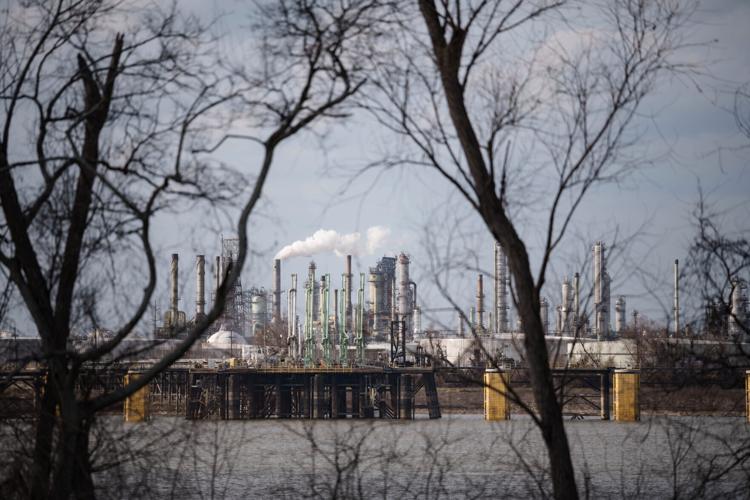
In a stretch of Louisiana with about 170 fossil fuel and petrochemical plants, premature death is a fact of life for people living nearby. The air is so polluted and the cancer rates so high it is known as Cancer Alley.
"Most adults in the area are attending two to three funerals per month," said Gary C. Watson Jr., who was born and raised in St. John the Baptist Parish, a majority Black community in Cancer Alley about 30 miles outside of New Orleans. His father survived cancer, but in recent years, at least five relatives have died from it.
Cancer Alley is one of many patches of America — mostly minority and poor — that suffer higher levels of air pollution from fossil fuel facilities that emit tiny particles connected to higher death rates. When the federal government in 2009 targeted carbon dioxide and other greenhouse gases as a public health danger because of climate change, it led to tighter regulation of pollution and cleaner air in some communities. But this month, the Trump administration's Environmental Protection Agency overturned that "endangerment finding."

Public health experts say the change will likely mean more illness and death for Americans, with communities like Watson's hit hardest. On Wednesday, a coalition of health and environmental groups sued the EPA over the revocation, calling it unlawful and harmful.
"Not having these protections, it's only going to make things worse," said Watson, with the environmental justice group Rise St. James Louisiana. He also worries that revoking the endangerment finding will increase emissions that will worsen the state's hurricanes.
The Trump administration said the finding — a cornerstone for many regulations aimed at fighting climate change — hurts industry and the economy. President Donald Trump has called the idea "a scam" despite repeated studies showing the opposite.

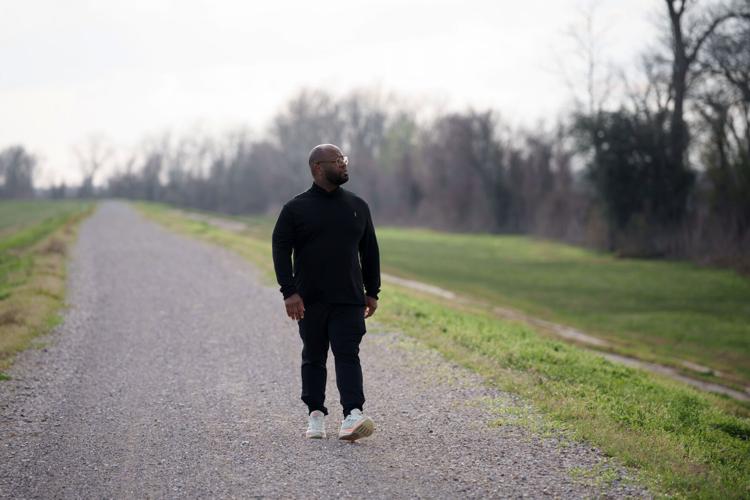
Gary C. Watson Jr. walks on a path Feb. 18 in Edgard, La., near a Marathon Petroleum Refinery.
Growing evidence shows that poor and Black, Latino and other racial and ethnic groups are typically more vulnerable than white people to pollution and climate-driven floods, hurricanes, extreme heat and more because they tend to have less resources to protect against and recover from them. The EPA, in a 2021 report no longer on its website, concluded the same.
The finding's reversal will affect everyone, but "overburdened communities, which are typically communities of color, Indigenous communities and low-income communities, they will, again, suffer most from these actions," said Matthew Tejada, senior vice president for environmental health at the Natural Resources Defense Council and a former deputy with the EPA's office for environmental justice.
Hilda Berganza, climate program manager with the Hispanic Access Foundation, said: "Communities that are the front lines are going to feel it the most. And we can see that the Latino population is one of those communities that is going feel it even more than others because of where we live, where we work."
Research shows the unequal harms of pollution, climate change
A study published in November found more than 46 million people in the U.S. live within a mile of at least one type of energy supply infrastructure, such as an oil well, a power plant or an oil refinery. But the study found that "persistently marginalized" racial and ethnic groups were more likely to live near multiple such sites. Latinos had the highest exposure.
The EPA, in that 2021 report, estimated that with a 2-degree Celsius rise in global warming, Black people were 40% more likely to live in places with the highest projected rise in deaths because of extreme heat. Latinos, who are overrepresented in outdoor industries such as agriculture and construction, were 43% more likely to live where labor hour losses were expected to be the highest because of heat.
Julia Silver, a senior research analyst at the University of California, Los Angeles' Latino Policy and Politics Institute, found in her own research that California Latino communities had 23 more days of extreme heat annually than non-Latino white neighborhoods. Her team also found those areas have poor air quality at about double the rate, with twice as many asthma-related emergency room visits. Other research shows that Latino children are 40% more likely to die from asthma than white children, in part because many lack consistent health care access.
"What we're risking with a rollback like this at the federal level is really human health and well-being in these marginalized groups," Silver said.

A Marathon Petroleum Refinery operates in Garyville, La., Feb. 18.
Experts say the disparate impacts will be significant
Armando Carpio, a longtime pastor in Los Angeles, has seen firsthand how vulnerable his mostly Latino parishioners are. Many are construction workers and gardeners who work outside, often in extreme heat. Others live and work near polluting freeways. He sees children with asthma and elders with dementia, both linked to exposure to air pollution.
"We're regressing," he said. "I don't know how many years back, but all of this really affects us."
It is difficult to quantify how much more communities of color could be impacted by the finding's revocation, but experts who spoke with The Associated Press all said it would be significant.
Beverly Wright, founding director of the Deep South Center for Environmental Justice in New Orleans, said at least four Black communities in Cancer Alley no longer exist because of the expansion of industrial facilities. The repeal will bring more pollution, higher cancer rates, more extreme weather and the disappearance of more historic communities, she said.
"It has us going in the wrong direction, and our communities are now at greater risk," she said.
Photos capture destruction, heartache and resilience as climate change advanced in 2025

Joe Chyuwei, right, Addison Black, front center, James Black, front left, and back row from left, Helen Chyuwei, Jameson Black, Grace Chyuwei and Grayson Black watch the sunset in the heat at Zabriskie Point, Aug. 3, 2025, in Death Valley National Park, Calif. (AP Photo/John Locher, File)

The head of a dead fish lies in the almost dry Aume River, Aug. 14, 2025, in Saint-Fraigne, France. (AP Photo/Yohan Bonnet, File)

Local farmer Turkan Ozkan, 64, cries next to one of her animals killed during a fire Aug. 12, 2025, in Guzelyeli, Turkey. (AP Photo/Khalil Hamra, File)

Members of the Mura Indigenous community maneuver a boat Feb. 17, 2025, in the Lago do Soares village in Autazes, Amazonas state, Brazil. (AP Photo/Edmar Barros, File)

Afeli Bernice Adzo leans against the remains of her father's room as she looks at the ocean that destroyed her family home March 5, 2025, in Avegadzi, Ghana. (AP Photo/Misper Apawu, File)

Scientists and veterinarians capture a pink river dolphin in the Amazon River to perform health checks Sept. 7, 2025, in Puerto Narino, Colombia. (AP Photo/Fernando Vergara, File)

Wanona Harp rescues a cat stranded on her neighbor's porch flooded by the Kentucky River, April 8, 2025, in Lockport, Ky. (AP Photo/Carolyn Kaster, File)

Mamadou Gueye, a 39-year-old farmer who lost his left hand after a fight with a herder over cattle in May 2022, guards his fields of peanuts Oct. 12, 2025, in Ross Bethio, Senegal. (AP Photo/Andrea Ferro)

An environmental agent of the Chico Mendes Institute takes photos of turtle hatchlings Nov. 17, 2025, at the Abufari Biological Reserve in Tapaua, Brazil. (AP Photo/Edmar Barros, File)

Luciane Mengual, 22, an Indigenous woman from the Wayuu community, poses with her baby at home Feb. 4, 2025, in the Villa del Sur neighborhood, on the outskirts of Riohacha, Colombia. (AP Photo/Ivan Valencia, File)

A Sudanese farmer carries his livestock after his farm was destroyed by floods Oct. 1, 2025, in Wad Ramli village, Sudan. (AP Photo/Marwan Ali, File)

Members of the Gadaba Indigenous communities gather tendu leaves to sell April 16, 2025, in Hatipakna village, India. (AP Photo/Rafiq Maqbool, File)

Cows stand in floodwaters at a farm July 25, 2025, in Buenos Aires province, Argentina. (AP Photo/Natacha Pisarenko, File)

An Indigenous group attends the opening ceremony of the People's Summit offsite from the COP30 U.N. Climate Summit, Nov. 12, 2025, in Belem, Brazil. (AP Photo/Fernando Llano, File)

Schuyler Clogston, left, makes shadows puppets with Agnes Suárez after setting up a sheet and light to attract moths for observation Oct. 7, 2025, in Charleston, S.C. (AP Photo/Joshua A. Bickel, File)

Cassandra Garduño cleans a canal in her chinampa, an island farm built by the Aztecs thousands of years ago May 8, 2025, in San Gregorio Atlapulco, a borough of Mexico City. (AP Photo/Felix Marquez, File)

Members of the Navajo Scouts firefighter crew kick up dust as they clear debris from a landslide across a road on a hillside as they battle the Eaton Fire, Jan. 17, 2025, in Altadena, Calif. (AP Photo/John Locher, File)

Fisherman Sunil Kumar, bottom, spreads a fishing net to help remove the weeds floating on Doddajala Lake, Aug. 23, 2025, on the outskirts of Bengaluru, India. (AP Photo/Aijaz Rahi, File)

Young Indigenous guards play on the walls of an old military defense barrier made of sandbags, remnants of the military occupation in the area July, 19, 2025, in the Lopez Adentro reserve in Caloto, Colombia. (AP Photo/Nadège Mazars, File)

Women open freshly cooked oysters Aug. 6, 2025, in Tsokomey, Ghana. (AP Photo/Misper Apawu, File)

Firefighters work from a deck as the Palisades Fire burns a beachfront property Jan. 8, 2025, in Malibu, Calif. (AP Photo/Etienne Laurent, File)

A Navy officer helps a woman cross a flooded street Oct. 12, 2025, in Poza Rica, Veracruz state, Mexico. (AP Photo/Felix Marquez, File)

Relatives of Rosiclaire Lenchise mourn during a funeral of victims killed by a landslide triggered by Hurricane Melissa, Nov. 15, 2025, in Petit Goave, Haiti. (AP Photo/Odelyn Joseph, File)

Arturo Huidobro, center, and a worker prepare to remove dead pigs from a farm following heavy rainfall Oct. 11, 2025, in Poza Rica, Mexico. (AP Photo/Felix Marquez, File)

Tanzin Dolma milks a yak as her husband, Punchuk Namdol, collects dung in the background on an early morning July 8, 2025, in Maan village, Ladakh, India. (AP Photo/Dar Yasin, File)

Baby ostriches huddle after being moved into a barn following recent flooding July 9, 2025, at a farm in Bend, Texas. (AP Photo/Joshua A. Bickel, File)

Members of the Lion Intervention Brigade conduct a patrol Jan. 14, 2025, at Niokolo Koba National Park, Senegal. (AP Photo/Annika Hammerschlag, File)

Judy Bertuso, left, feeds her husband Apollo inside a tent at an evacuation center as Typhoon Fung-wong enters the country Nov. 9, 2025, in Quezon city, Philippines. (AP Photo/Aaron Favila, File)

Olsjen Mucobega, 32, uses his motorcycle to evacuate a sheep from a wildfire Aug. 13, 2025, in Patras, Greece. (AP Photo/Thanassis Stavrakis, File)

A man rides his bicycle through an inundated street during the aftermath of Hurricane Melissa, Oct. 30, 2025, in Black River, Jamaica. (AP Photo/Matias Delacroix, File)

Ari Rivera, rear, and Anderson Hao hold each other in front of their destroyed home Jan. 9, 2025, in Altadena, Calif. (AP Photo/John Locher, File)

Gentoo penguins nest at Neko Harbour in Antarctica, Saturday, Nov. 22, 2025. (AP Photo/Mark Baker)

A pod of orcas swim in the Drake Passage en route to Antarctica, Friday, Nov. 21, 2025. (AP Photo/Mark Baker)

Passengers walk inside the volcano at Deception Island in Antarctica, Wednesday, Nov. 26, 2025. (AP Photo/Mark Baker)

Gentoo penguins walk at Neko Harbour in Antarctica, Saturday, Nov. 22, 2025. (AP Photo/Mark Baker)

Gentoo penguins nest at Neko Harbour in Antarctica, Saturday, Nov. 22, 2025. (AP Photo/Mark Baker)

A member of the ship's crew looks at an iceberg near Yalour Islands in Antarctica, Monday, Nov. 24, 2025. (AP Photo/Mark Baker)

A crew member looks for whales at Yalour Islands in Antarctica, Monday, Nov. 24, 2025. (AP Photo/Mark Baker)

The sun sets near a iceberg in Antarctica, Friday, Nov. 21, 2025. (AP Photo/Mark Baker)

Passengers watch as a ship sails through the Lemaire Channel in Antarctica, Monday, Nov. 24, 2025. (AP Photo/Mark Baker)

Adelie penguins stand on a block of floating ice at Yalour Islands in Antarctica, Monday, Nov. 24, 2025. (AP Photo/Mark Baker)

A elephant seal reacts at Walker Island in Antarctica, Wednesday, Nov. 26, 2025. (AP Photo/Mark Baker)

Gentoo penguins nest at Walker Island in Antarctica, Wednesday, Nov. 26, 2025. (AP Photo/Mark Baker)

Gentoo penguins prepare to enter the water at Walker Island in Antarctica, Wednesday, Nov. 26, 2025. (AP Photo/Mark Baker)

An ice covered rock formation is reflected in the waters at Pleneau Island in Antarctica, Monday, Nov. 24, 2025. (AP Photo/Mark Baker)

A Pintado petrel flys over the Drakes Passage on the way to Antarctica, Thursday, Nov. 20, 2025. (AP Photo/Mark Baker)

Sea ice covers the ocean at Yalour Islands in Antarctica, Monday, Nov. 24, 2025. (AP Photo/Mark Baker)

