

WASHINGTON — Donald Trump made no secret of his willingness to exert a maximalist approach to enforcing immigration laws and keeping order as he campaigned to return to the White House. The fulfillment of that pledge is now on full display in Los Angeles.
The president put hundreds of National Guard troops on the streets to quell protests over his administration's immigration raids, a deployment that state and city officials say only inflamed tensions. Trump called up the California National Guard over the objections of Democratic Gov. Gavin Newsom — the first time in 60 years a president has done so — and deployed active-duty troops to support the guard.
By overriding Newsom, Trump already went beyond what he did to respond to Black Lives Matter protests in 2020, when he warned he could send troops to contain demonstrations that turned violent if governors in the states did not act to do so themselves.

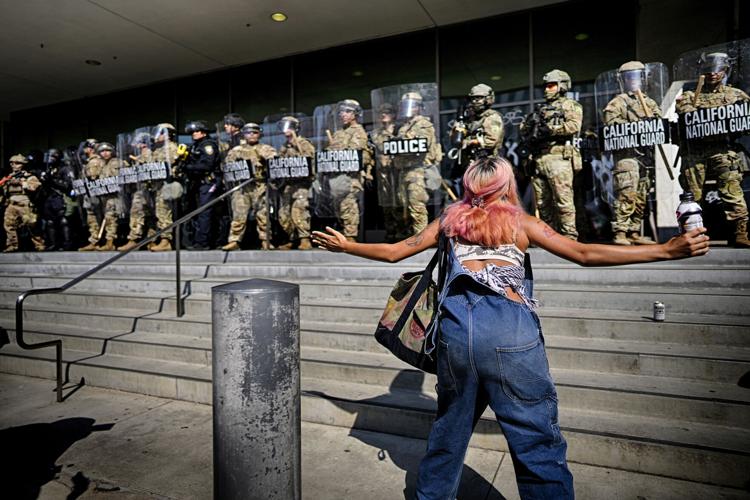
A protester taunts a line of California National Guard protecting a federal building Monday in downtown Los Angeles.
Trump said in September of that year that he "can't call in the National Guard unless we're requested by a governor" and that "we have to go by the laws."
But now, the past and current president is moving swiftly, with little internal restraint to test the bounds of his executive authority to deliver on his promise of mass deportations.
What remains to be seen is whether Americans will stand by him once it's operationalized nationwide, as Trump looks to secure billions from Congress to dramatically expand the country's detention and deportation operations.
For now, Trump is betting that they will.

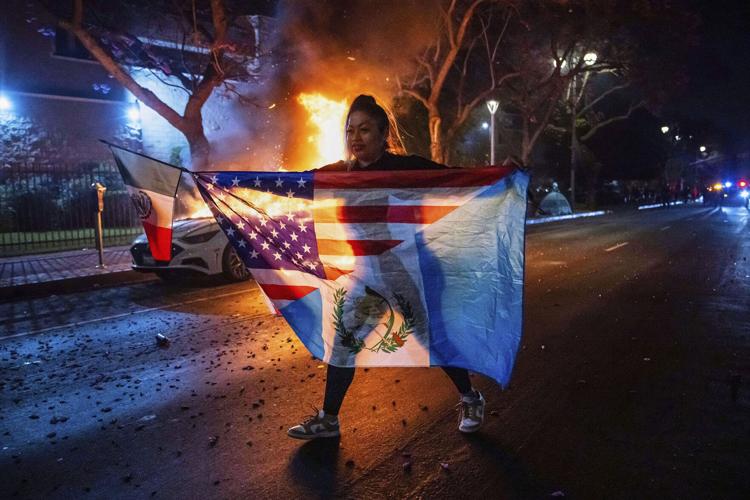
A person holding flags walks past a burning car Monday during protests over the Trump administration's immigration raids in Los Angeles.
'A crisis of Trump's own making'
The protests began to unfold Friday as federal authorities arrested immigrants in several locations throughout the sprawling city, including in the fashion district of Los Angeles and at a Home Depot. The anger over the administration's actions quickly spread, with protests in Chicago and Boston as demonstrations in the southern California city.
Trump and other administration officials capitalized on the images of burning cars, graffiti and Mexican flags — which, while not dominant, started to become the defining images of the unrest — to bolster their law-and-order cause.
Leaders in the country's most populous state were similarly defiant.
California officials sued the Trump administration Monday, with the state's attorney general, Rob Bonta, arguing that the deployment of troops "trampled" on the state's sovereignty and pushing for a restraining order.

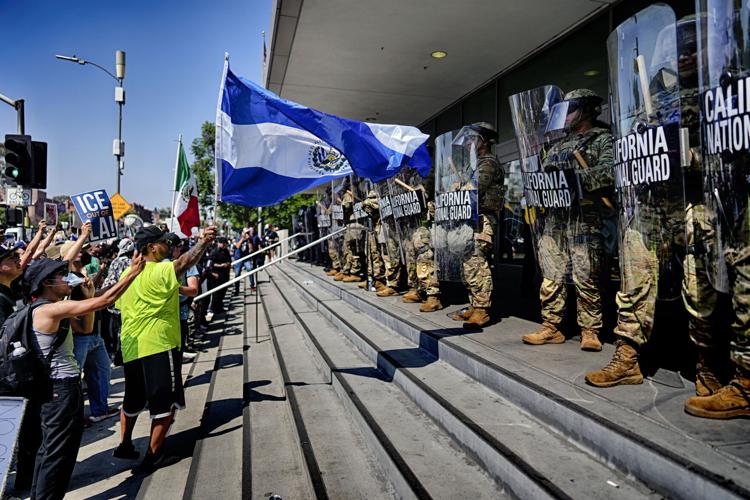
A protester waves a National Flag of El Salvador in front of a line of California National Guard on Monday in downtown Los Angeles.
The state's senior Democratic senator, Alex Padilla, said in an interview that "this is absolutely a crisis of Trump's own making."
"There are a lot of people who are passionate about speaking up for fundamental rights and respecting due process, but the deployment of National Guard only serves to escalate tensions and the situation," Padilla told The Associated Press. "It's exactly what Donald Trump wanted to do."
Padilla slammed the deployment as "counterproductive" and said the Los Angeles Sheriff's Department was not advised ahead of the federalization of the National Guard. His office also pushed the Pentagon for a justification on the deployment, and "as far as we're told, the Department of Defense isn't sure what the mission is here," Padilla added.

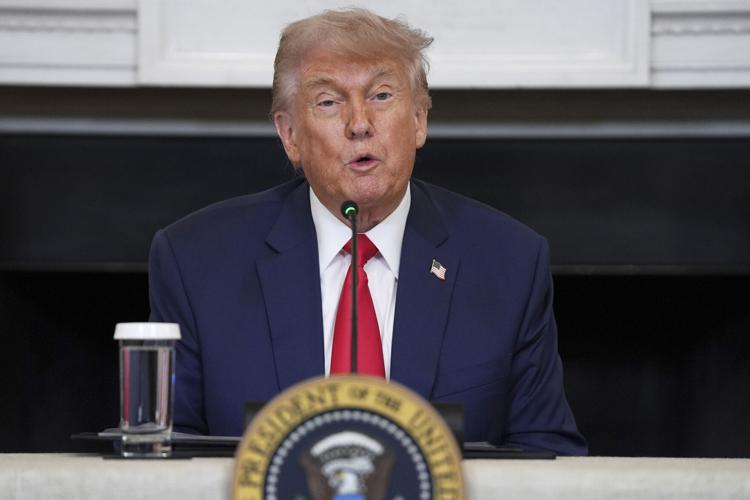
President Donald Trump speaks with business leaders Monday at the White House in Washington.
Trump previewed strategy
During his 2024 presidential campaign, Trump pledged to conduct the largest domestic deportation operation in American history to expel millions of immigrants in the country without legal status.
He often praised President Dwight D. Eisenhower's military-style immigration raids, and the candidate and his advisers suggested they would have broad power to deploy troops domestically to enact Trump's far-reaching immigration and public safety goals.
Trump's speedy deployment in California of troops against those whom the president has alluded to as "insurrectionists" on social media is a sharp contrast to his decision to issue no order or formal request for National Guard troops during the insurrection at the U.S. Capitol on Jan. 6, 2021, despite his repeated and false assertions that he made such an offer.
Trump is now surrounded by officials who have no interest in constraining his power. In 2020, Trump's then-Pentagon chief publicly rebuked Trump's threat to send in troops using the Insurrection Act, an 1807 law that empowers the president to use the military within the U.S. and against American citizens.
Current Defense Secretary Pete Hegseth signaled support on social media for deploying troops to California, writing, "The National Guard, and Marines if need be, stand with ICE," referring to the U.S. Immigration and Customs Enforcement agency.
The Defense Department said Monday it will deploy about 700 active-duty Marines to Los Angeles to support National Guard troops already on the ground to respond to the protests.
Photos: Protesters clash with law enforcement in Los Angeles

California National Guard guard the Federal Building on Tuesday, June 10, 2025, in downtown Los Angeles. (AP Photo/Eric Thayer)

Diego Coloma rests on a railing as he looks on at law enforcement officers during a protest on Tuesday, June 10, 2025, in Los Angeles. (AP Photo/Eric Thayer)

A man raises his fist as California National Guardsmen look on during a protest on Tuesday, June 10, 2025, in Los Angeles. (AP Photo/Eric Thayer)

Demonstrators march during a protest Tuesday, June 10, 2025, in Los Angeles. (AP Photo/Eric Thayer)

Protesters gather to denounce ICE, U.S Immigration and Customs Enforcement, operations Tuesday, June 10, 2025, in Los Angeles. (AP Photo Damian Dovarganes)

California Highway Patrol officers clash with protesters on Tuesday, June 10, 2025, in Los Angeles. (AP Photo/Eric Thayer)

California Highway Patrol push protesters back along a street during a protest on Tuesday, June 10, 2025, in Los Angeles. (AP Photo/Eric Thayer)

A protester yells at police and federal agents in an action to denounce the ICE, U.S. Immigration and Customs Enforcement, operations in the area Tuesday, June 10, 2025, in downtown Los Angeles. (AP Photo/Eric Thayer)

A protester is arrested by California Highway Patrol near the federal building in downtown Los Angeles on Tuesday, June 10, 2025. (AP Photo/Eric Thayer)

Protesters are detained by law enforcement near the federal building in downtown Los Angeles on Tuesday, June 10, 2025. (AP Photo/Eric Thayer)

A protester is arrested by California Highway Patrol near the federal building in downtown Los Angeles on Tuesday, June 10, 2025. (AP Photo/Eric Thayer)

A protester offers a flower to Los Angeles police officers in riot gear while they attempt to clear a street in downtown Los Angeles on Monday, June 9, 2025. (AP Photo Jae Hong)

A person carrying multiple flags walks past a burning car during protests over the Trump administration's immigration raids in Los Angeles, Monday, June 9, 2025. (AP Photo/Ethan Swope)

Protesters jump over a fence to avoid being kettled by police during protests over the Trump administration's immigration raids in Los Angeles, Monday, June 9, 2025. (AP Photo/Ethan Swope)

An injured protester is tended to by another during protests over the Trump administration's immigration raids in Los Angeles, Monday, June 9, 2025. (AP Photo/Ethan Swope)

Protesters gather outside the federal building to denounce the ICE, U.S. Immigration and Customs Enforcement, operations in the area Tuesday, June 10, 2025, in downtown Los Angeles. (AP Photo/Eric Thayer)

Tear gas fills the street as protesters confront Border Patrol personnel during a demonstration over the dozens detained in an operation by federal immigration authorities a day earlier, in Paramount, Calif., on Saturday, June 7, 2025. (AP Photo/Eric Thayer)

A car burns during a protest in Compton, Calif., Saturday, June 7, 2025, after federal immigration authorities conducted operations. (AP Photo/Eric Thayer)

A person carries an injured protester to cover during a protest in Compton, Calif., Saturday, June 7, 2025, after federal immigration authorities conducted operations. (AP Photo/Ethan Swope)

Authorities stand in tear gas while trying to clear protesters at the metropolitan detention center in downtown Los Angeles, Sunday, June 8, 2025, following last night's immigration raid protest. (AP Photo/Jae Hong)

A protester is detained by police in downtown Los Angeles, Sunday, June 8, 2025, following last night's immigration raid protest. (AP Photo/Eric Thayer)

A protester is detained in downtown Los Angeles, Sunday, June 8, 2025, following last night's immigration raid protest. (AP Photo/Eric Thayer)

A police officer's face is covered in pepper spray outside the Metropolitan Detention Center of downtown Los Angeles, Sunday, June 8, 2025, following last night's immigration raid protest. (AP Photo/Jae Hong)

Maribel Parra screams as protesters confront a line of police near the metropolitan detention center of downtown Los Angeles, Sunday, June 8, 2025, following last night's immigration raid protest. (AP Photo/Jae Hong)

Protesters are seen on the 101 Freeway near the Metropolitan Detention Center of downtown Los Angeles, Sunday, June 8, 2025, following last night's immigration raid protest. (AP Photo/Eric Thayer)

A protester throws a smoke canister on the 101 Freeway near the Metropolitan Detention Center of downtown Los Angeles, Sunday, June 8, 2025, following last night's immigration raid protest. (AP Photo/Eric Thayer)

Protesters confront police on the 101 Freeway near the Metropolitan Detention Center of downtown Los Angeles, Sunday, June 8, 2025, following last night's immigration raid protest. (AP Photo/Jae C. Hong)

A protester holds a sign as a Waymo taxi burns near the metropolitan detention center of downtown Los Angeles, Sunday, June 8, 2025, following last night's immigration raid protest. (AP Photo/Eric Thayer)

A police officer fires a soft round near the metropolitan detention center of downtown Los Angeles, Sunday, June 8, 2025, following last night's immigration raid protest. (AP Photo/Eric Thayer)

Protesters take cover behind chairs near the Metropolitan Detention Center in downtown Los Angeles, Sunday, June 8, 2025, following last night's immigration raid protest. (AP Photo/Eric Thayer)

Officers make their way down a ramp to the 101 Freeway near the Metropolitan Detention Center in downtown Los Angeles, Sunday, June 8, 2025, following last night's immigration raid protest. (AP Photo/Jae C. Hong)

Matt Hobbs uses milk after being teargassed near the Metropolitan Detention Center in downtown Los Angeles, Sunday, June 8, 2025, following last night's immigration raid protest. (AP Photo/Jae C. Hong)

Two California Highway Patrol officers try to dodge rocks being thrown near the Metropolitan Detention Center in downtown Los Angeles, Sunday, June 8, 2025, following last night's immigration raid protest. (AP Photo/Jae C. Hong)

A protester throws a scooter at a police vehical near the metropolitan detention center of downtown Los Angeles, Sunday, June 8, 2025, following last night's immigration raid protest. (AP Photo/Jae C. Hong)

EDS NOTE: OBSCENITY A flash bomb explodes on the 101 Freeway near the metropolitan detention center of downtown Los Angeles, Sunday, June 8, 2025, following last night's immigration raid protest. (AP Photo/Eric Thayer)

People take cover as a fire work explodes during a protest near the Metropolitan Detention Center in downtown Los Angeles, Sunday, June 8, 2025. (AP Photo/Ethan Swope)

A woman waves the Mexican flag as flames erupt from a burning dumpster during a protest in downtown Los Angeles, Sunday, June 8, 2025. (AP Photo/Ethan Swope)

A California Highway Patrol officer pulls an electric scooter off a vehicle on a highway as protesters throw objects at the police vehicles near the Metropolitan Detention Center in downtown Los Angeles, Sunday, June 8, 2025. (AP Photo/Ethan Swope)

