

If history is a guide, Republicans stand a good chance of losing control of the House of Representatives in 2026. They have just a slim majority in the chamber, and the incumbent party usually gives up seats in midterm elections.

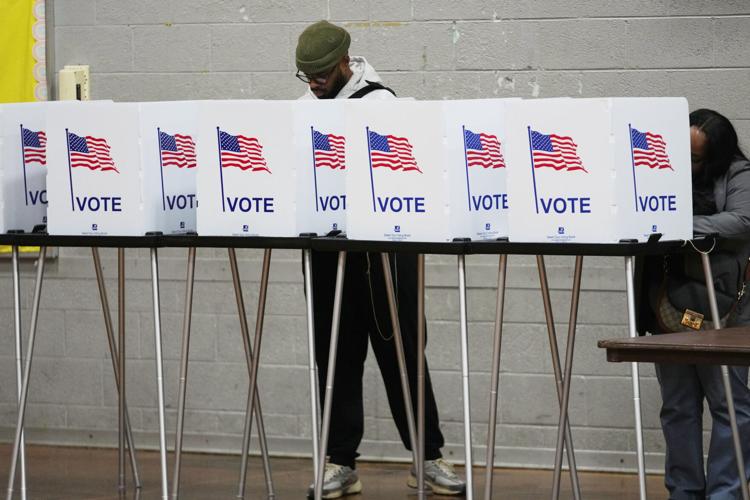
Voters fill out their ballots Nov. 4 in Detroit.
President Donald Trump, whose loss of the House halfway through his first term led to two impeachments, is trying to keep history from repeating — and doing so in ways his opponents say are intended to manipulate next year's election landscape.
He has rallied his party to remake congressional maps across the country to create more conservative-leaning House seats, an effort that could end up backfiring on him. He’s directed his administration to target Democratic politicians, activists and donors. And, Democrats worry, he’s flexing his muscles to intervene in the midterms like no administration ever has.
Democrats and other critics point to how Trump has sent the military into Democratic cities over the objections of Democratic mayors and governors. They note that he’s pushed the Department of Homeland Security to be so aggressive that at one point its agents handcuffed a Democratic U.S. senator. And some warn that a Republican-controlled Congress could fail to seat winning candidates if Democrats reclaim the House majority, recalling Trump's efforts to stay in power even after voters rejected him in 2020, leading to the violent attack by his supporters on the U.S. Capitol.
Regarding potential military deployments, Ken Martin, chairman of the Democratic National Committee, told The Associated Press: "What he is going to do is send those troops there, and keep them there all the way through the next election, because guess what? If people are afraid of leaving their house, they’re probably not going to leave their house to go vote on Election Day. That’s how he stays in power.”

Trump told the WSJ he’s unsure whether his economic policies will help Republicans in the 2026 midterms, citing delayed impacts and blaming De…
Democrats sounded similar alarms just before November's elections, and yet there were no significant incidents. California Gov. Gavin Newsom, a frequent Trump antagonist who also warns about a federal crackdown on voting in 2026, predicted that masked immigration agents would show up at the polls in his state, where voters were considering a ballot measure to counter Trump’s redistricting push.
There were no such incidents in November, and the measure to redraw California's congressional lines in response to Trump's efforts elsewhere won in a landslide.
White House spokeswoman Abigail Jackson said the concerns about the midterms come from Democratic politicians who are “fearmongering to score political points with the radical left flank of the Democrat party that they are courting ahead of their doomed-to-fail presidential campaigns.”
She described their concerns as “baseless conspiracy theories.”
Susie Wiles, Trump's chief of staff, denied that Trump was planning to use the military to try to suppress votes.
“I say it is categorically false, will not happen. It’s just wrongheaded,” she told Vanity Fair for an interview that was published earlier in December.
DNC litigation director Dan Freeman said he hasn’t seen an indication that Trump will send immigration enforcement agents to polling places during the midterms, but is wary.
He said the DNC filed public records requests in an attempt to learn more about any such plans and is drafting legal pleadings it could file if Trump sends armed federal agents to the polls or otherwise intervenes in the elections.
“We’re not taking their word for it,” Freeman said in an interview.
November's off-year elections may not be the best indicator of what could lie ahead. They were scattered in a handful of states, and Trump showed only modest interest until late in the fall when his Department of Justice announced it was sending federal monitors to California and New Jersey to observe voting in a handful of counties. It was a bureaucratic step that had no impact on voting, even as it triggered alarm from Democrats.
Alexandra Chandler, the legal director of Protect Democracy, a group that has clashed with Trump over his role in elections, said she was heartened by the lack of drama during the 2025 voting.

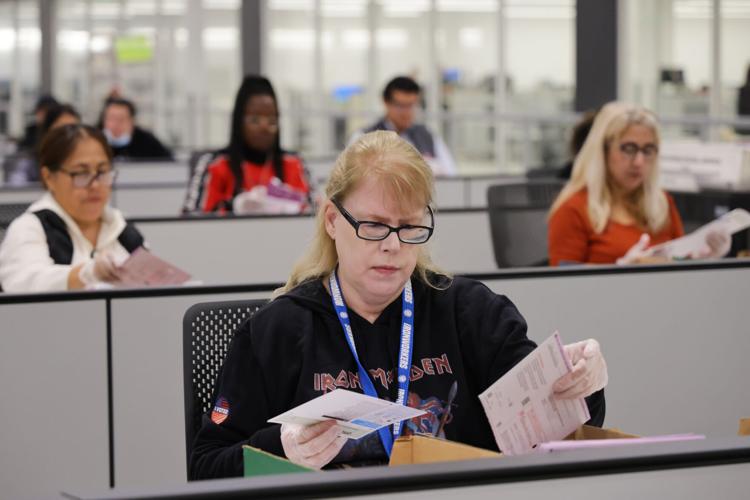
A worker examines ballots at the L.A. County Ballot Processing Center on Nov. 4 in City of Industry, Calif.
“We have so many positive signs we can look to,” Chandler said, citing not only a quiet election but GOP senators’ resistance to Trump’s demands to eliminate the filibuster and the widespread resistance to Trump’s demand that television host Jimmy Kimmel lose his job because of his criticism of the president. “There are limits” on Trump’s power, she noted.
“We will have elections in 2026,” Chandler said. “People don’t have to worry about that.”
Under the Constitution, a president has limited tools to intervene in elections, which are run by the states. Congress can help set rules for federal elections, but states administer their own election operations and oversee the counting of ballots.
When Trump tried to singlehandedly revise election rules with a sweeping executive order shortly after returning to office, the courts stepped in and stopped him, citing the lack of a constitutional role for the president. Trump later promised another order, possibly targeting mail ballots and voting machines, but it has yet to materialize.
Still, there’s plenty of ways a president can cause problems, said Rick Hasen, a UCLA law professor.
Trump unsuccessfully pushed Georgia’s top election official to “find” him enough votes to be declared the winner there in 2020 and could try similar tactics in Republican-dominated states in November. Likewise, Hasen said, Trump could spread misinformation to undermine confidence in vote tallies, as he has done routinely ahead of elections.
It’s harder to do that in more lopsided contests, as many in 2025 turned into, Hasen noted.
“Concerns about Trump interfering in 2026 are real; they’re not frivolous,” Hasen said. “They’re also not likely, but these are things people need to be on guard for.”
Helping to run an election in Pennsylvania often starts with running for election
Helping to run an election in Pennsylvania often starts with running for election
Updated
You know those workers at the polling place who help you cast your ballot each election? There are elections for them, too.
This year, voters across Pennsylvania will have a chance to choose the people who will staff their polling locations for the next four years, Votebeat explains.
In most states, these workers are appointed, but in Pennsylvania, the people who oversee voting at the precinct level are elected officials with four-year terms.
Historians say it has been this way since 1799, and according to data from the U.S. Election Assistance Commission, Pennsylvania is the only state that does it quite like this.
Some small New England states have elected town officials who oversee polling places as part of their job. But Pennsylvania takes this exercise in democracy to another level, with elections for three out of the five people who staff each polling place: the judge of elections, as well as the majority and minority inspectors. With more than 9,000 precincts across the state, this means upwards of 27,000 positions are up for election this year.
Judges of elections are the supervisors at the precinct. Their primary responsibilities are to ensure things run smoothly on Election Day and that the ballots and results make it back to the county office safely at the end of the night, according to a guide put together by the Philadelphia-based nonprofit Committee of Seventy. The majority and minority inspectors are tasked with checking voter registration documents, signing in voters, and ensuring the election is conducted legally and fairly.
Pennsylvania's way of choosing poll workers through elections is meant to prevent any one political party from having complete control over voting in a precinct, and allows the opportunity to switch them out every four years, said Jeff Greenburg, a former election director in Mercer County who now works as a senior adviser on election administration for the Committee of Seventy. The process is structured to make sure at least one member of each major political party is represented.
The downside is that there often aren't enough candidates running, which means counties have to appoint people to fill vacancies, which can be difficult.
"Without poll workers, we cannot have elections," Greenburg said. "They are the foundation of our election system."
The state doesn't track how many spots on the ballot go empty across the state, but election officials say that it's fairly common for no one to run for the four-year term staffing polling places.
Officials in Montgomery, Bucks, and Chester counties told Votebeat and Spotlight PA that election officials typically need to appoint people to 30% to 50% of their poll worker positions.
Sean Drasher, the election director for Lebanon County, said that as of March 5, he had received nomination petitions for fewer than 10% of his open poll worker positions, though he expected that number to increase before the March 11 filing deadline.
The job can be taxing. Poll workers work a minimum of 13 hours on Election Day, and the judge of election tends to work even longer. The pay varies by county but is typically low. Most who serve think of it as community service.
Jay Schneider, a Chester County resident who served as an appointed judge in his precinct for the 2024 election, said just getting on the ballot can be a chore.
He tried to get on this year's ballot to be a poll worker, but gave up. His first nomination petition was rejected this winter because the voters who signed it signed before the petition period was open, and his second was rejected because the second page of the petition, which he printed on the back of the first, was upside down.
"And I thought, 'I am not asking people a third time to sign this," he said.
Schneider said making the role appointed, rather than elected, and shortening the term would make the positions attractive.
"No one is making any money on this. It's just a service and you're running people through the wringer to get them to sign up," he said. "It's a very long day and there's a fair amount of responsibility and there is no upside. If you're a younger person and you're excited about it, yes, but otherwise I would change the rules instead of making it such an involved process and make it a shorter term."
How to run for poll worker
People interested in serving as a poll worker should first contact their county elections office.
Candidates for both judge and inspector were required to submit nomination petitions by March 11 to appear on the ballot for the May 20 primary election. Judges must obtain signatures from 10 qualified voters, and candidates for inspector must get five voters to sign. Each party can nominate one person for each position to appear on the November ballot. Voters choose the poll workers who will serve their own precinct.
During the Nov. 4 municipal election, the judge candidate who receives the most votes is the winner. Among candidates for inspector, the one who receives the most votes becomes the majority inspector, and the one who comes in second becomes minority inspector. This is intended to ensure a bipartisan team at the precinct.
If you didn't submit your nomination petition by March 11, it is still possible to be elected as a poll worker. Many poll workers run successful write-in campaigns in the primary and municipal elections, sometimes with just a handful of write-in votes.
Counties may be looking for appointees for positions that went unfilled in the election. Voters should ask their county elections office about the appointment process.
The guide from the Committee of Seventy has more information on running for and serving as a poll worker.

This story was produced by Votebeat and reviewed and distributed by Stacker.

