

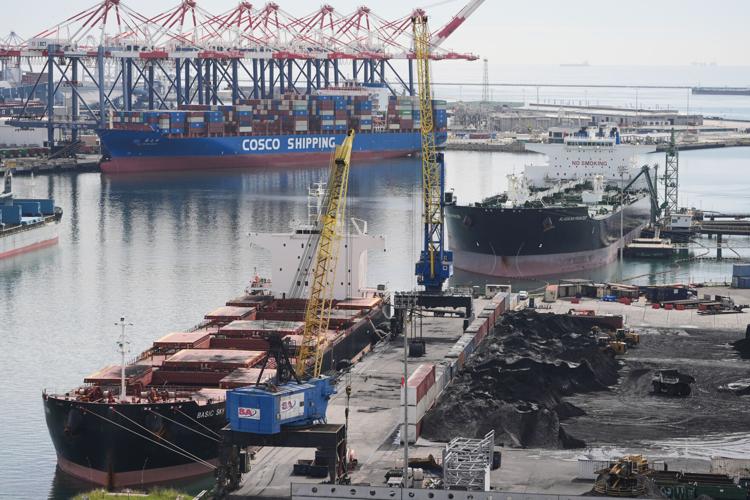
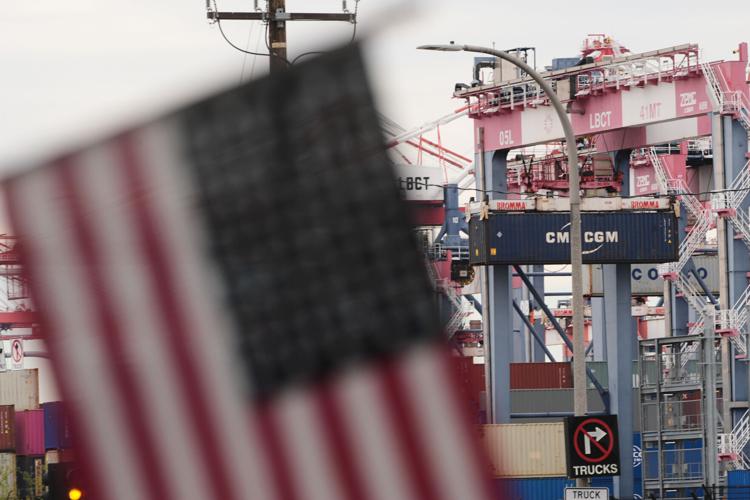
WASHINGTON — The Supreme Court struck down President Donald Trump's biggest and boldest tariffs. But the justices left a $133 billion question unanswered: What's going to happen to the money the government already collected in import taxes now declared unlawful?
Trade lawyers say importers are likely to get money back — eventually. "It's going to be a bumpy ride for awhile," said trade lawyer Joyce Adetutu, a partner at the Vinson & Elkins law firm.
The refund process is likely to be hashed out by a mix of the U.S. Customs and Border Protection agency, the specialized Court of International Trade in New York and other lower courts, according to a note to clients by lawyers at the legal firm Clark Hill.
"The amount of money is substantial," Adetutu said. "The courts are going to have a hard time. Importers are going to have a hard time.''
Still, she added, "it's going to be really difficult not to have some sort of refund option," given how decisively the Supreme Court repudiated Trump's tariffs.
In its 6-3 opinion, the court ruled Trump's attempt to use an emergency powers law to enact the levies was not valid.
At issue are double-digit tariffs Trump imposed on almost every country in the world last year by invoking the 1977 International Emergency Economic Powers Act. The Supreme Court ruled that the law does not give the president authority to tax imports, a power that belongs to Congress.
The U.S. customs agency already collected $133 billion in IEEPA tariffs as of mid-December. However, consumers are unlikely to be refunded for the higher prices they paid when companies passed along the cost of the tariffs; that's more likely to go to the companies themselves.
In a dissenting opinion, Justice Brett Kavanaugh dinged his colleagues for dodging the refund issue: "The Court says nothing today about whether, and if so how, the Government should go about returning the billions of dollars that it has collected from importers.''
Borrowing a word that Justice Amy Coney Barrett — who sided with the majority — used during a November hearing on the case, Kavanaugh warned that "the refund process is likely to be a 'mess.'"
"We'll end up being in court for the next five years," Trump told reporters at a news conference Friday, in which he decried the court's decision.
The end of the IEEPA tariffs could help the economy by easing inflationary pressures. The tariff refunds — like other tax refunds — could stimulate spending and growth.
However, the effects likely will be modest. Most countries still face steep tariffs from the U.S. on specific sectors, and Trump intends to replace the IEEPA levies using other options.
Refunds will take time to roll out — 12 to 18 months, TD Securities estimates.
The U.S. customs agency has a process for refunding duties when importers can show there's been some kind of error. The agency might try to build on the existing system to refund Trump's IEEPA tariffs, said trade lawyer Dave Townsend, a partner with the law firm Dorsey & Whitney.
There is a precedent for courts making arrangements to give companies their money back in trade cases. In the 1990s, the courts struck down as unconstitutional a harbor maintenance fee on exports and set up a system for exporters to apply for refunds.
However, the courts and U.S. customs never had to deal with anything like this — thousands of importers and tens of billions of dollars at once.
"Just because the process is difficult to administer doesn't mean the government has the right to hold on to fees that were collected unlawfully," said trade lawyer Alexis Early, partner at the law firm Bryan Cave Leighton Paisner.
Ryan Majerus, a partner at King & Spalding and a former U.S. trade official, said it's hard to know how the government will deal with the massive demand for refunds. It might try to streamline the process, perhaps setting up a special website where importers can claim their refunds.
Adetutu warned that "the government is well-positioned to make this as difficult as possible for importers. I can see a world where they push as much responsibility as possible onto the importer" — maybe forcing them to go to court to seek the refunds.
Many companies filed lawsuits claiming refunds before the Supreme Court ruled, essentially seeking to be at the head of line if the tariffs were struck down. More legal battles are likely ahead. For example, manufacturers might sue for a share of refunds given to suppliers that jacked up the price of raw materials to cover the tariffs.
The higher prices consumers had to pay would likely be hard to attribute to a specific tariff. Should they pursue refunds anyway? Early wouldn't advise wasting money on legal fees, but said, "In America, we have the ability to file a lawsuit for anything we want.''
Illinois Gov. JB Pritzker, a Democrat and Trump antagonist, demanded a refund on behalf of his state's 5.11 million households, saying the tariffs cost each Illinois household $1,700 — or $8.7 billion. He said failure to pay will elicit "further action.''
Nevada Treasurer Zach Conine submitted a payment request to the federal government for $2.1 billion to recoup the costs of the tariffs, his office announced Friday.

