

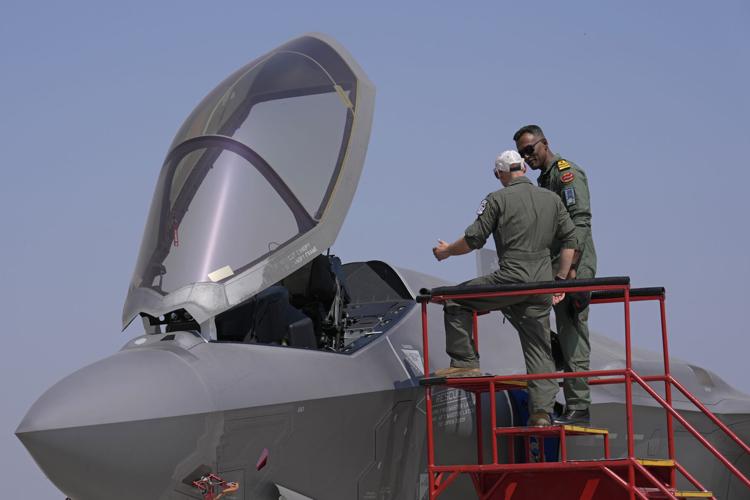
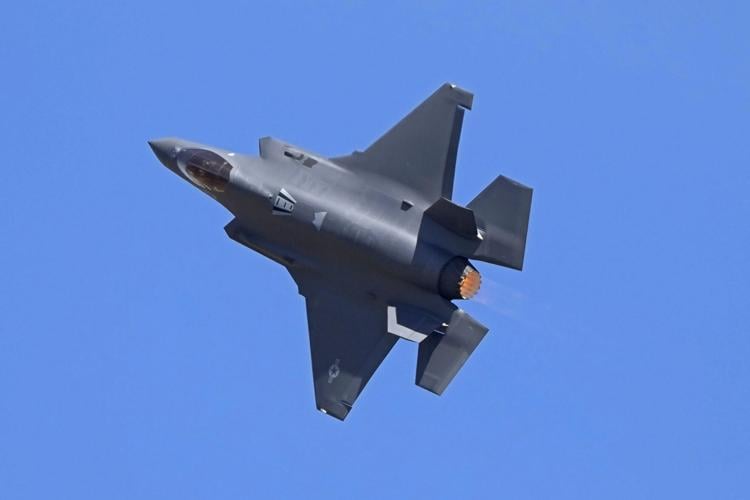
Questions are mounting in Canada and in Europe over whether big-ticket purchases of U.S. weaponry, such as the F-35 Joint Strike Fighter, are still a wise strategic choice for Western countries worried about their investment in U.S. defense technology.
In less than two months, U.S. President Donald Trump upended decades of foreign policy. He left NATO members questioning whether Washington will honor the alliance's defense commitment if Russia attacks other European countries. He also made overtures to Moscow and suspended most U.S. foreign aid.
That could impact foreign sales of the Lockheed Martin-produced F-35 and other advanced U.S. jets. As Russia's war in Ukraine grinds on, Eastern European NATO members still have vast stores of Soviet-era weapons in their stockpiles that weren't interoperable with Western weaponry.
A long-term plan to get all of NATO on similar platforms — by replacing old Soviet-era jets with Western ones, particularly the F-16 and in some cases, the F-35 — gained momentum.
Some of the NATO countries are now rethinking tying their defense to U.S.-made systems and potentially considering European jets.
The European Union recently announced a new drive to break its security dependency on the United States, with a focus on buying more defense equipment in Europe. In recent years, the EU's 27 nations placed about two-thirds of their orders with U.S. defense companies.
Angering a partner
In Canada, where Trump launched a trade war and threatened economic coercion to make it the 51st American state, new Prime Minister Mark Carney asked Defense Minister Bill Blair to review its purchase of F-35s. Canada was a partner with the U.S. in developing the fighter.
Blair will see if there are other options "given the changing environment," a defense spokesman said.
Carney since announced an early warning radar system purchase from Australia worth $4.2 billion. Officials say it will have a smaller footprint than a similar U.S. system.
In Portugal, the outgoing defense minister told a Portuguese newspaper that "recent positions" taken by Washington compelled a rethink about the purchase of F-35s. Portugal is considering various options to replace its F-16s.
"You're not just buying an airplane, you're buying a relationship with the United States," said Winslow T. Wheeler, who spent three decades in Congress working for Democrats and Republicans on national security and defense issues. "People in the past have not just welcomed, but craved that kind of relationship."
The Netherlands and Norway, on the other hand, recently voiced support for the F-35 program.
F-35 'kill switch'?
The F-35 Joint Strike Fighter was designed to combine stealth, maneuverability and attack capabilities in a single aircraft. Each jet costs about $85 million, and the price jumps to as high as $150 million when supporting infrastructure and spare parts are included.
About 1,100 were produced to date for 16 military services across the globe.
The F-35B, which can take off from ship decks vertically, is the latest model. It's the most expensive weapons system the U.S. ever produced, with estimated lifetime costs now expected to top $1.7 trillion. One way the program was counting on reducing those costs was by selling more aircraft to international customers.
The Trump administration's recent stance on the Russia-Ukraine war fueled fears that Washington may have ways to coerce buyers in a future fight — such as by embedding a hypothetical "kill switch" in the F-35's programming.
The Pentagon's F-35 Lightning II Joint Program Office vehemently rejected that notion. "There is no kill switch," it said.
The F-35 requires constant U.S.-controlled tech upgrades to operate in combat. If a relationship with the U.S. soured and updates were delayed, it could make a jet — or even a fleet — inoperable, Wheeler said.
Lockheed Martin said it delivers "all system infrastructure and data required for all F-35 customers to sustain the aircraft."
European jets
The Swedish-made Saab Gripen is used by the militaries of Sweden, the Czech Republic, Hungary, South Africa, Brazil and Thailand. Conventional defense industry wisdom says it's significantly cheaper than the F-35, Wheeler said.
The Eurofighter Typhoon, part of the British, German, Spanish and Italian forces, is manufactured by a consortium of defense companies: Airbus, BAE Systems and Leonardo.
The French-built Dassault Rafale twin-jet fighter is used by some branches of France's armed forces. The governments of Egypt, India, Qatar, Greece, Croatia, the United Arab Emirates, Serbia and Indonesia signed contracts for Rafales.
All three could see an increase in sales if other countries decide to forgo their F-35 purchases, but none has the F-35's stealth capabilities.

