

JERUSALEM — New footage shows what an expert investigative group says is likely an American Tomahawk missile hitting a compound in southern Iran, yards from the school where an unclaimed blast killed more than 165 people at the start of the war raging in the Mideast.

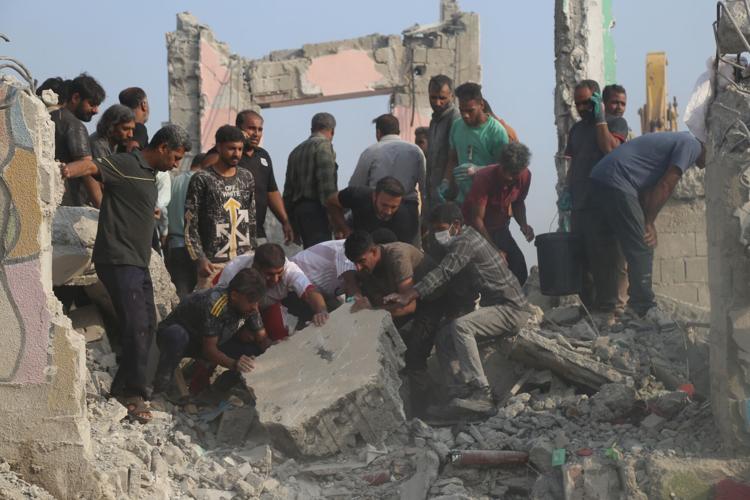
Rescue workers and residents search through the rubble in the aftermath of what Iranian officials said was an Israeli-U.S. strike on a girls' elementary school Feb. 28 in Minab, Iran.
It comes as mounting evidence points to U.S. culpability for the Feb. 28 strike, which hit a school next to a Revolutionary Guard base in Minab, Iran, in the country’s southern Hormozgan Province. Experts interviewed by The Associated Press, citing satellite image analysis, say the school was probably struck amid a quick succession of bombs dropped on the compound.
A U.S. official familiar with internal deliberations on the matter told the AP that the strike was likely American. The official spoke anonymously because they were not authorized to comment publicly on the matter.
The new footage, first analyzed by the investigative group Bellingcat, was taken the day the school was struck but circulated Sunday by Iran’s semiofficial Mehr news agency. It shows a missile hitting a building, sending a dark plume of smoke into the air.
The AP was able to geolocate the video and determine it was taken from a site next to the school, while smoke was already rising from the school vicinity. Satellite imagery of the compound is consistent with visual identifiers found in the video, including a flat-roofed building, power lines and vehicles.
Trevor Ball, a Bellingcat researcher, identified the munition as a Tomahawk cruise missile — which only the U.S. is known to possess in this war. It’s the first evidence of a munition used in the strike.

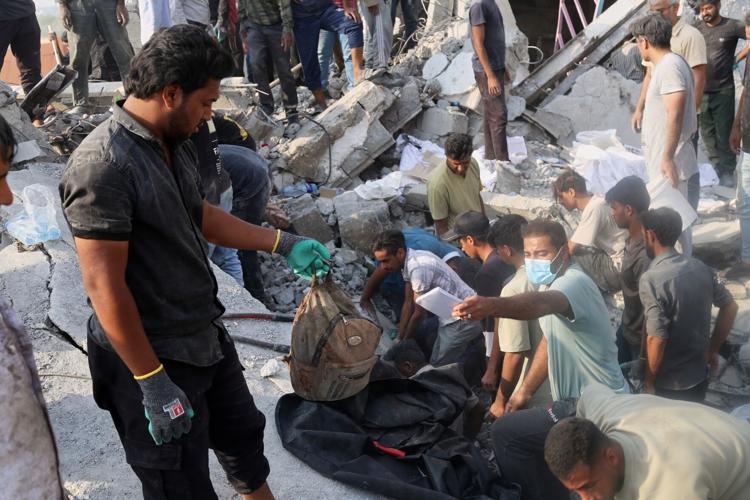
A man hold a child's backpack as rescue workers and residents search through the rubble in the aftermath of what Iranian officials said was an Israeli-U.S. strike on a girls' elementary school Feb. 28 in Minab, Iran.
U.S. Central Command acknowledged using Tomahawk missiles in this war and even released a photo of the USS Spruance, part of the USS Abraham Lincoln aircraft carrier group located within range of the school, firing a Tomahawk missile on Feb. 28.
Bellingcat said the footage “appears to contradict” U.S. President Donald Trump’s claim that Iran was responsible for the deadly school blast. Neither the U.S. military’s Central Command nor the Israeli military immediately replied to requests for comment Monday from the AP.
When asked by a reporter Saturday whether the U.S. was responsible for the blast, which killed mostly children, Trump responded, without providing evidence: “No, in my opinion, based on what I’ve seen, that was done by Iran.” Trump added that Iran is “very inaccurate” with its munitions. Defense Secretary Pete Hegseth quickly chimed in to say the U.S. was investigating.
Several other factors point to a U.S. strike.
One is the launching of an assessment of the incident by the U.S. military. According to the Pentagon’s instructions on processes for mitigating civilian harm, an assessment is launched after a group of investigators make an initial determination that the U.S. military may bear culpability.
Another is the location of the school — next to the Revolutionary Guard base and close to barracks for a naval unit. The U.S. military has focused on naval targets and acknowledged strikes in the province, including one in the vicinity of the school. Israel, which denied conducting the strike, has focused on areas of Iran closer to Israel and hasn’t reported any strikes south of Isfahan, 500 miles away.

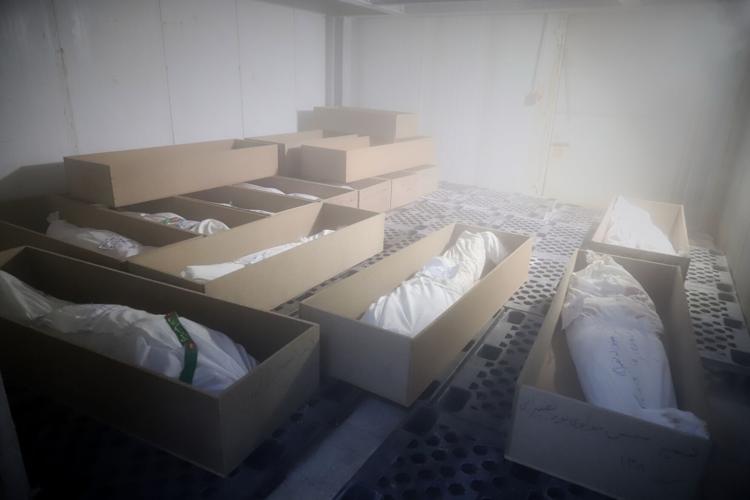
Coffins holding the bodies of mostly children sit in a room March 3 as they are prepared for the funeral of those killed in what Iranian officials said was an Israeli-U.S. strike Feb. 28 at a girls' elementary school in Minab, Iran.
Complicating an assessment of the incident is the lack of images of bomb fragments from the blast. No independent agency has reached the site during the war to investigate.
Janina Dill, an expert on international law at Oxford University, wrote on X that even if the strike were a misidentification — and the attacker believed that the school was a part of the neighboring IRGC base — it would still be “a very serious violation of international law.”
“Attackers are under an obligation to do everything feasible to verify the status of targeted object,” she wrote.
The Trump administration, however, strikes a different tone on international humanitarian law.
Speaking about the U.S. operation at a news conference March 2, Hegseth said: “America, regardless of what so-called international institutions say, is unleashing the most lethal and precise air power campaign in history.”
“No stupid rules of engagement,” he said. “No politically correct wars. We fight to win, and we don’t waste time or lives.”
Photos show global reaction to US and Israeli strikes

Demonstrators gather Saturday in Los Angeles in reaction to the U.S. and Israeli strikes on Iran.

A demonstrator holds a portrait of Iran's Supreme Leader Ayatollah Ali Khamenei on Saturday at a bridge leading to the fortified Green Zone, where the U.S. Embassy is located in Baghdad, Iraq, during a protest against U.S. and Israeli attacks on Iran.

A demonstrator marching in support of regime change in Iran reacts Saturday in Richmond Hill, Ontario, Canada, to unconfirmed reports that the Supreme Leader Ayatollah Ali Khamenei was killed in U.S. and Israeli strikes on Iran.

Shiite Muslims hold placards and chant slogans Saturday in Lahore, Pakistan, during a protest against the U.S. and Israel, and to show solidarity with Iran.

People attend a demonstration Saturday in front of the U.S. Embassy in Berlin, Germany, in support of the U.S. and Israeli strikes on Iran.

Iranian people attend a demonstration Saturday in Berlin, Germany, in support of the U.S. and Israeli strikes on Iran.

A woman holds up a placard with images of President Donald Trump and some of his Cabinet members Saturday in New York during a protest against U.S. and Israeli strikes on Iran.

People chant slogans Saturday outside a NATO base in Izmir, Turkey, as they protest against U.S. and Israeli strikes on Iran.

People march Saturday in New York during a protest against U.S. and Israeli strikes on Iran.

A protester holds a portrait of Iran's Supreme Leader Ayatollah Ali Khamenei on Saturday at a bridge leading to the fortified Green Zone where the U.S. Embassy is located in Baghdad, Iraq, during a protest against U.S. and Israeli attacks on Iran.

People attend a demonstration in support of the U.S. and Israeli strikes on Iran on Saturday in front of the U.S. Embassy in Berlin, Germany.

People demonstrate Saturday in New York during a protest against U.S. and Israeli strikes on Iran.

Protesters march in support of regime change in Iran during a demonstration Saturday in Richmond Hill, Ontario, Canada.

Iranian people attend a demonstration Saturday in Berlin, Germany, in support of the U.S. and Israeli strikes on Iran.

A protester holds a crown Saturday in London after U.S. and Israeli forces carried out strikes on Iran.

A protester wears a mask Saturday during a rally in London after U.S. and Israeli forces carried out strikes on Iran.

Iranian people attend a demonstration Saturday in front of the Iranian Embassy in Yerevan, Armenia, in support of the U.S. and Israeli strikes on Iran.

Protesters gather Saturday in London after U.S. and Israeli forces carried out strikes on Iran.

People protest Saturday in New York against U.S. and Israeli strikes on Iran.

Iranian people attend a demonstration Saturday in front of the Iranian Embassy in Yerevan, Armenia, in support of U.S. and Israeli strikes on Iran.

National Guard members watch Saturday as people demonstrate near the White House in Washington during a protest against U.S. and Israeli strikes on Iran.

Demonstrators hug Saturday in Los Angeles as they march in reaction to the U.S. and Israeli strikes on Iran.

A demonstrator waves Iranian flags Saturday in Los Angeles in reaction to the U.S. and Israeli strikes on Iran.

Two people embrace Saturday in Los Angeles during a demonstration in reaction to the U.S. and Israeli strikes on Iran.

People who support the U.S. and Israel strikes on Iran rally Saturday near the White House in Washington.

People attend a protest Saturday in New York against U.S. and Israeli strikes on Iran.

