

WASHINGTON — President Donald Trump expressed uncertainty Thursday that NATO would come to the United States' defense if the country were attacked — though the alliance did just that after Sept. 11, the only time in its history that the defense guarantee was invoked.
Trump also suggested the U.S. might abandon its commitments to the alliance if member countries don't meet defense spending targets, a day after his pick for NATO ambassador assured senators that the administration's commitment to the military alliance was "ironclad."

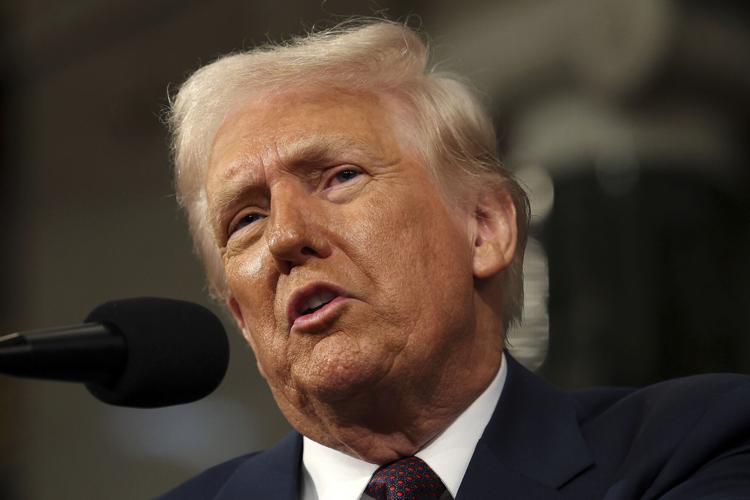
President Donald Trump addresses a joint session of Congress on Tuesday at the Capitol in Washington.
Trump's comments denigrating NATO, which was formed to counter Soviet aggression during the Cold War, are largely in line with his yearslong criticism of the alliance, which he accused of not paying its fair share toward the cost of defense.
They come at a time of heightened concern in the Western world over Trump's cozy relationship with Russian President Vladimir Putin, long seen NATO as a threat, and as the U.S. president seeks to pressure Ukraine into agreeing to a peace deal with the country that invaded it three years ago.
U.S. Defense Secretary Pete Hegseth sent the alliance into upheaval last month when he said in a speech that the U.S. would not participate in any peacekeeping force in Ukraine, which is not a NATO member, and would not defend any country that participated in it if attacked by Russia.

Trump said Thursday in the Oval Office that other countries would not come to the defense of the U.S. — though they did exactly that in the only instance that the Article 5 defense guarantee was invoked.
"You know the biggest problem I have with NATO? I really, I mean, I know the guys very well. They're friends of mine. But if the United States was in trouble, and we called them, we said, 'We got a problem, France. We got a problem, couple of others I won't mention.' Do you think they're going to come and protect us? They're supposed to. I'm not so sure."
Article 5 was invoked after the Sept. 11, 2001, attacks, leading to NATO's largest operation in Afghanistan. France's military participated in the operation.

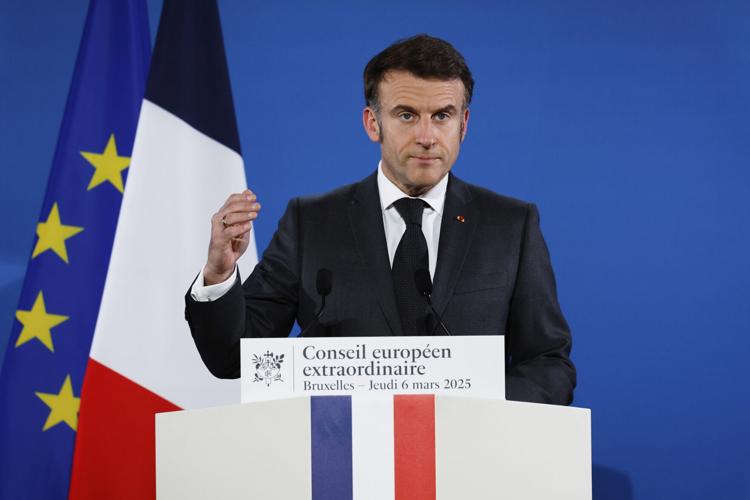
French President Emmanuel Macron speaks Thursday during a media conference at a European Union summit in Brussels.
"We are loyal and faithful allies," French President Emmanuel Macron responded Thursday, expressing "respect and friendship" toward U.S. leaders.
"I think we're entitled to expect the same," he said.
Macron invoked "centuries-old history," namechecking the Marquis de Lafayette, a 19-year-old French nobleman who was a major general in the American Continental Army during the Revolutionary War, and Gen. John Pershing, commander of the American army in France during World War I. Macron added that a few days ago, he met American World War II veterans who landed on Omaha Beach as part of the D-Day invasion of Nazi-occupied France.
France and the U.S. "have always been there for each other," Macron said.
Trump, when asked Thursday if it he was making it U.S. policy that the U.S. would not defend NATO countries that don't meet military spending targets, said: "Well, I think it's common sense, right? If they don't pay, I'm not going to defend them. No, I'm not going to defend them."
Trump suggested since his 2016 presidential campaign that the U.S. under his leadership might not comply with the alliance's mutual defense guarantees and would only defend countries that met targets to commit 2% of their gross domestic products on military spending.

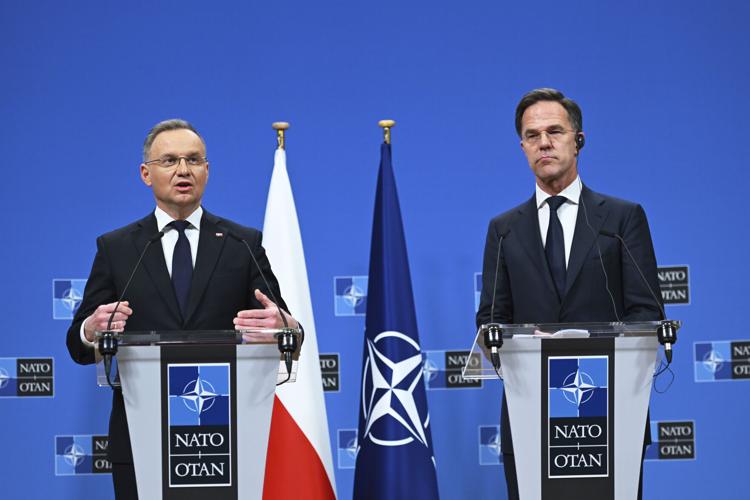
Poland's President Andrej Duda, left, and NATO Secretary-General Mark Rutte address a news media conference Thursday at NATO headquarters in Brussels.
The U.S. is the most powerful nation of the seven-decade alliance, has the largest economy among members and spends more on defense than any other member.
The U.S. was one of 12 nations that formed NATO following World War II to counter the threat posed by the Soviet Union to Western Europe during the Cold War. Its membership since grew to 32 countries, and its bedrock mutual defense guarantee, known as Article 5, states an attack on one member is considered an attack on all.
Trump also seemed to suggest Thursday that the U.S. commitment to NATO might be leveraged in his trade war as he seeks to target what he says are unfair trade policies with other nations, including the European Union.
"I view NATO as potentially good, but you've got to get, you've got to get some good thinking in NATO. It's very unfair, what's been happening," Trump said. "Until I came along, we were paying close to 100% of NATO. So think of it, we're paying 100% of their military, and they're screwing us on trade."
On Wednesday, Trump's choice for NATO ambassador, Matt Whitaker, said at his confirmation hearing that in regards to the U.S. commitment to the NATO alliance and specifically Article 5, "it will be ironclad."
Last year, then-NATO Secretary-General Jens Stoltenberg said a record 23 of NATO's 32 member nations hit the military alliance's defense spending target.
Trump took credit for countries meeting those targets because of his threats, and Stoltenberg himself said Trump was responsible for getting other nations to increase their spending.
Finland's NATO membership
ACCEPTANCE LETTERS
Updated
Turkey on Tuesday handed its acceptance letter for Finland's accession to U.S. Secretary of State Antony Blinken at NATO headquarters in Brussels. The United States is the depositary, or safekeeper, of NATO under the alliance’s 1949 founding treaty.
INVITATION
Updated
NATO sends a letter signed by Stoltenberg inviting Finland to join the military alliance.
SIGNATURES
Updated
Finland sends its own acceptance document, signed by Foreign Minister Pekka Haavisto, to the U.S. State Department. Finnish President Sauli Niinistö, pictured, authorized Haavisto to sign the document. Either the Finnish Embassy in Washington or a Finnish government official will deliver the document.
FULL MEMBERSHIP
Updated
Once Finland's membership acceptance document reaches the State Department in Washington, the country officially becomes a NATO member.
FINLAND-SWEDEN
Updated
Finland and neighboring Sweden jointly applied for NATO membership in May 2022. The countries, which have close cultural, economic and political ties, planned to enter the alliance simultaneously.
Sweden's bid, however, has stalled due to opposition from Turkey, whose president has said his country wouldn't ratify membership before disputes between Ankara and Stockholm were resolved. The Turkish government has accused Sweden of being too soft on groups that it deems to be terror organizations.
Hungary's parliament also has yet to ratify Sweden's accession to NATO, and it remains unclear when it will do so.

