


By summer, Congress delivered.
The Republican Party’s big bill of tax breaks and spending cuts that Trump signed into law July 4 included what’s arguably the biggest boost of funds yet to the Department of Homeland Security — nearly $170 billion, almost double its annual budget.
The staggering sum is powering the nation’s sweeping new Immigration and Customs Enforcement operations, delivering gripping scenes of people being pulled off city streets and from job sites across the nation — the cornerstone of Trump’s promise for the largest domestic deportation operation in American history. Homeland Security confirmed last weekend ICE is working to set up detention sites at certain military bases.
“We’re getting them out at record numbers,” Trump said at the White House bill signing ceremony. “We have an obligation to, and we’re doing it.”

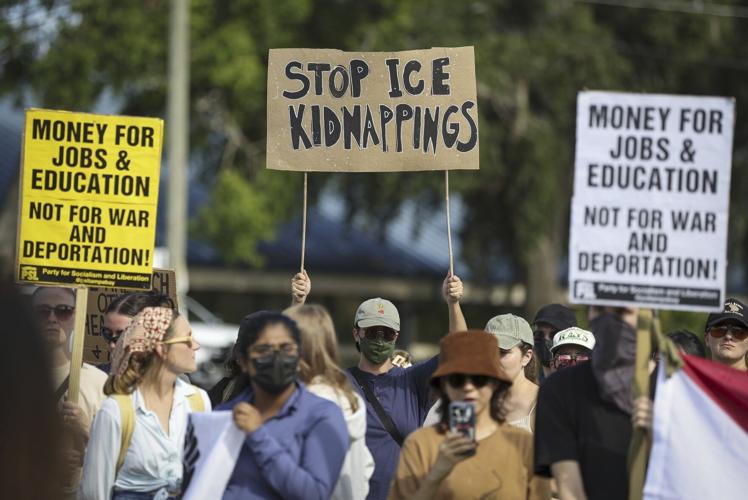
Demonstrators hold signs during an immigration rally near the Pinellas County Jail in Clearwater, Fla., on June 14.
The crush of new money is setting off alarms in Congress and beyond, raising questions from lawmakers in both major political parties who are expected to provide oversight. The bill text provided general funding categories — almost $30 billion for ICE officers, $45 billion for detention facilities, $10 billion for the office of Homeland Security Secretary Kristi Noem — but few policy details or directives. Homeland Security recently announced $50,000 ICE hiring bonuses.
And it’s not just the big bill’s fresh infusion of funds fueling the president’s agenda of 1 million deportations a year.
In the months since Trump took office, his administration has been shifting as much as $1 billion from the Federal Emergency Management Agency and other accounts to pay for immigration enforcement and deportation operations, lawmakers said.

“Your agency is out of control,” Sen. Chris Murphy, D-Conn., told Noem during a Senate committee hearing in the spring.
The senator warned that Homeland Security would “go broke” by July.
Noem quickly responded that she always lives within her budget.
But Murphy said later in a letter to Homeland Security, objecting to its repurposing funds, that ICE was being directed to spend at an “indefensible and unsustainable rate to build a mass deportation army,” often without approval from Congress.

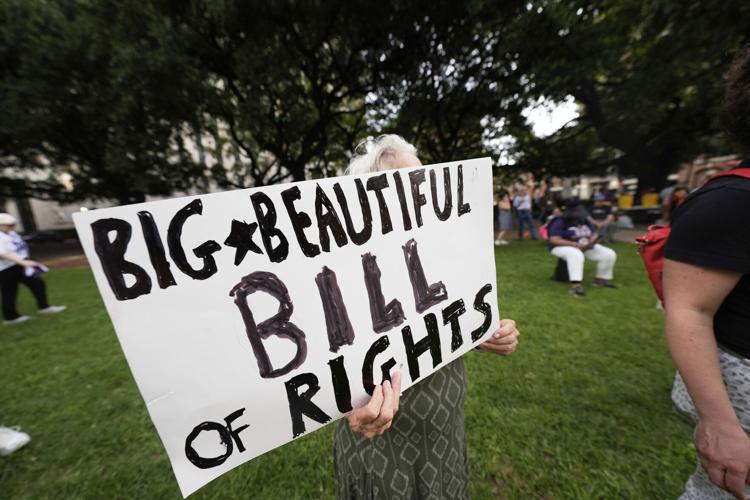
A protestor holds a sign during a demonstration organized by the Service Employees International Union protesting ICE detentions, in New Orleans, July 1.
This past week, the new Republican chairman of the House Homeland Security Committee, Rep. Andrew Garbarino of New York, along with a subcommittee chairman, Rep. Michael Guest of Mississippi, requested a briefing from Noem on the border security components of the One Big Beautiful Bill Act, or OBBBA, which included $46 billion over the next four years for Trump’s long-sought U.S.-Mexico border wall.
“We write today to understand how the Department plans to outlay this funding to deliver a strong and secure homeland for years to come,” the GOP lawmakers said in a letter to Noem, noting border apprehensions are at record lows.
“We respectfully request that you provide Committee staff with a briefing on the Department’s plan to disburse OBBBA funding,” they wrote, seeking a response by Aug. 22.
DHS Assistant Secretary Tricia McLaughlin said in a statement to The Associated Press the department is in daily discussions with the committee “to honor all briefing requests including the spend plan for the funds allocated” through the new law.
All together, it’s what observers on and off Capitol Hill see as a fundamental shift in immigration policy — enabling DHS to reach far beyond the U.S. southern border and deep into communities to conduct raids and open detention facilities as holding camps for immigrants.
The Defense Department, the Internal Revenue Service and other agencies are being enlisted in what Kathleen Bush-Joseph, an analyst at the Migration Policy Institute, calls a “whole of government” approach.
“They’re orienting this huge shift,” Bush-Joseph said, as deportation enforcement moves “inward.”
The flood of cash comes when Americans’ views on immigration are shifting. Polling showed 79% of U.S. adults say immigration is a “good thing” for the country, having jumped substantially from 64% a year ago, according to Gallup. Only about 2 in 10 U.S. adults say immigration is a bad thing right now.
At the same time, Trump’s approval rating on immigration has slipped. According to a July AP-NORC poll, 43% of U.S. adults said they approved of his handling of immigration, down slightly from 49% in March.
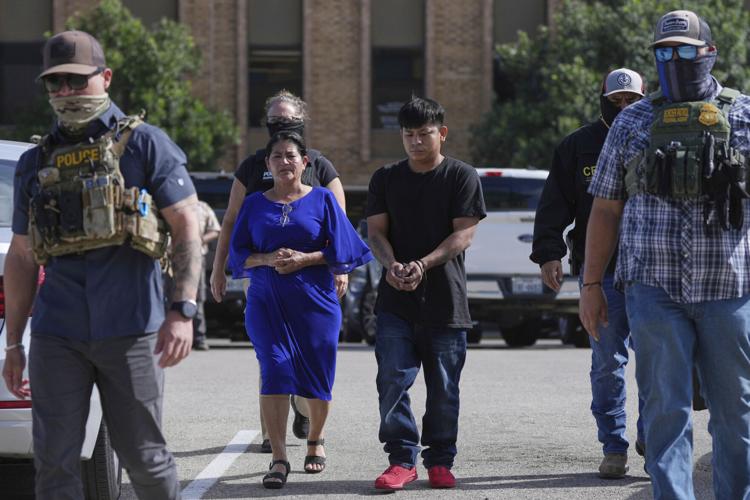
Americans are watching images of often masked officers arresting college students, parents and workers. Stories abound of people being whisked off to detention facilities, often without allegations of wrongdoing beyond being unauthorized to remain in the U.S.
Detention centers are being stood up, from “Alligator Alcatraz” in Florida to the repurposed federal prison at Leavenworth, Kansas, and the proposed new “Speedway Slammer” in Indiana. Flights are ferrying migrants not just home or to El Salvador’s notorious mega-prison but far away to Africa and beyond.
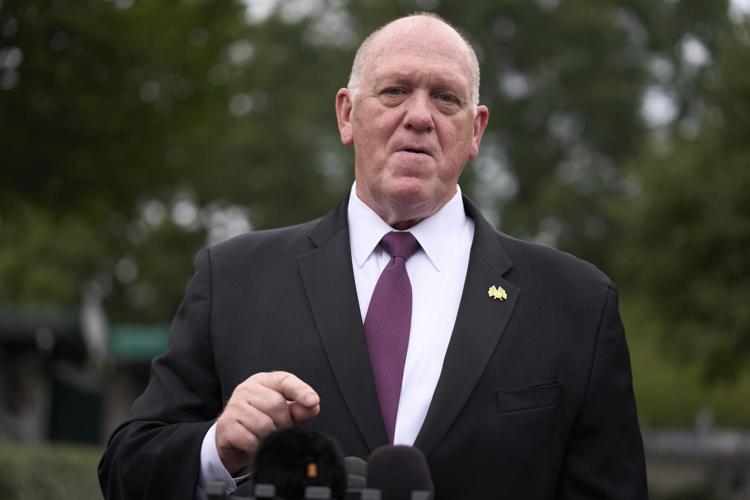
Homan has insisted in recent interviews those being detained and deported are the “worst of the worst,” and he dismissed as “garbage” the reports showing many of those being removed have not committed violations beyond their irregular immigration status.
“There’s no safe haven here,” Homan said recently outside the White House. “We’re going to do exactly what President Trump has promised the American people he’d do.”

