

WASHINGTON — President Donald Trump said Wednesday he will impose a 100% tariff on computer chips and semiconductors, likely raising the cost of electronics, autos, household appliances and other goods.
However, companies that make computer chips in the United States would be spared the import tax, the Republican president said in the Oval Office while meeting with Apple CEO Tim Cook.

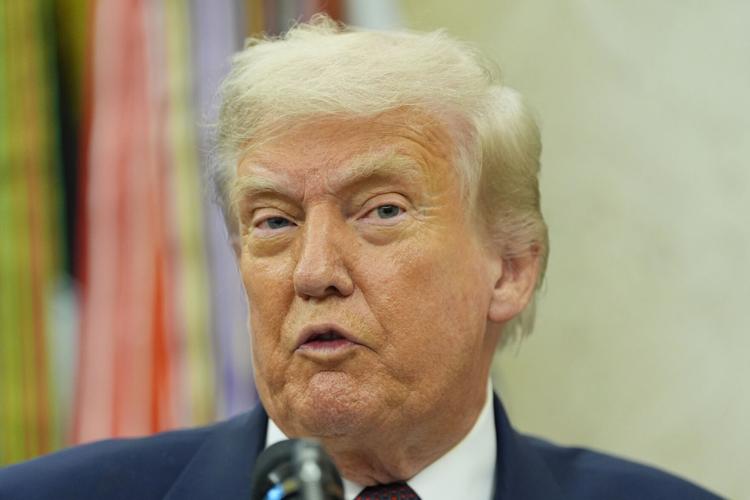
President Donald Trump makes an announcement Wednesday in the Oval Office in Washington.
During the COVID-19 pandemic, a shortage of computer chips increased the price of autos and contributed to an overall uptick in inflation. Demand for computer chips climbed worldwide, with sales increasing 19.6% in the year-ended in June, according to the World Semiconductor Trade Statistics organization.
Chip makers Nvidia and Intel did not immediately answer inquiries.
Trump's tariff threats mark a significant break from existing plans to revive computer chip production in the U.S. He is choosing an approach that favors the proverbial stick over carrots in order to incentivize more production. Essentially, the president bets that higher chip costs would force most companies to open factories domestically, despite the risk that tariffs could squeeze corporate profits and push up prices for mobile phones, TVs and refrigerators.
By contrast, the bipartisan CHIPS and Science Act signed into law in 2022 by then-President Joe Biden provided more than $50 billion to support new computer chip plants, fund research and train workers for the industry. The mix of funding support, tax credits and other financial incentives were meant to draw in private investment, a strategy Trump vocally opposed.
The announcement came after Trump signed an executive order to place an additional 25% tariff on India for its purchases of Russian oil, bringing the combined tariffs imposed by the U.S. on its ally to 50%. The tariffs would go in effect 21 days after the signing of the order, meaning both India and Russia might have time to negotiate with the U.S. on the import taxes.
Meanwhile, Brazil requested consultations at the World Trade Organization over tariffs Trump imposed against the South American nation that went in effect Wednesday. Trump directly tied the 50% tariff on many imported Brazilian goods to the judicial situation of his embattled ally, former President Jair Bolsonaro, who is under house arrest over an attempted coup plot.

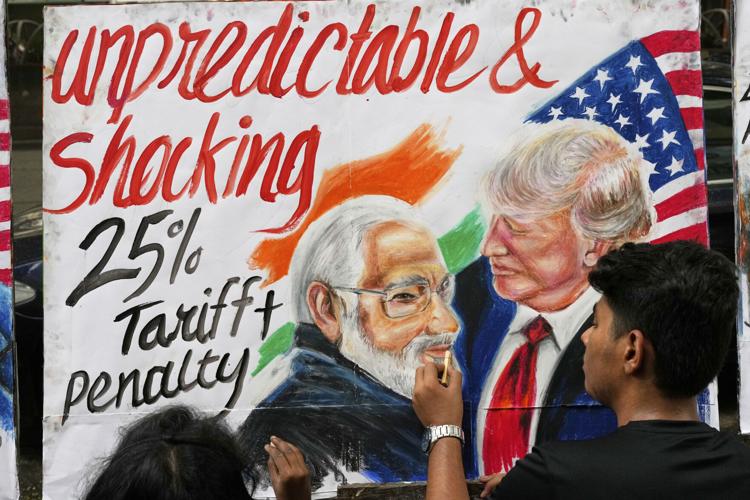
A student of Gurukul school of Art completes artwork Friday of U.S. President Donald Trump and Prime Minister of India Narendra Modi in Mumbai, India.
Trump hikes tariffs on India
Trump is pushing China and India to stop buying oil from Russia and helping fund the Kremlin’s war against Ukraine. China also buys oil from Russia, but it was not included in the order the Republican president signed.
As part of a negotiating period with Beijing, Trump placed 30% tariffs on goods from China, a smaller rate than the combined import taxes with which he threatened New Delhi.

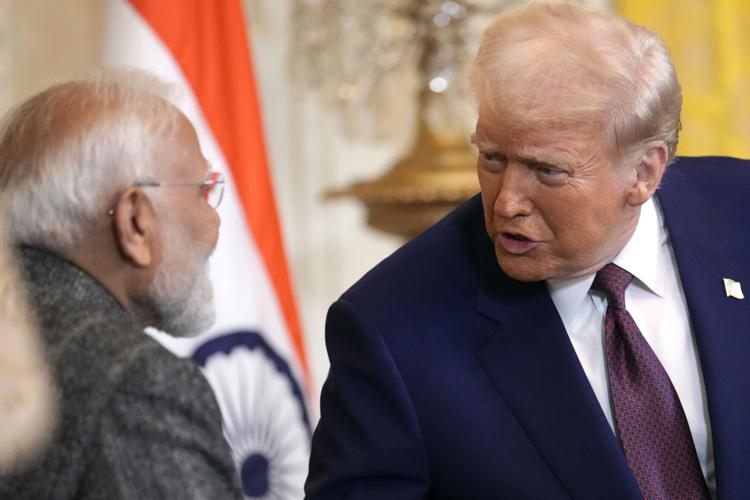
President Donald Trump, right, speaks with India's Prime Minister Narendra Modi during a Feb. 13 news conference in the East Room of the White House in Washington.
During an event Wednesday in the Oval Office, Trump affirmed the 50% tariff number, not giving a specific answers as to whether additional tariffs on India would be dropped if there were a deal between Russia and Ukraine.
“We’ll determine that later," he said. "But right now they’re paying a 50% tariff.”
The Indian government called the additional tariffs "unfortunate."
"We reiterate that these actions are unfair, unjustified and unreasonable," Foreign Ministry spokesman Randhir Jaiswal said in a statement Wednesday, adding that India would take all actions necessary to protect its interests.
Jaiswal said India already made its stand clear that the country's imports were based on market factors and were part of an overall objective of ensuring energy security for its 1.4 billion people.

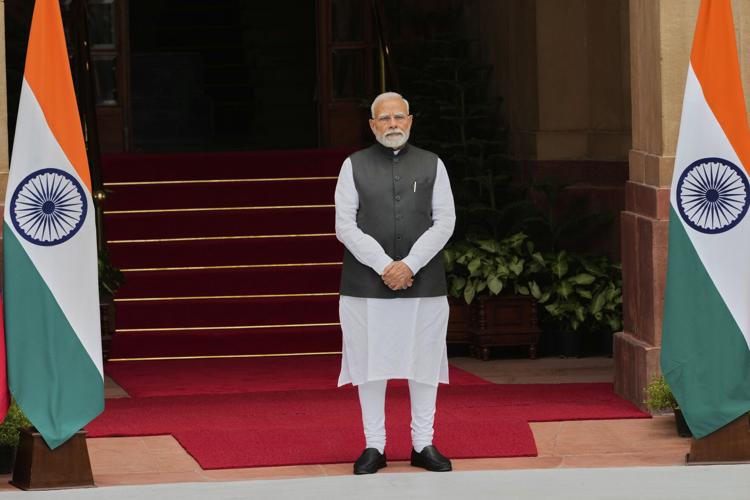
Indian Prime Minister Narendra Modi waits Tuesday to receive visiting Philippines President Ferdinand Marcos Jr. for a meeting in New Delhi, India.
Ajay Srivastava, a former Indian trade official, said the latest tariff places the country among the most heavily taxed U.S. trading partners and far above rivals such as China, Vietnam and Bangladesh.
"The tariffs are expected to make Indian goods far costlier," he said, with the potential to cut exports to the U.S. by about 40% to 50%.
Srivastava said Trump's decision was "hypocritical" because China bought more Russian oil than India did last year.
"Washington avoids targeting Beijing because of China's leverage over critical minerals which are vital for U.S. defense and technology," he said.
The U.S. and China are in negotiations on trade, with Washington imposing a 30% tariff on Chinese goods and facing a 10% retaliatory tax from Beijing on American products.
In 2024, the U.S. ran a $45.8 billion trade deficit in goods with India, meaning America imported more from India than it exported, according to the U.S. Census Bureau. American consumers and businesses buy pharmaceutical drugs, precious stones and textiles and apparel from India, among other goods.
Brazil accuses US of violating commitments
"The United States has flagrantly violated key commitments the country has agreed upon at the WTO, such as the principle of the most favored nation and tariff ceilings negotiated at that organization,” Brazil's foreign ministry said.
The most favored nation principle is a cornerstone of Geneva-based WTO, whose aim is to get countries to respect trade agreements. The principle directs its members to treat one another equally in trade. WTO panels are set if no agreement is reached in disputes between members.
“Brazil’s government reiterates its availability for negotiation and hopes these consultations contribute to a solution to the matter,” the Brazilian foreign office said.
Earlier, a Brazilian government official who spoke on condition of anonymity said Brazil understands the case could drag on and there's no guarantee of success.
Brazil's government estimates that 35.9% of the country's goods shipped to the American market are affected. That is about 4% of Brazil's total exports.
Photos: A look at global trade

FILE - Swiss chocolate bars from the brands Favarger, Villars, Cailler and Swiss-Dream are photographed in a souvenir shop window on Thursday, April 10, 2025, in Geneva. (Martial Trezzini/Keystone via AP)

FILE - Watches in the Omega shop window at the Bahnhofsstrasse in Zuerich, Switzerland, on Thursday, April 10, 2025. (Til Buergy/Keystone via AP)

FILE - A view of Gruy're AOP cheese wheels in the Gruy're AOP maturing cellars of Fromco, part of the Emmi Group, on Tuesday, May 6, 2025 in Moudon in the canton of Vaud. (Jean-Christophe Bott/Keystone via AP)

FILE - An employee at On tidies up sports shoes from the On sports brand in the On store on Wednesday, Jan. 22, 2025, at On's headquarters in Zurich. (Gaetan Bally/Keystone via AP)

A container is loaded on a truck at the Civitavecchia Harbour, Italy, Thursday, Aug. 7, 2025. (AP Photo/Gregorio Borgia)

A man works at a leather factory at Dharavi in Mumbai, India, Thursday, Aug. 7, 2025. (AP Photo/Rajanish Kakade)

Vehicles for export are parked at a port in Pyeongtaek, South Korea, Thursday, Aug. 7, 2025. (AP Photo/Ahn Young-joon)

An Indian customer, reflected on a mirror, tries a gold necklace at a jewelry shop in Lucknow, India, Thursday, Aug. 7, 2025. (AP Photo/Rajesh Kumar Singh)

An employee sorts medicines in a medicine wholesale shop in Guwahati, India, Thursday, Aug. 7, 2025. (AP Photo/Anupam Nath)

Trucks navigate along stacks of containers at the Manila North Harbour Port in Manila, Philippines on Thursday, Aug. 7, 2025. (AP Photo/Aaron Favila)

A truck navigates along stacks of containers at the Manila North Harbour Port in Manila, Philippines on Thursday, Aug. 7, 2025. (AP Photo/Aaron Favila)

An employee holds U.S. dollar notes at a money changer in Jakarta, Indonesia, Thursday, Aug. 7, 2025. (AP Photo/Tatan Syuflana)

A man watches stock prices displayed on an electronic board at the Indonesia Stock Exchange in Jakarta, Indonesia, Thursday, Aug. 7, 2025. (AP Photo/Tatan Syuflana)

A crane works on stacks of containers at the Bangkok Port in Bangkok, Thailand, Wednesday, Aug. 6, 2025. (AP Photo/Sakchai Lalit)

A crane unloads a shipping container from a truck at IPC Container Terminal at Tanjung Priok Port in Jakarta, Indonesia, Wednesday, Aug. 6, 2025. (AP Photo/Achmad Ibrahim)

A worker waits for customers at Roopam Sarees, which sells clothing imported from India, on Thursday, July 31, 2025, in Berkeley, Calif. (AP Photo/Noah Berger)

Sen. Minority Leader Chuck Schumer of N.Y., speaks during a news conference on tariffs on Capitol Hill, Thursday, July 31, 2025, in Washington. (AP Photo/Mariam Zuhaib)

Cargo containers line a shipping terminal at the Port of Oakland on Thursday, July 31, 2025, in Oakland, Calif. (AP Photo/Noah Berger)

A worker assembles steel decking in the construction of a housing project, Thursday, July 31, 2025, in Portland, Maine. (AP Photo/Robert F. Bukaty)

A welder works on steel decking during construction of a housing project, Thursday, July 31, 2025, in Portland, Maine. (AP Photo/Robert F. Bukaty)

New cars are parked in a lot at the International Car Operators terminal in the Port of Zeebrugge, Belgium, Thursday, July 31, 2025. (AP Photo/Virginia Mayo)

The Atlantic Navigator II departs from the Port of Baltimore, Thursday, July 31, 2025, in Baltimore. (AP Photo/Stephanie Scarbrough)

A South Korean protester holds up a banner during a rally against U.S. President Donald Trump's tariffs policy on South Korea, near the U.S. Embassy in Seoul, South Korea, Wednesday, July 30, 2025. The signs at bottom read "We can't give you a penny." (AP Photo/Ahn Young-joon)

Workers prep bulk bags of sugar to be loaded on a container ship at the port of Santos, Brazil, Tuesday, July 29, 2025. (AP Photo/Andre Penner)

Workers load a truck with the last boxes filled with clothes from the empty Tzicc clothing factory following the threat of U.S.-imposed tariffs in Maseru, Lesotho, Tuesday, July 22, 2025. (AP Photo/Bram Janssen)

A sewing machine is covered by a sheet inside the empty Tzicc clothing factory following the threat of U.S.-imposed tariffs in Maseru, Lesotho, Tuesday, July 22, 2025. (AP Photo/Bram Janssen)

A woman works in a Celine shop, Monday, July 28, 2025 in Paris. (AP Photo/Thomas Padilla)

Customers and influencers try on new Korean perfume during a workshop at Senti Senti in New York on Friday, July 25, 2025. (AP Photo/Yuki Iwamura)

A worker tends to plants inside a greenhouse at the Veggie Prime tomato farm, which exports to the United States, in Ajuchitlan, Mexico, Wednesday, July 23, 2025. (AP Photo/Marco Ugarte)

FILE - President Donald Trump speaks during an event to announce new tariffs in the Rose Garden at the White House, on April 2, 2025, in Washington. (AP Photo/Mark Schiefelbein, File)

