

WASHINGTON — U.S. President Donald Trump and Canadian Prime Minister Mark Carney faced off in the Oval Office on Tuesday and showed no signs of retreating from their gaping differences in an ongoing trade war that has shattered decades of trust between the two countries.
The two kept it civil, but as for Trump's calls to make Canada the 51st state, Carney insisted his nation was "not for sale" and Trump shot back, "time will tell."
Asked by a reporter if there was anything Carney could tell him to lift his tariffs of as much as 25% on Canada, Trump bluntly said: "No."
The U.S. president added for emphasis, "Just the way it is."

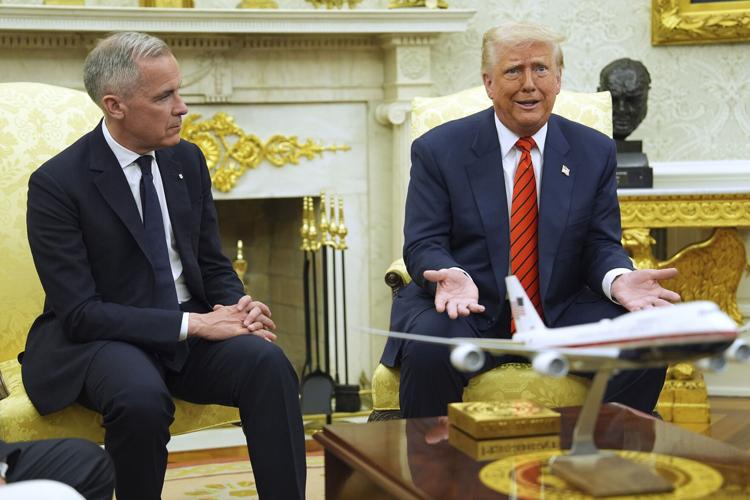
U.S. President Donald Trump, right, meets with Canadian Prime Minister Mark Carney on Tuesday in the Oval Office of the White House in Washington.
Carney acknowledged that no bit of rhetoric on tariffs would be enough to sway Trump, saying that "this is a bigger discussion."
"There are much bigger forces involved," the Canadian leader continued. "And this will take some time and some discussions. And that's why we're here, to have those discussions."
The meeting between the two leaders showcased the full spectrum of Trump's mix of aggression, hospitality and stubbornness.
Shortly before Carney's arrival, Trump insulted Canada by posting on social media that the United States didn't need "ANYTHING" from its northern neighbor, only to then turn on the charm and praise Carney's election win in person before showing his obstinance on matters of policy substance.

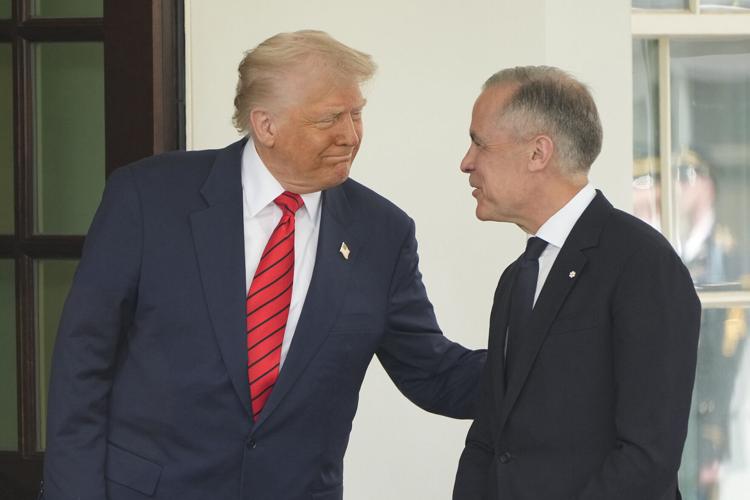
U.S. President Donald Trump, left, greets Canadian Prime Minister Mark Carney as he arrives Tuesday at the West Wing of the White House in Washington.
Carney won the job of prime minister by promising to confront the increased aggression shown by Trump, even as he preserved the calm demeanor of an economist who led the central banks of both Canada and the United Kingdom.
At times, Carney struggled to interject his views and raised his hand to talk as Trump held forth at length and veered between topics, touching on California Democratic Gov. Gavin Newsom, Carney's predecessor, Justin Trudeau, and teasing a "great" upcoming announcement that's "not necessarily on trade."
Trump offended Canada's sense of pride and friendship by saying he wants to make Canada the 51st U.S. state and levying steep tariffs against an essential partner in the manufacturing of autos and the supply of oil, electricity and other goods.
The outrage provoked by Trump enabled Carney's Liberal Party to score a stunning comeback victory last month as the trade war and attacks on Canadian sovereignty angered voters.
Trump said the two would not discuss making Canada part of the U.S., even as he insisted the idea would lead to lower taxes for Canadians.

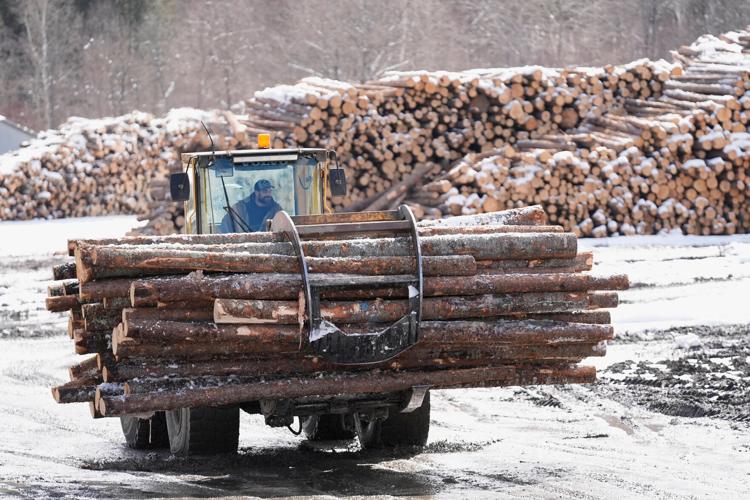
Vincent Routhier transports softwood logs April 9 at the Marcel Lauzon sawmill in East Hereford, Quebec.
"It's not for sale," Carney said. "It won't be for sale. Ever. But the opportunity is in the partnership and what we can build together."
Trump persisted by saying that the United States did not want to buy autos from Canada, even if the vehicles were also assembled in America. The U.S. leader insisted that the $63 billion trade deficit in goods — which he inflated to $200 billion — was a subsidy that needed to come an end.
The meeting never devolved into the outburst that the public saw in Trump's meeting with Ukrainian President Volodymyr Zelenskyy, who was berated by the U.S. president and his team for not being sufficiently deferential. Nor did it have the ease of Trump's sit down with the United Kingdom's Prime Minister Keir Starmer, who invited Trump for a visit provided by King Charles III.
The stakes of the meeting were high and the messages beforehand mixed. Trump told reporters on Monday that he wasn't quite sure why Carney was visiting.
"I'm not sure what he wants to see me about," Trump said. "But I guess he wants to make a deal."
U.S. Commerce Secretary Howard Lutnick further stoked doubts about their interest in repairing the relationship with Canada in a Monday interview on Fox Business Network's “Kudlow” show.
Asked if the U.S. could make a deal with Canada, Lutnick called the country a “socialist regime” that has been “basically feeding off America." Lutnick said Tuesday's meeting would be “fascinating.”

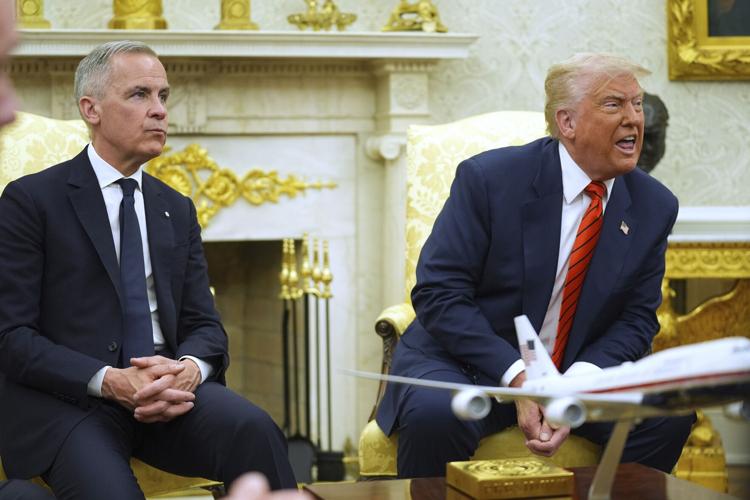
U.S. President Donald Trump, right, meets with Canadian Prime Minister Mark Carney on Tuesday in the Oval Office of the White House in Washington.
Carney, at a Friday news conference ahead of his trip, said the talks would focus on immediate trade pressures and the broader economic and national security relationships.
He said his "government would fight to get the best deal for Canada" and "take all the time necessary" to do so, even as Canada pursues a parallel set of talks to deepen relations with other allies and lessen its commitments with the U.S.
Canada is the top export destination for 36 U.S. states. Almost $2.7 billion worth of goods and services cross the border each day. About 60% of U.S. crude oil imports are from Canada, and 85% of U.S. electricity imports are from Canada.
Canada is also the largest foreign supplier of steel, aluminum and uranium to the U.S. and has 34 critical minerals and metals that the Pentagon is eager for and investing in for national security. Canada is one of the most trade-dependent countries in the world, and 77% of Canada's exports go to the U.S.
High tariffs and car repairs cost: The ripple effect
High tariffs and car repairs cost: The ripple effect
Updated
High tariffs—they affect not only governments and corporations but also consumers right where it hurts—their wallets. Because high tariffs raise the cost of motor parts, maintenance, and even insurance claims, the auto industry is particularly affected. High tariffs have the potential to cause everyday spending to soar, regardless of whether you own a car, have insurance, or occasionally rent one.
However, what are the precise effects of these increased tariffs? More significantly, how can you protect your money from needless spending? Way.com examines how the automotive business is affected by high tariffs in various ways and what you can do to avoid higher costs.
Car Repairs: The First to Feel the Heat
A car is a necessity rather than a luxury for many individuals. Repair costs, however, start to rise as tariffs raise the price of imported parts.
Why Is the Cost of Repairs Increasing?
A lot of auto parts are produced abroad.
The cost of these components increases when import duties rise. As a result, auto repair firms charge their clients more.
- Increased cost of replacement parts: If a fender that used to cost $200 now costs $300 because of tariffs, the additional cost eventually reaches you.
- Limited availability: Mechanics may have to find more costly domestic alternatives or wait longer for items to arrive if fewer parts are imported because of financial constraints.
- Increased labor costs: Mechanics may bill extra for their time and skills because they now have to deal with more expensive parts and delays.
Car owners are instantly affected by the price increase, as a basic bumper replacement that used to cost $800 might now cost up to $1,000.
Car Parts: A Supply Chain Nightmare
The cost of car components isn't rising—it's getting volatile. Supply chain breakdowns leave customers with both shortages and higher prices.
Which Car Components Are Hit the Worst?
Some of the most typically impacted pieces are:
- Brake pads and rotors: Most are produced in China, Mexico, and Europe.
- Engines and transmissions: Big, costly pieces that are much more expensive under high tariffs.
- Electronic parts: Vehicles depend on imported semiconductors and chips, which are extremely vulnerable to trade barriers.
New vs. Used Parts: A Difficult Decision
As new car parts become increasingly costly, most car owners opt for used or aftermarket parts. Used parts, however, might not always be accessible, and aftermarket parts might not be of the same quality.
Insurance Claims: Higher Payouts, Higher Premiums
When repairs become more costly, insurance companies notice. As they pay out higher amounts on claims, they necessarily raise premiums.
How insurance companies respond
- Increased premiums: To compensate for higher repair costs, insurers increase policy premiums.
- Lower payments: Insurers can attempt to save money by making lower payments for claims.
- Increased claim processing times: Insurers, as they deal with increased costs, might take longer to approve claims in order to re-evaluate costs.
The outcome? Vehicle owners not only pay more for repairs but also for the very insurance policies that are supposed to cover them.
Rental Cars: The Hidden Cost Surge
Whether you require a rental following an accident or for a weekend escape, you may be surprised by the inflated costs. The effects of exorbitant tariffs trickle down to rental companies, compelling them to revise their pricing structures.
Why rental car prices are on the increase
- Increased vehicle acquisition cost: Car rental companies buy cars in bulk and mostly rely on imports.
- More costly repairs and parts: Costlier repairs and replacement parts make keeping rental fleets more costly.
- Disruption of supply chains: With less cars available and delays in production, more demand drives prices even higher.
A rental that used to cost $50 a day can now be as much as $75 a day, making short-term rentals costly.
Impact on the Average Car Owner
All these add up to make the perfect storm for the average drivers. Let us dissect what that means to the average car owner:
Brake Pad Replacement
- Previous Cost (Estimate): $250
- Post-Tariff Cost (Estimate): $350+
Insurance Premiums (Annual)
- Previous Cost (Estimate): $1,200
- Post-Tariff Cost (Estimate): $1,500+
Car Rental (Per Day)
- Previous Cost (Estimate): $50
- Post-Tariff Cost (Estimate): $75+
Bumper Repair
- Previous Cost (Estimate): $800
- Post-Tariff Cost (Estimate): $1000+
To the person who gets hit with various car expenses per year, it can equate to another $3,000 or more on top of expenditures every year.
How Do You Protect Yourself?
Although you cannot control trade agreements or government policies, you can take certain steps to reduce the financial burden.
Compare repair quotes
Various stores might have varied sourcing strategies for automobile parts. Requesting estimates from multiple places can lead to the best bargain.
Use alternative parts
Refurbished and aftermarket parts can be an inexpensive substitute for costly original equipment manufacturer, or OEM, parts.
Reconsider your insurance policy
Comparing auto insurance rates and shopping around for insurance carriers can help you get a reduced premium even as prices increase.
Employ ride-sharing or public transit
When car rental is becoming too expensive, employing public transport or ride-sharing for short-term requirements can prevent you from spending extra money.
Utilize savings apps for transport
One of the best methods to counteract increasing transportation expenses is intelligent financial planning. Certain apps enable users to save money on everything from parking and insurance to gas and maintenance. By streamlining daily expenses, you may save as much as $3,000 annually, making a concrete impact on your budget.
Final Thoughts
High tariffs trigger a ripple effect that touches just about everything, from car maintenance to insurance fees and rental expenses. While you may feel their pinch in the form of sticker shock, becoming proactive and identifying intelligent savings methods can keep the costs in line.
By becoming proactive—perhaps by comparing the cost of auto insurance, browsing for substitute automobile parts, or employing money-related tools—you are able to shield your finances while keeping your vehicle expenses in line.

This story was produced by Way.com and reviewed and distributed by Stacker.

