

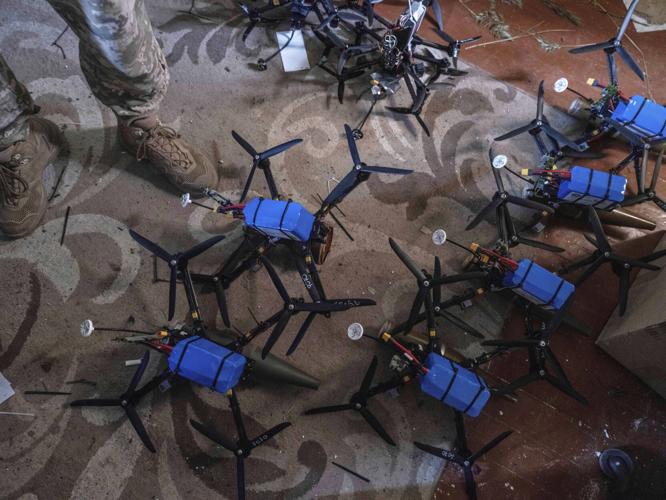
The targets were Russian warplanes, including strategic bombers and command-and-control aircraft, worth hundreds of millions of dollars. The weapons were Ukrainian drones, each costing under $1,000 and launched from wooden containers carried on trucks.
"Operation Spiderweb," which Ukraine said destroyed or damaged over 40 aircraft parked near air bases across Russia on Sunday, wasn't just a blow to the Kremlin's prestige. It was also a wake-up call for the West to bolster its air defense systems against such hybrid tactics, military experts said.

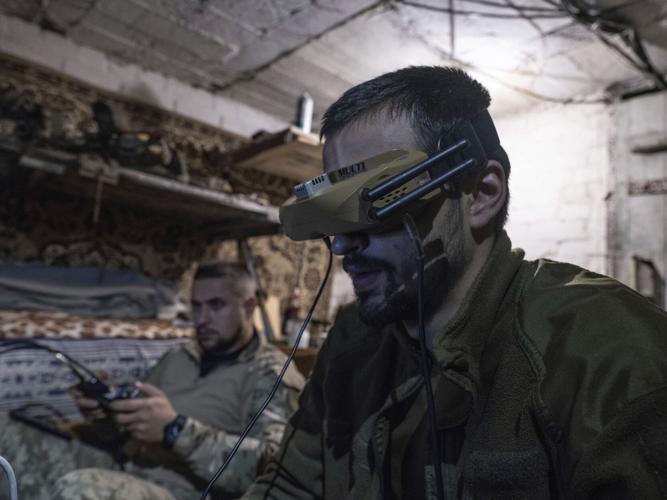
Soldiers use drones to fire on Russian positions May 23 from a shelter in Kostyantynivka, Donetsk region, Ukraine. Ukraine used drones June 1 to carry out “Operation Spiderweb,” which attacked expensive Russian warplanes.
Ukraine took advantage of inexpensive drone technology that has advanced rapidly in the last decade and combined it with outside-the-box thinking to score a morale-boosting win in the 3-year-old war that lately has turned in Moscow's favor.
How deeply the attack will impact Russian military operations is unclear. Although officials in Kyiv estimated it caused $7 billion in damage, the Russian Foreign Ministry disputed that, and there have been no independent assessments. Moscow still has more aircraft to launch its bombs and cruise missiles against Ukraine.
Still, the operation showed what "modern war really looks like and why it's so important to stay ahead with technology," said Ukrainian President Volodymyr Zelenskyy.
Where the West is vulnerable
For Western governments, it's a warning that "the spectrum of threats they're going to have to take into consideration only gets broader," said Douglas Barrie, senior fellow for military aerospace at the International Institute of Strategic Studies in London.
In the past decade, European countries have accused Russia of carrying out a sabotage campaign against the West, with targets ranging from defense executives and logistics companies to businesses linked to Ukraine. Unidentified drones have been seen in the past year flying near military bases in the U.S., the U.K and Germany, as well as above weapons factories in Norway.

Drones are prepared to be fired at Russian positions May 23 at a shelter in Kostyantynivka, Donetsk region, Ukraine.
High-value weapons and other technology at those sites are "big, juicy targets for both state and non-state actors," said Caitlin Lee, a drone warfare expert at RAND in Washington.
"The time is now" to invest in anti-drone defenses, she said.
Low-cost options to protect aircraft include using hardened shelters, dispersing the targets to different bases and camouflaging them or even building decoys.
U.S. President Donald Trump last month announced a $175 billion "Golden Dome" program using space-based weapons to protect the country from long-range missiles.

Not mentioned were defenses against drones, which Lee said can be challenging because they fly low and slow, and on radar can look like birds. They also can be launched inside national borders, unlike a supersonic missile fired from abroad.
Drones "dramatically increase" the capacity by a hostile state or group for significant sabotage, said Fabian Hinz, a missile expert and research fellow at IISS.
"How many targets are there in a country? How well can you defend every single one of them against a threat like that?" he said.

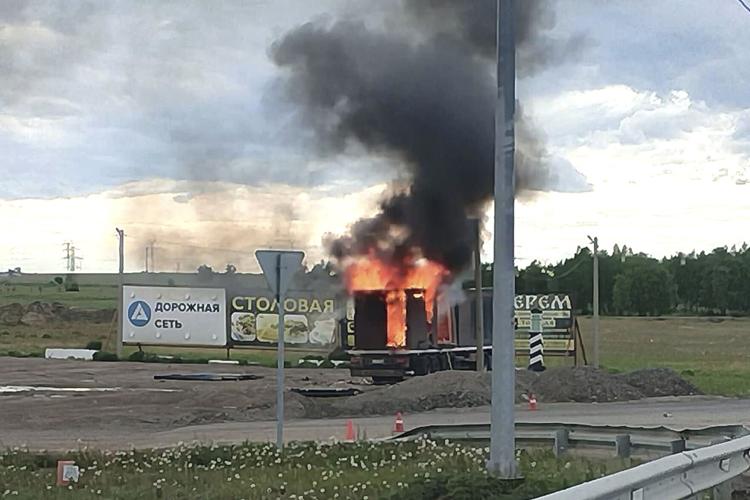
A truck that was apparently used to launch Ukrainian drones is shown June. 1 in Irkutsk, Russia.
Ukraine's resourceful, outside-the-box thinking
In "Operation Spiderweb," Ukraine said it smuggled the first-person view, or FPV, drones into Russia, where they were placed in the wooden containers and driven close to the airfields in the Irkutsk region in Siberia, the Murmansk region in the Arctic, and the Amur region in the Far East, as well as to two bases in western Russia.
Ukraine's Security Service, or SBU, said the drones had highly automated capabilities and were jointly piloted by an operator and by using artificial intelligence, which flew them along a pre-planned route in the event the drones lost signal. Such AI technology likely would have been unavailable to Ukraine five years ago.
SBU video showed drones swooping over and under Russian aircraft, some of which were covered by tires. Experts suggested the tires could have been used to confuse an automatic targeting system by breaking up the plane's silhouette or to offer primitive protection.
"The way in which the Ukrainians brought this together is creative and obviously caught the Russians completely off guard," Barrie said.
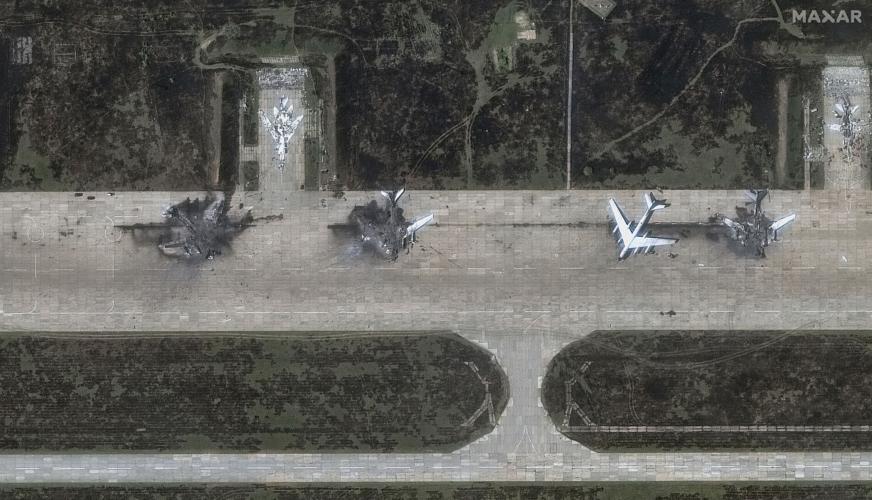
Satellite photos analyzed by The Associated Press showed seven destroyed bombers on the tarmac at Irkutsk's Belaya Air Base, a major installation for Russia's long-range bomber force. At least three Tu-95 four-engine turboprop bombers and four Tu-22M twin-engine supersonic bombers appear to be destroyed.

This satellite image shows damage from a Ukrainian drone attack at the Belaya Air Base on June 4 in the Irkutsk region of eastern Siberia, Russia.
Since the beginning of Russia's full-scale invasion in 2022, the outgunned and outnumbered Ukrainian military has adopted a creative approach to warfare. Its forces deployed wooden decoys of expensive U.S. HIMARS air defense systems to draw Russia's missile fire, created anti-drone units that operate on pickup trucks, and repurposed captured weapons.
Experts compared Sunday's attack to Israel's operation last year in which pagers used by members of the militant group Hezbollah exploded almost simultaneously in Lebanon and Syria. Israel also has used small, exploding drones to attack targets in Lebanon and Iran.
The U.S. used Predator drones more than a decade ago to kill insurgents in Afghanistan from thousands of miles away. Developments in technology have made those capabilities available in smaller drones.
Hinz compared the state of drone warfare to that of the development of the tank, which made its debut in 1916 in World War I. Engineers sought to work out how to best integrate tanks into a working battlefield scenario — contemplating everything from a tiny vehicle to a giant one "with 18 turrets" before settling on the version used in World War II.
With drones, "we are in the phase of figuring that out, and things are changing so rapidly that what works today might not work tomorrow," he said.
How the attack affects Russian operations in Ukraine

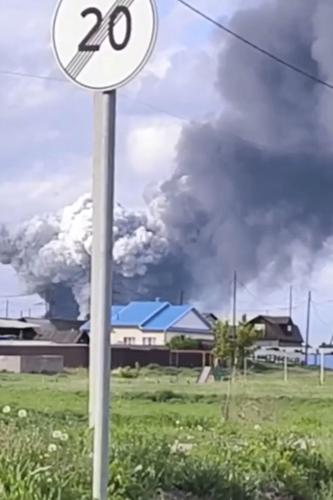
Plumes of smoke are seen June 1 rising over the Belaya air base in eastern Siberia after a Ukrainian drone attack.
The Tu-95 bombers hit by Ukraine are "effectively irreplaceable" because they're no longer in production, said Hinz, the IISS expert. Ukraine said it also hit an A-50 early warning and control aircraft, similar to the West's AWACS planes, that coordinate aerial attacks. Russia has even fewer of these.
"Whichever way you cut the cake for Russia, this requires expense," said Thomas Withington of the Royal United Services Institute in London. "You can see the billions of dollars mounting up,"
Russia must repair the damaged planes, better protect its remaining aircraft and improve its ability to disrupt such operations, he said. Experts also suggested the strikes could force Moscow to speed up its program to replace the Tu-95.
While underscoring Russian vulnerabilities, it's not clear if it will mean reduced airstrikes on Ukraine.
Russia has focused on trying to overwhelm Ukraine's air defenses with drones throughout the war, including the use of decoys without payloads. On some nights last month, Moscow launched over 300 drones.
"Even if Ukraine was able to damage a significant portion of the Russian bomber force, it's not entirely clear that the bomber force was playing a linchpin role in the war at this point," Lee said.
Ukrainian air force data analyzed by AP shows that from July 2024 through December 2024, Russia used Tu-22M3s and Tu-95s 14 times against Ukraine but used drones almost every night.
Sunday's operation might temporarily reduce Russia's ability to launch strategic missile attacks but it will probably find ways to compensate, Lee said.
Photos: More than 200 Ukrainian POWs have died in Russian prisons

An injured Ukrainian soldier who was a prisoner of war is placed on a stretcher after being returned to his home country by Russia, April. 19, 2025. (AP Photo/Evgeniy Maloletka)

Halyna Hryhorieva of Pyriatyn, Ukraine, shows her tattoo of words often spoken by her husband, who was a prisoner of war in Russia: "Everything will be all right," on March 9, 2025. (AP Photo/Alex Babenko)

A portrait of Serhii Hryhoriev, a Ukrainian prisoner of war who died in Russia, is seen next to his grave in Pyriatyn, Ukraine, March 9, 2025. (AP Photo/Alex Babenko)

Forensic workers at a morgue in Kyiv, Ukraine, collect a pendant with an image of St. Nicholas that belonged to the body of a Ukrainian soldier, June 24, 2024. (AP Photo/Alex Babenko)

A forensic worker in Kyiv, Ukraine, examines the body of a prisoner of war repatriated by Russia, June 24, 2024. (AP Photo/Alex Babenko)

Forensic workers at a morgue in Kyiv, Ukraine, examine the body of a Ukrainian prisoner of war returned by Russia, June 24, 2024. (AP Photo/Alex Babenko)

Workers change clothes at a morgue in Kyiv, Ukraine, June 24, 2024. (AP Photo/Alex Babenko)

FILE - Ukrainian soldiers sit in a bus in the Sumy region of Ukraine after returning from captivity in Russia, May 31, 2024. (AP Photo/Evgeniy Maloletka, File)

Fingerprints taken from the body of a Ukrainian prisoner of war returned by Russia, at a morgue in Kyiv, Ukraine, June 24, 2024. (AP Photo/Alex Babenko)

FILE - A Ukrainian soldier shouts, "Glory to Ukraine," after returning from captivity in Russia, in the Sumy region of Ukraine, May 31, 2024. (AP Photo/Evgeniy Maloletka)

Halyna Hryhorieva, left, and her daughter, Oksana Hryhorieva, pose for a portrait in their house in Pyriatyn, Ukraine, March 9, 2025. (AP Photo/Alex Babenko)

Halyna Hryhorieva, the wife of Serhii Hryhoriev, a prisoner of war who died in Russia, sits at home in Pyriatyn, Ukraine, March 9, 2025. (AP Photo/Alex Babenko)

A portrait of Ukrainian soldier Serhii Hryhoriev, who died in Russian captivity, is displayed in his family's house in Pyriatyn, Ukraine, March 9, 2025. (AP Photo/Alex Babenko)

Oksana Hryhorieva of Pyriatyn, Ukraine, shows a video of her father, Serhii Hryhoriev, from when he was a prisoner of war in Russia, March 9, 2025. (AP Photo/Alex Babenko)

In Pyriatyn, Ukraine, Oksana Hryhorieva, left, and her mother, Halyna Hryhorieva, visit the grave of Serhii Hryhoriev, who died as a prisoner of war in Russia, March 9, 2025. (AP Photo/Alex Babenko)

