

U.S. military recruitment made a comeback after a downturn caused primarily by the COVID-19 pandemic, low unemployment and stiff competition from the private sector.
Posts circulating widely on social media give President Donald Trump and Defense Secretary Pete Hegseth credit for this increase, a claim pushed by the president and others in his administration.
Defense Department data shows the uptick began well before Trump’s reelection in November and experts point to actions taken by the military during the Biden administration as key reasons for the increase.

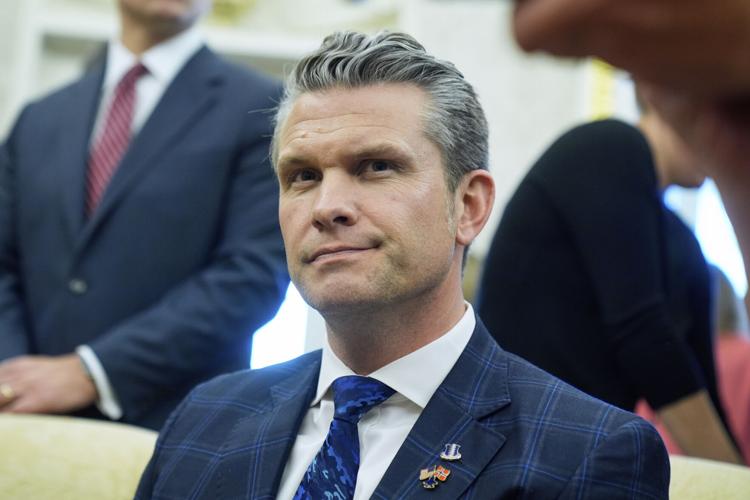
Secretary of Defense Pete Hegseth listens Thursday during a bilateral meeting in the Oval Office of the White House in Washington.
Here’s a look at the facts.
Claim: Trump and Hegseth are causing military recruitment numbers to skyrocket.
The facts: This is an overstatement and is missing context. Recruitment numbers for all military branches were on the rise for the last few years, according to Defense Department data. Experts cite factors such as improving recruitment strategies, increased bonuses and new prep courses that predated the 2024 presidential election as factors, though they acknowledge Trump’s election also could have played a role.
“There may be some American teenagers or their parents, more likely, who were more comfortable joining the military in a Republican administration than a Democratic administration,” said Katherine Kuzminski, director of studies at the independent Washington think tank Center for a New American Security and an expert on military recruitment. “But I don’t think that alone explains why we’ve seen an increase lately.”
Military enlistment was 12.5% higher in fiscal year 2024, which ran from Oct. 1, 2023, to Sept. 30, 2024, than in fiscal year 2023. There were 225,000 new recruits in the former and 200,000 in the latter, Katie Helland, who oversees recruitment policies and programs as the Defense Department’s director of Military Accession Policy, said at a media roundtable in October.
Those totals include both active and reserve troops in all five military branches, as well as about 4,800 Navy recruits from fiscal year 2024 who signed contracts but could not be shipped out because of basic training limitations.
The recruiting numbers for the current fiscal year 2025, which started the month before Trump’s election, continued to increase.

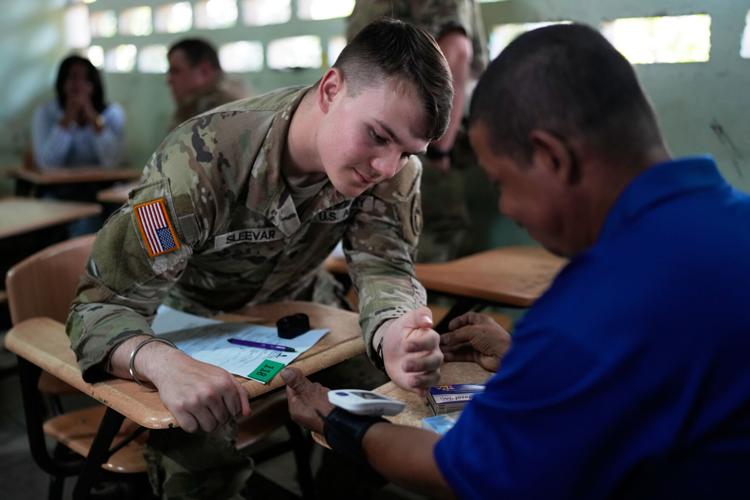
U.S. military members attend to patients March 27 as part of a program with Panama’s Health Ministry in Sardinilla, Panama.
In a January interview, then-Army Secretary Christine Wormuth said the Army was on pace to bring in 61,000 young people by the end of the fiscal year in September and will have more than 20,000 additional young people signed up in the delayed entry program for 2026. It will be the Army’s second straight year of meeting its enlistment goals.
“What’s really remarkable is the first quarter contracts that we have signed are the highest rate in the last 10 years,” Wormuth said.
Some on social media gave Trump and Hegseth sole credit for the improving numbers, citing a Fox News graphic that aired last week during a “Fox & Friends” interview with Hegseth. The graphic compared cumulative recruitment numbers for the first two months of the current fiscal year with those of the first five months.
“Holy smokes. Military recruitment is THROUGH THE ROOF,” reads one post on X, the social media platform formerly known as Twitter, sharing the Fox graphic. “Absolutely smashing every goal. This is what happens when you have strong leadership.”
Kuzminski noted there’s no data to back up whether Trump’s election was a factor in the most recent increase in recruiting numbers.
“We can’t rule out that for some people it was a factor, but the real way to get around that would be to actually do more qualitative surveys or interviews,” she said.
The Department of Defense did not respond to a request for comment beyond providing recruitment numbers.
Its most recent Joint Advertising Market Research Survey, published in January, does not list politics among the top reasons for either joining or not joining the military.
The survey polled youth ages 16-21. Fifty-three percent of respondents listed “pay/money” in response to the question, “If you were to consider joining the U.S. Military, what would be the main reason(s)?”
Seventy-two percent chose “possibility of physical injury/death” in response to the question, “What would be the main reason(s) why you would NOT consider joining the U.S. Military?”
Prior to the recent uptick in recruits, military services struggled to overcome severe restrictions on in-person recruiting mandated by the pandemic, the low unemployment rate and stiff competition from private companies able to pay more and provide similar or better benefits.
Kuzminski said modernizing recruitment efforts was a major factor in improving the numbers. She said there was a push over the past 20 years to “think about capturing American youth where they exist online and not just in person.”
According to the most recent Defense Department data available, 77% of youth 17 to 24 years old do not qualify for military service without some type of waiver for issues such as weight, drug abuse or mental health.
Military officials and experts pointed to prep courses intended to help potential recruits meet academic and physical military standards as helping to solve this issue. The Army launched its Future Soldier Preparatory Course in August 2022. The Navy launched its Future Sailor Preparatory Course in April 2023.
Enticements, such as bonuses for recruiters who exceed their baseline enlistment requirement and promotions for young enlisted soldiers who successfully bring in recruits, also play a role.
Mark Cancian, a senior adviser in the Center for Strategic and International Studies’ defense and security department, said, “In part, I think you’re seeing the results of money that the Biden administration put in, and Congress too, the incentives are greater.”
But, he added, “I think that, to be honest, Hegseth, I think he has excited a certain part of the American society.”
He noted that, ultimately, there isn’t enough data yet to know the impact Trump and Hegseth have had on military recruitment.(tncms-asset)8f187e35-4dcd-531d-81b4-80975b0044e3[4](/tncms-asset)(tncms-asset)e03b7ba2-28f8-519b-93ba-e4fb76307da4[5](/tncms-asset)(tncms-asset)c7513270-09ee-558b-9b6c-45d380c95d10[6](/tncms-asset)
Panama, Pandora and Pentagon Papers: 10 of the most groundbreaking leaks in history
Panama, Pandora, and Pentagon Papers: 10 of the most groundbreaking leaks in history
Updated
The biggest secrets aren’t revealed in a traditional way. Leaking information can be dangerous—even fatal—but many people throughout history have risked their safety in the name of the truth. In some cases, whistleblowers remain maligned for their work even long after their deaths. But time has changed the way we see many of the leaks from years ago.
Stacker chose the top 10 most groundbreaking leaks in history, containing the largest scale of information and the most impactful aftermaths. Their stories are as dramatic and riveting as any spy novel, but anything but fictional. Some of the following leaks uncovered massive amounts of data and some released very little, but shaped wars and the way we view our governments. Whatever secrets they brought to light, these leaks changed history forever.
Ordered chronologically, the leaks take you through how leaking information has changed over almost 200 years, from strictly newspapers to complicated and encrypted computer data. The future of leaking information is bound to be groundbreaking, especially after looking back at what has occurred already.
You may also like: Defining historical moments from the year you were born

Treaty of Guadalupe Hidalgo
Updated
At the end of the Mexican-American War, the document that would end the war was leaked to journalist John Nugent before it was signed. He published the treaty in the New York Herald in its entirety, revealing the negotiations for peace before they were settled or agreed upon. Mexico would secede over half of its territory in the treaty, establishing most of America’s southern border as we know it today. The United States Senate tried to get Nugent’s source from him through gruelling interrogations and a month-long house arrest. He never did reveal his source, even though investigations long after the leak point towards James Buchannan, who was secretary of state at the time and would become president a decade later. This leak demonstrated the hidden workings between media and politicians very early in our nation’s history.
Manhattan Project Soviet Leaks
Updated
Spies recruited by the Soviet Union knew about the United States’ atomic bomb plans before our own FBI in 1941. Americans and Brits fed information and diagrams of bombs to Russia all through World War II, some in service to communism and some to prevent one country from having a monopoly on nuclear weapon technology. While this information leak was not public until the Soviet codes were cracked after the war and the cases were declassified in the 1990s, this leak made the Cold War arms race between the Soviet Union and the United States an almost equal race. These leaks led to the execution of two Americans, Ethel and Julius Rosenberg, despite the fact that they denied their involvement until their death. To this day, we don’t know how much information was leaked to the Soviets during World War II, or all of the spies involved, making it a mysterious leak in history.
Operation Mincemeat
Updated
This leak from the Allied Forces during World War II proved that not all leaks were necessarily the truth. Operation Mincemeat was a planned “leak” consisting of fake “top secret” information planted on a dead body that washed up on a beach on the coast of Spain. The purpose of this trickery was to fool the Nazis into thinking that the Allies were going to invade Greece and Sardina instead of Italy. British intelligence officers invented an entire fictional life for the corpse they planted on the beach, with fake correspondence and even photographs of a fake fiancee. The plan fooled both Spanish authorities, who seized the body, and German leaders in 1943, who sent all of their troops to Greece just as the Allies invaded Sicily. As Axis powers were losing the battle of Sicily, Italian dictator Mussolini was dismissed as prime minister and imprisoned. While historians disagree with the level of impact that Operation Mincemeat had on the defeat of the Axis powers, it remains one of the most interesting leaks in history.
The Pentagon Papers
Updated
The Vietnam War shaped how we viewed our government unlike any war before it. However, there was much the country didn’t know about the war until 1971. Daniel Ellsberg leaked confidential government records in the Report of the Office of the Secretary of Defense Vietnam Task Force, popularly referred to as the Pentagon Papers. In them, details of unreported expansions of America’s involvement in the Vietnam War uncovered that multiple presidential administrations had lied to the public regarding the war. The New York Times, The Washington Post, and Ellsberg faced criminal charges in court for their efforts to get the papers into public knowledge, but the Supreme Court eventually allowed for further publication of the papers. This leak bred major distrust in the United States government, which would only grow with the next major leak.
Watergate and the Nixon Tapes
Updated
Initially, President Nixon and his conspirators hid their involvement in the 1972 burglary attempt upon the Democratic National Committee headquarters in the Watergate complex. As the 1972 presidential election approached, an anonymous source named “Deep Throat” fed Washington Post reporters Carl Bernstein and Bob Woodward leaked info that “the Watergate bugging incident stemmed from a massive campaign of political spying and sabotage conducted on behalf of President Nixon’s re-election and directed by officials of the White House.” Despite this, Nixon was reelected, but he did not avoid investigation. The court hearings investigating the abuses of the presidential campaign captured America’s attention every day for weeks in 1973. Only after the Supreme Court ordered him to present the tapes did Nixon have no other choice but to resign and admit guilt. The leak, subsequent court hearings, and media revelations revealed corruption beyond most of America’s imagination at the time, and changed the way we viewed government leaders forever.
You may also like: 25 terms you should know to understand the health care debate
The Iraq War Logs (WikiLeaks)
Updated
In 2010, documents leaked on WikiLeaks uncovered shocking details about the Iraq War. Australian Julian Assange created the website WikiLeaks in 2006 with the goal of “analysis and publication of large datasets of censored or otherwise restricted official materials involving war, spying and corruption.” Some 400,000 U.S. military documents were unleashed to the public, and with them came details of Iraqi civilian deaths, abuse of war prisoners, and Iran’s involvement in the war. It became the largest U.S. military leak at the time. Unlike many of the other leaks before this, the information was not analyzed or assembled before being released to the public, which journalists considered irresponsible. The Iraq War Logs, as they are known, detailed ugly aspects of a war that the government wanted to prove was worth the effort.
Edward Snowden and the NSA
Updated
Edward Snowden was forced to flee the country when he leaked government information to The Guardian in 2013. As a former contractor for the CIA, Snowden had access to U.S. surveillance documents, which he stole before fleeing to Hong Kong to leak portions of thousands of documents to journalists. The documents detailed the National Security Agency’s collection of personal data, including phone records, social media data, and emails belonging to U.S. and non-U.S. citizens. Snowden’s leak left him stranded in a Russian airport for a month while seeking asylum in Russia. It wasn’t until September 2020 that U.S. courts condemned the intelligence programs Snowden uncovered for being illegal and unconstitutional. This leak was a revelation into government security practices post-9/11, most of which the U.S. citizens were unaware of and furious about.
The Panama Papers
Updated
The International Consortium of Investigative Journalists and German newspaper Süddeutsche Zeitung (SZ) released 11.5 million documents detailing offshore tax havens. The papers were anonymously shared with SZ anonymously from Panama, but the newspaper needed to spend a year deciphering encrypted files before they could release them to the public. In April of 2016, SZ published the findings, which showed the private financial information of celebrities, politicians, and business leaders from around the world. Most of the actions detailed in the documents were not technically illegal, but two arrests were made for wire and tax fraud, tax evasion, and forming a criminal organization. The largest arrest happened to Juergen Mossack and Ramón Fonseca, who were investigated by the Cologne and Panama governments. Thanks to the leak, they had to close their business in 2018.
The Dark Side of the Kremlin
Updated
In 2019, “hacktivists” infiltrated some of Russia’s most powerful figures and distributed over 170 gigabytes of data on a website called Distributed Denial of Secrets. Emails and documents published on the site confirmed what many people suspected of how the Russian government seeks to control its citizens. Journalist Roman Dobrokhotov claims they found “how the government controls media in Russia, how they spread their messages through members of parliament and loyal TV channels or newspapers.” Considering the danger that journalists have been in when going against the Russian government, this leak was a risk to take. The sheer amount of data and the rarity of information on the inner workings of Russia’s secretive government makes this leak memorable in history.
The Pandora Papers
Updated
In October of 2021, the International Consortium of Investigative Journalists published the first leaks of what would total almost 12 million documents. The dealings of the world’s wealthiest individuals and political leaders were uncovered to reveal the secret offshore accounts used to evade taxes. The ICIJ considers their investigation to be “the most expansive leak of tax haven files in history.” To uncover the massive amount of information, they worked with more than 600 journalists in 117 countries, making public the ways in which politics, business, and real estate are impacted by corruption. This leak changed the course of a Czech Republic election and sparked calls for governments to crack down on money laundering, tax evasion, and other corrupted ways of hiding wealth.
You may also like: A timeline of WWII, the most devastating conflict in history

