

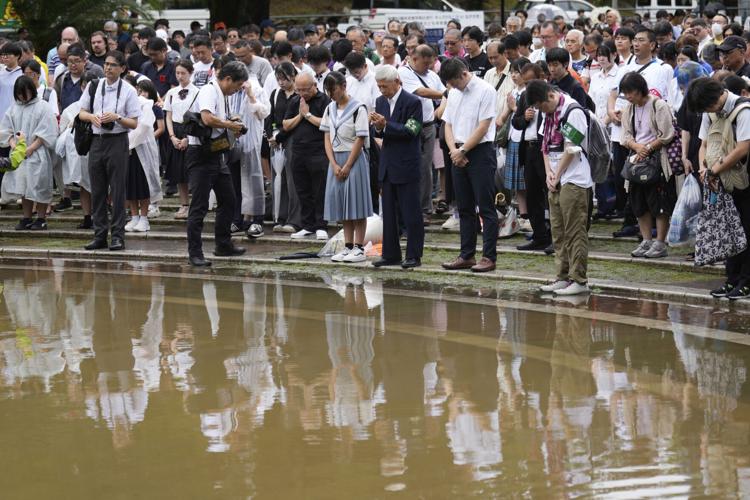
NAGASAKI, Japan — The southern Japanese city of Nagasaki on Saturday marked 80 years since the U.S. atomic attack that killed tens of thousands and left survivors who hope their harrowing memories can help make their hometown the last place on Earth to be hit by a nuclear bomb.
The United States launched the Nagasaki attack Aug. 9, 1945, killing 70,000 by the end of that year, three days after the U.S. bombing of Hiroshima that killed 140,000. Japan surrendered Aug. 15, 1945, ending World War II and nearly half a century of aggression by the country across Asia.
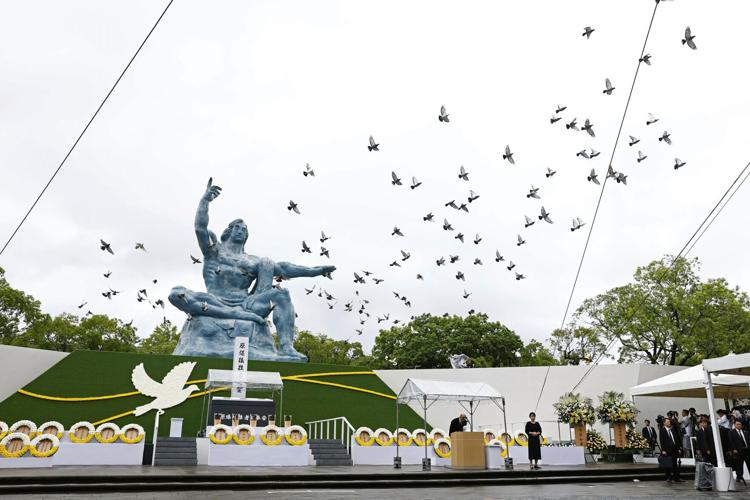
About 2,600 people, including representatives from more than 90 countries, attended a memorial event at Nagasaki Peace Park, where Mayor Shiro Suzuki and Prime Minister Shigeru Ishiba spoke, among other guests. At 11:02 a.m., the exact time when the plutonium bomb exploded above Nagasaki, participants observed a moment of silence as a bell rang.
“Even after the war ended, the atomic bomb brought invisible terror,” survivor Hiroshi Nishioka, 93, said in his speech at the memorial, noting many who survived without severe wounds started bleeding from their gums and losing hair and died.
“Never use nuclear weapons again, or we’re finished,” he said.
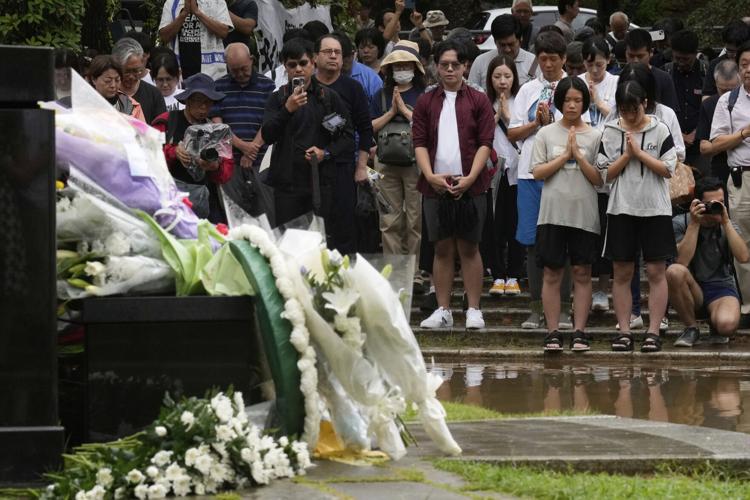
Survivors and their families gathered Saturday in rainy weather at Peace Park and nearby Hypocenter Park, located below the bomb’s exact detonation spot, hours before the official ceremony.
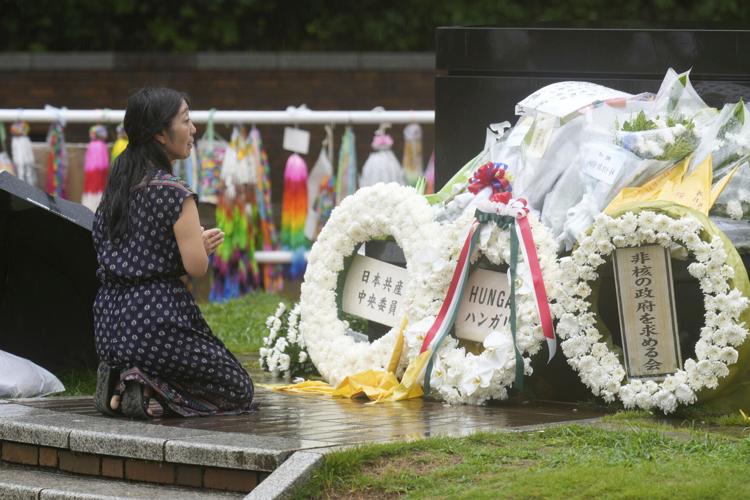
“I simply seek a world without war,” said Koichi Kawano, 85, a survivor who laid flowers at the hypocenter monument decorated with colorful origami paper cranes and other offerings.
Some others prayed at churches in Nagasaki, home to Catholic converts who went deep underground during centuries of violent persecution in Japan’s feudal era.
The twin bells at Urakami Cathedral, which was destroyed in the bombing, also rang together again after one of the bells that went missing after the attack was restored by volunteers.
Despite their pain from wounds, discrimination and illnesses from radiation, survivors publicly committed to a shared goal of abolishing nuclear weapons. Still, they worry about the world moving in the opposite direction.
Aging survivors and their supporters in Nagasaki now put their hopes of achieving nuclear weapons abolition in the hands of younger people, telling them the attack isn’t distant history, but an issue that remains relevant to their future.

“There are only two things I long for: the abolition of nuclear weapons and prohibition of war,” said Fumi Takeshita, an 83-year-old survivor. “I seek a world where nuclear weapons are never used and everyone can live in peace.”
In the hope of passing down the lessons of history to current and future generations, Takeshita visits schools to share her experience with children.
“When you grow up and remember what you learned today, please think what each of you can do to prevent war,” Takeshita told students during such a visit this past week.
Teruko Yokoyama, 83, a member of a Nagasaki organization supporting survivors, said she thinks of the growing absence of those she worked with, and that fuels her desire to document the lives of others who are still alive.

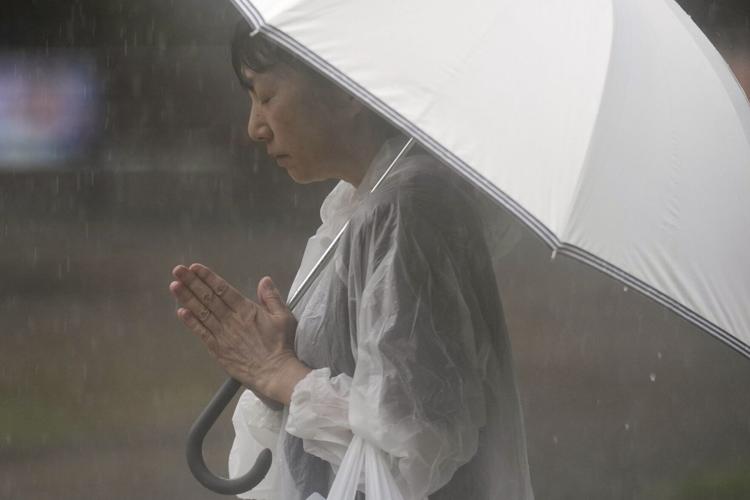
A person prays Saturday at Atomic Bomb Hypocenter Park in Nagasaki, Japan, ahead of a memorial ceremony.
The number of survivors fell to 99,130, about a quarter of the original number, with their average age exceeding 86. Survivors worry about fading memories, as the youngest of the survivors were too young to clearly recall the attack.
“We must keep records of the atomic bombing damages of the survivors and their lifetime story,” said Yokoyama, whose two sisters died after suffering illnesses linked to radiation.
Her organization started to digitize the narratives of survivors for viewing on YouTube and other social media platforms with the help of a new generation.
“There are younger people who are beginning to take action,” Yokoyama told The Associated Press on Friday. “So I think we don’t have to get depressed yet.”
Nagasaki hosted a “peace forum” on Friday where survivors shared their stories with more than 300 young people from around the country. Seiichiro Mise, a 90-year-old survivor, said that he’s handing seeds of “flowers of peace” to the younger generation in hopes of seeing them bloom.
Survivors are frustrated by a growing nuclear threat and support among international leaders for developing or possessing nuclear weapons for deterrence. They criticize the Japanese government’s refusal to sign or even participate in the Treaty on the Prohibition of Nuclear Weapons as an observer because Japan, as an American ally, says it needs U.S. nuclear possession as deterrence.
In Ishiba’s speech, the prime minister reiterated Japan’s pursuit of a nuclear-free world, pledging to promote dialogue and cooperation between countries with nuclear weapons and nonnuclear states at the Non-Proliferation of Nuclear Weapons review conference scheduled for April and May 2026 in New York. Ishiba didn’t mention the nuclear weapons ban treaty.
“Countries must move from words to action by strengthening the global disarmament regime,” with the Treaty on the Non-Proliferation of Nuclear Weapons, or NPT, at the center, complemented by the momentum created by the nuclear weapons ban treaty, said U.N. Secretary-General António Guterres, in his message Undersecretary-General Izumi Nakamitsu read in Nagasaki.
Nagasaki invited representatives from all countries to attend the ceremony Saturday.(tncms-asset)03b0c2a0-a86b-5380-aaa2-2f427fd61d61[6](/tncms-asset)(tncms-asset)2e50ecd2-13a0-54ee-9ca5-a15a8fb2a8e7[7](/tncms-asset)
Today in history: Aug. 9
1934: Franklin D. Roosevelt
Updated
In 1934, President Franklin D. Roosevelt signed an executive order nationalizing silver.
1936: Jesse Owens
Updated
In 1936, Jesse Owens won his fourth gold medal at the Berlin Olympics as the United States took first place in the 400-meter relay.
1945: "Fat Man"
Updated
In 1945, three days after the atomic bombing of Hiroshima, Japan, a U.S. B-29 Superfortress code-named Bockscar dropped a nuclear device ("Fat Man") over Nagasaki, killing an estimated 74,000 people.
1969: Charles Manson
Updated
In 1969, actor Sharon Tate and four other people were found brutally slain at Tate’s Los Angeles home; cult leader Charles Manson and a group of his followers were later convicted of the crime.
1974: Gerald R. Ford
Updated
On Aug. 9, 1974, Vice President Gerald R. Ford became the nation’s 38th chief executive as President Richard Nixon’s resignation took effect.
1982: John W. Hinckley Jr
Updated
In 1982, a federal judge in Washington ordered John W. Hinckley Jr., who’d been acquitted of shooting President Ronald Reagan and three others by reason of insanity, committed to a mental hospital.
1988: Lauro Cavazos
Updated
In 1988, President Ronald Reagan nominated Lauro Cavazos (kah-VAH’-zohs) to be secretary of education; Cavazos became the first Hispanic to serve in the Cabinet.
1995: Jerry Garcia
Updated
In 1995, Jerry Garcia, lead singer of the Grateful Dead, died in Forest Knolls, California, of a heart attack at age 53.
2012: Usain Bolt
Updated
At the London Games, Usain Bolt won the 200 meters in 19.32 seconds, making him the only man with two Olympic titles in that event.
2014: Michael Brown Jr.
Updated
In 2014, Michael Brown Jr., an 18-year-old Black man, was shot to death by a police officer following an altercation in Ferguson, Missouri; Brown’s death led to sometimes-violent protests in Ferguson and other U.S. cities, spawning a national “Black Lives Matter” movement.
2017: Tiger Woods
Updated
Prosecutors in Florida said golfer Tiger Woods had agreed to plead guilty to reckless driving and would enter a diversion program that would allow him to have his record wiped clean; he’d been charged with DUI in May when he was found asleep in his car, apparently under the influence of a prescription painkiller and sleeping medication.
2018: Space Force
Updated
In 2018, Vice President Mike Pence announced plans for a new, separate U.S. Space Force as a sixth military service by 2020.
2021: Robert Durst
Updated
Testifying at his Los Angeles murder trial, Robert Durst denied killing his best friend, Susan Berman, at her home in 2000. (Durst would be convicted of first-degree murder; the real estate heir died in January 2022 at age 78 while serving a life sentence.)

