

As its immigration crackdown in Minneapolis intensified, the Trump administration leaned into messaging that borrows from phrases, images and music about national identity popular among right-wing groups.
On Jan. 9, two days after a U.S. Immigration and Customs Enforcement agent's killing of Renee Good sent tensions in Minneapolis to a fever pitch, the Department of Homeland Security posted to social media an image of a man on a horse riding through a snowy, mountainous landscape with the words "We'll have our home again." That's the chorus to a song about ousting a foreign presence by a self-described "folk-punk" band the Proud Boys and other far-right and white supremacist groups used.
The next day, the Department of Labor posted: "One Homeland. One People. One Heritage. Remember who you are, American." Several Trump critics drew a parallel to a notorious Nazi slogan, "One People, One Realm, One Leader."
Last week, as President Donald Trump stepped up his pressure campaign to claim Greenland, the White House posted an image that showed a dog sled facing a fork in the trail, one that leads to an American flag and the White House and another that leads to the Russian and Chinese flags. Above the image was the phrase, "Which way, Greenland Man?"
The post refers to a meme that riffs off the title of a notorious white supremacist book titled "Which Way Western Man?" The administration also used the framing in an ICE recruiting post last year, which asked, "Which way, American Man?"
The posts renewed criticism about the sometimes cryptic use of imagery popular with the far right and white supremacists in the administration's campaign to rally the nation behind its immigration crackdown, which it frames as a battle to preserve Western civilization.

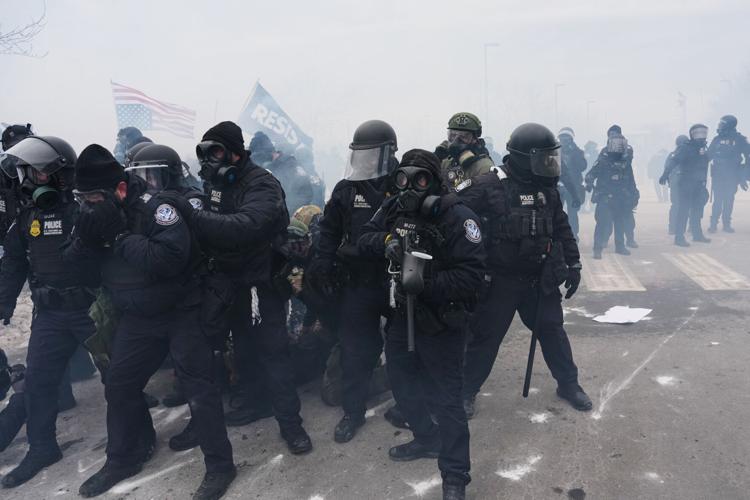
Federal immigration officers confront protesters Thursday outside the Bishop Henry Whipple Federal Building in Minneapolis.
Administration tells critics to 'get a grip'
The administration says it's tired of criticism that its messaging is framed around white supremacy or Nazi slogans.
"It seems that the mainstream media has become a meme of their own: The deranged leftist who claims everything they dislike must be Nazi propaganda," White House spokeswoman Abigail Jackson said. "This line of attack is boring and tired. Get a grip."
Referring to the "We'll Have Our Home Again" post, DHS spokeswoman Tricia McLaughlin said it "was a reference to 20-plus million illegal aliens invading the country."
"I don't know where you guys are getting this stuff," she added, "but it is absurd."

César Cuauhtémoc García Hernández, a law professor at Ohio State University, said the administration's references are a choice.
"You don't have to dip into white supremacist sloganeering to promote immigration regulation," he said, noting former President Bill Clinton signed two bills toughening penalties on immigrants who were in the country illegally in the 1990s without such messaging.
He added that the administration seems to calibrate its references.
"The imagery is not simply a reproduction of common white supremacist imagery or text, but a play on that imagery — and that gives them the breathing room they want," Garcia Hernández said.

Trump won his second term with robust support from Latino voters and increased his backing among both Black and Asian voters, while running on pledges of tough border enforcement and mass deportations.
Still, Trump for years created enthusiasm among white supremacist groups, who see his nationalist and anti-immigrant stance as validating their own.
The president complained that immigrants are "poisoning the blood of our country" and spoke favorably about white immigrants compared to others. In his first term, he bemoaned the number of immigrants coming from Haiti or countries in Africa, wondering why the U.S. doesn't draw more people from Norway. Last month, he called Somali immigrants "garbage."
Trump changed immigration policy to favor whites in one area by shutting down the admission of refugees except for white South Africans, whom he contends, against evidence, face discrimination in their home country.

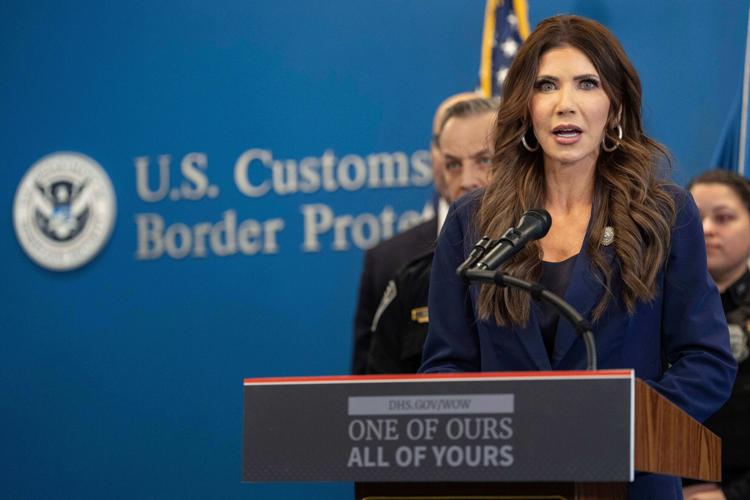
U.S. Homeland Security Secretary Kristi Noem speaks Jan. 8 at a news conference in New York.
Online appeal for the far right
Some of Trump's most prominent supporters openly embraced the cause of white nationalists.
Elon Musk, who was Trump's biggest donor in the 2024 presidential campaign and ran the Department of Government Efficiency for the first part of last year, recirculated a social media post that called for "white solidarity" to prevent the mass murder of white men and added a "100" emoji indicating agreement.
The administration's history led to claims that it uses white supremacist language even when there is no evidence for it.
In the aftermath of Good's shooting in Minnesota, a sign that appeared on Secretary of Homeland Security Kristi Noem's lectern during a news conference — reading "One Of Ours, All Of Yours" — drew widespread attention on social media, with many commentators suggesting it was a Nazi phrase. The Southern Poverty Law Center, however, could not trace the words to any Nazi slogan.
McLaughlin said it was a reference to "a CBP officer who was shot — he was one of our officers and all of the country's federal law enforcement officer."
Hannah Gais, a senior researcher with the SPLC, long tracked white supremacist groups and said she thinks the administration knows what it's doing with its messaging.
"They know their base is this overly online right-winger who they know will go nuts if they say 'Which Way, Western Man?'" Gais said. "I don't think it's a tenable strategy for the long term because the stuff is incomprehensible to most people. And if it is comprehensible, people don't like it."
Anti-ICE nationwide protests in photos

A protester yells at a Portland police officer outside the U.S. Immigration and Customs Enforcement facility on Thursday, Jan. 8, 2026, in Portland, Ore. (AP Photo/Jenny Kane)

An American flag burns outside the U.S. Immigration and Customs Enforcement facility on Thursday, Jan. 8, 2026, in Portland, Ore. (AP Photo/Jenny Kane)

Protesters gather during a demonstration calling for an end to federal immigration enforcement operations and U.S. attacks on Venezuela, Saturday, Jan. 10, 2026, in Los Angeles. (AP Photo/Jill Connelly)

A protester gestures during a demonstration calling for an end to federal immigration enforcement operations and U.S. attacks on Venezuela, Saturday, Jan. 10, 2026, in Los Angeles. (AP Photo/Jill Connelly)

People gather during a protest on Saturday, Jan. 10, 2026 in downtown Durham, NC. (AP Photo/Allen G. Breed)

Demonstrators protest outside the White House in Washington, Saturday, Jan. 10, 2026, against the Immigration and Customs Enforcement agent who fatally shot Renee Good in Minneapolis. (AP Photo/Jose Luis Magana)

Demonstrators protest outside the White House in Washington, Saturday, Jan. 10, 2026, against the Immigration and Customs Enforcement agent who fatally shot Renee Good in Minneapolis. (AP Photo/Jose Luis Magana)

Demonstrators protest outside the White House in Washington, Saturday, Jan. 10, 2026, against the Immigration and Customs Enforcement agent who fatally shot Renee Good in Minneapolis. (AP Photo/Jose Luis Magana)

Demonstrators protest outside the White House in Washington, Saturday, Jan. 10, 2026, against the Immigration and Customs Enforcement agent who fatally shot Renee Good in Minneapolis. (AP Photo/Jose Luis Magana)

Demonstrators march outside the White House in Washington, Saturday, Jan. 10, 2026, against the Immigration and Customs Enforcement agent who fatally shot Renee Good in Minneapolis. (AP Photo/Jose Luis Magana)

Protesters gather during a rally for Renee Good, who was fatally shot by an ICE officer earlier in the week, Saturday, Jan. 10, 2026, in Minneapolis. (AP Photo/John Locher)

People line Dodge Street during a protest against Immigration and Customs Enforcement in Omaha, Neb., on Saturday, Jan. 10, 2026. (Chris Machian/Omaha World-Herald via AP)

Protesters gather during a demonstration calling for an end to federal immigration enforcement operations and U.S. attacks on Venezuela, Saturday, Jan. 10, 2026, in Los Angeles. (AP Photo/Jill Connelly)

People gather around a makeshift memorial honoring Renee Good, who was fatally shot by an ICE officer, near the site of the shooting in Minneapolis, Friday, Jan. 9, 2026. (AP Photo/John Locher)

People march to the U.S. Immigration and Customs Enforcement facility in honor of victims of ICE shootings Friday, Jan. 9, 2026, in Portland, Ore. (AP Photo/Jenny Kane)

A sign for Renee Good, who was fatally shot by an ICE officer in Minneapolis earlier in the week, is seen on the ground alongside candles as people gather outside the U.S. Immigration and Customs Enforcement facility Friday, Jan. 9, 2026, in Portland, Ore. (AP Photo/Jenny Kane)

Minnesota State Patrol officers are seen during a protest and noise demonstration calling for an end to federal immigration enforcement operations in the city, Friday, Jan. 9, 2026, in Minneapolis. (AP Photo/John Locher)

Two people sit in the street with their hands up in front of Minnesota State Patrol during a protest and noise demonstration calling for an end to federal immigration enforcement operations in the city, Friday, Jan. 9, 2026, in Minneapolis. (AP Photo/John Locher)

Minnesota State Patrol officers are seen during a protest and noise demonstration calling for an end to federal immigration enforcement operations in the city, Friday, Jan. 9, 2026, in Minneapolis. (AP Photo/John Locher)

A protester holds up a sign outside the Bishop Henry Whipple Federal Building in Minneapolis, Saturday, Jan. 10, 2026. (AP Photo/Adam Gray)

Rep. Kelly Morrison D-Minn., center, Rep. Ilhan Omar, D-Minn., second from the right, and Rep. Angie Craig, D-Minn., far right, at the Bishop Whipple Federal Building, Saturday, Jan. 10, 2026, in Minneapolis. (AP Photo/Adam Gray)

