

MINNEAPOLIS — President Donald Trump softened his tone Monday on the immigration crackdown in Minnesota, touting productive conversations with the governor and Minneapolis mayor as he sent the border czar to take charge of much of the enforcement effort.
Some federal agents were expected to leave as soon as Tuesday.

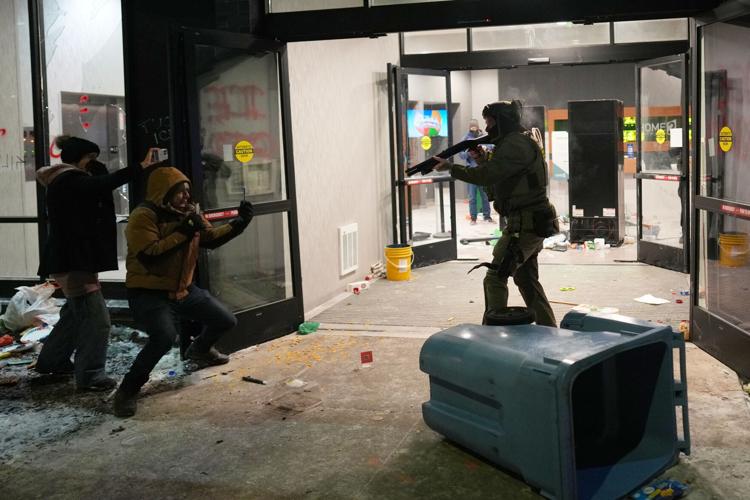
A federal agent points a weapon at a person outside a hotel Sunday during a noise demonstration protest in response to federal immigration enforcement operations in Minneapolis.
Minneapolis Mayor Jacob Frey said he spoke by phone with Trump, who praised the discussion that declared that "lots of progress is being made." Frey said he asked Trump in a phone call to end the immigration enforcement surge and that Trump agreed the present situation cannot continue.
The mayor said some agents would soon leave and that he would keep pushing for others involved in Operation Metro Surge to go.
Among those who are expected to depart was senior Border Patrol commander Greg Bovino, a person familiar with the matter told The Associated Press on condition of anonymity.
Bovino has been at the center of the administration's aggressive enforcement surge in cities nationwide. His departure marks a significant public shift in federal law enforcement posture amid mounting outrage after Border Patrol agents shot and killed 37-year-old ICU nurse Alex Pretti.

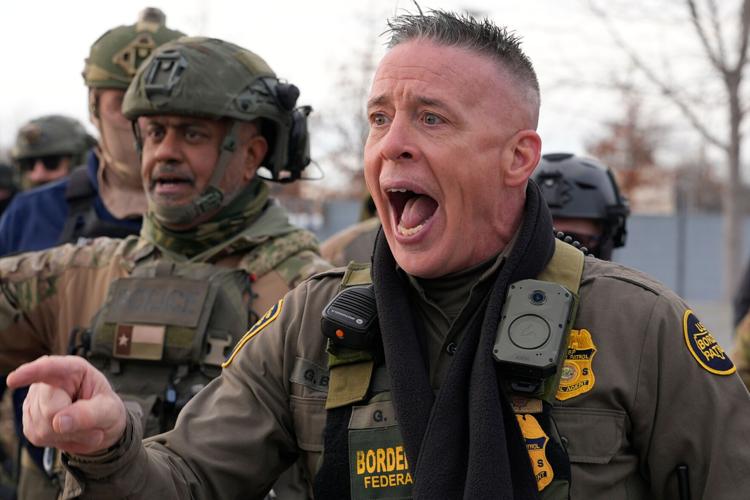
U.S. Border Patrol Cmdr. Gregory Bovino shouts at protesters Jan. 11 in Minneapolis.
Bovino's leadership of highly visible federal crackdowns, including operations that sparked mass demonstrations in Los Angeles, Chicago, Charlotte and Minneapolis, drew fierce criticism from local officials, civil rights advocates and congressional Democrats.
Criticism increased around Bovino in the last few days after his public defense of the Pretti shooting and disputed claims about the confrontation that led to his killing.
The border czar, Tom Homan, will take charge of Immigration and Customs Enforcement operations in Minnesota.

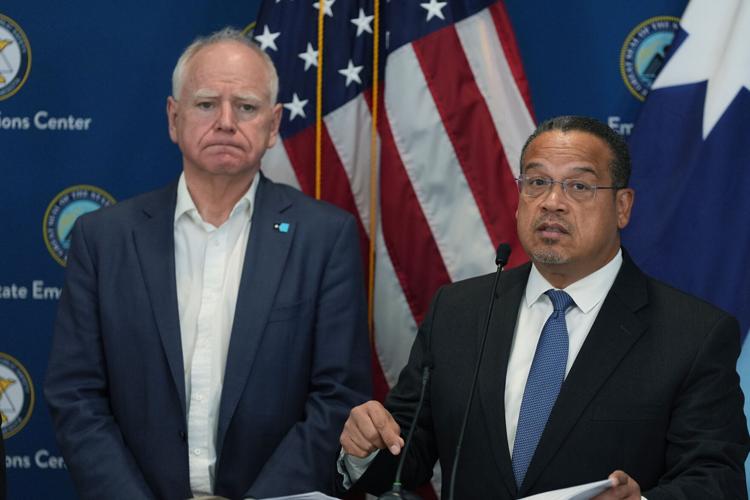
Attorney General Keith Ellison, right, and Minnesota Gov. Tim Walz give a news conference Sunday in Blaine, Minn.
Trump call with Walz
Trump and Democratic Gov. Tim Walz spoke in a phone call and later offered comments that were a marked change from the critical statements they exchanged in the past. Their conversation happened on the same day a federal judge heard arguments in a lawsuit aimed at halting the federal immigration enforcement surge in the state.
"We, actually, seemed to be on a similar wavelength," the president wrote in a social media post.
Walz, in a statement, said the call was "productive" and that impartial investigations into the shootings were needed. Trump said his administration was looking for "any and all" criminals the state has in their custody. Walz said the state Department of Corrections honors federal requests for people in its custody.
Meanwhile, attorneys for the administration, the state and the cities of Minneapolis and St. Paul appeared Monday before U.S. District Judge Katherine Menendez, who is considering whether to grant requests to temporarily halt the immigration operation.
She said the case was a priority, though she issued no immediate ruling.
Lawyers for the state and the Twin Cities argued the situation on the street is so dire it requires the court to halt the federal government's enforcement actions.
"If this is not stopped right here, right now, I don't think anybody who is seriously looking at this problem can have much faith in how our republic is going to go in the future," Minnesota Assistant Attorney General Brian Carter said.

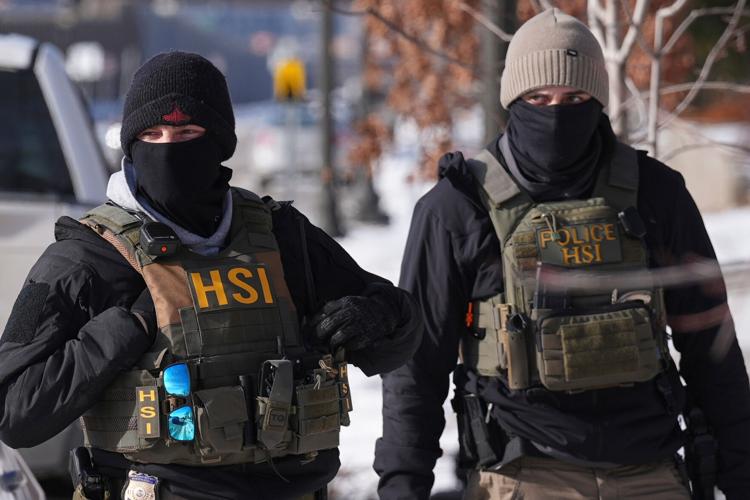
Federal agents stand Monday outside a property in St. Paul, Minn.
Judge questions motives
The judge questioned the government's motivation behind the crackdown and expressed skepticism about a letter recently sent by Attorney General Pam Bondi to Minnesota Gov. Tim Walz. The letter asked the state to give the federal government access to voter rolls, to turn over state Medicaid and food assistance records, and to repeal sanctuary policies.
"I mean, is there no limit to what the executive can do under the guise of enforcing immigration law?" Menendez asked. She noted that the federal requests are the subject of litigation.
Brantley Mayers, a Justice Department attorney, said the government's goal is to enforce federal law. Mayers said one lawful action should not be used to discredit another lawful action.
Menendez made it clear that she was struggling with how to rule because the case is so unusual, and there are few precedents.
"It's because this is important that I'm doing everything I can to get it right," she said.
The state of Minnesota and the cities sued the Department of Homeland Security this month, five days after an Immigration and Customs officer shot and killed Renee Good. Pretti's killing Saturday added urgency to the case.
Late Monday, a federal appeals court declined to lift a temporary hold on a ruling Menendez issued in a separate case on Jan. 16.
She ruled then that federal officers in Minnesota cannot detain or tear gas peaceful protesters who are not obstructing authorities, including people who follow and observe agents. A three-judge panel of the 8th Circuit Court of Appeals said that ruling was unlikely to hold up on appeal.

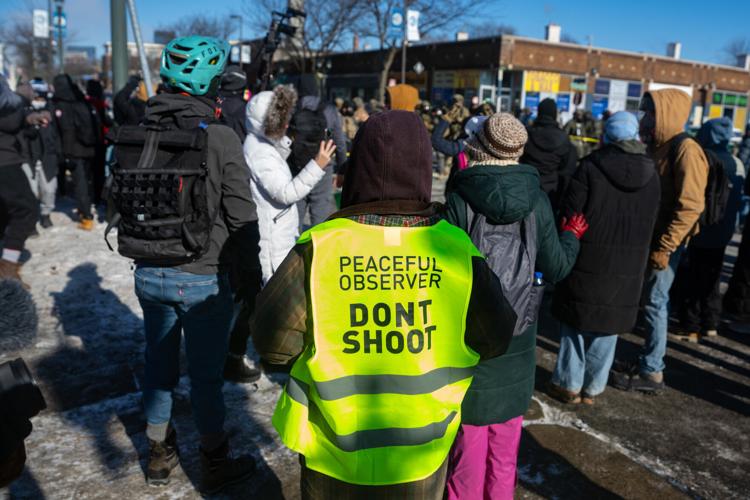
A large crowd gathers at the scene Saturday where federal authorities shot and killed Alex Pretti in Minneapolis.
'Unmitigated disaster'
Meanwhile, lawyer for the immigration officer who shot and killed Good dropped out of the Minnesota governor race Monday, breaking with many fellow Republicans and calling Trump’s immigration operation in the state an “unmitigated disaster.”
Chris Madel's surprise move came amid growing calls from Republicans to investigate federal immigration tactics in Minnesota after a U.S. Border Patrol agent fatally shot Alex Pretti in Minneapolis on Saturday.
Madel went a step further than most Republicans in his video, saying that while he supports the goal of deporting “the worst of the worst” from Minnesota, he thinks the Trump administration's immigration enforcement operation in the Twin Cities has gone too far.
“I cannot support the national Republicans’ stated retribution on the citizens of our state,” Madel said. “Nor can I count myself a member of a party that would do so.”
Madel said that U.S. citizens, “particularly those of color, live in fear.”
“United States citizens are carrying papers to prove their citizenship," Madel said. "That’s wrong.”
Killing in Minnesota intensifies protests

A protester is pepper sprayed at close range while being detained near the site of the fatal shooting of 37-year-old Alex Pretti by federal agents in Minneapolis on Saturday, Jan. 24, 2026. (Ellen Schmidt/MinnPost via AP)

A person holds up their hands as law enforcement deploys a thick screen of teargas on Nicollet Avenue in Minneapolis on Saturday, Jan. 24, 2026. (Ben Hovland/Minnesota Public Radio via AP)

Federal agents deploy tear gas and other munitions into a crowd of people near the intersection of 27th Street and Nicollet Avenue in Minneapolis after a federal officer shot and killed 37-year-old Alex Pretti on Saturday, Jan. 24, 2026. (Ben Hovland/Minnesota Public Radio via AP)

A border patrol agent aims a munition launcher at a crowd of people near the intersection of 27th Street and Nicollet Avenue in Minneapolis after a federal officer shot and killed 37-year-old Alex Pretti on Saturday, Jan. 24, 2026. (Ben Hovland/Minnesota Public Radio via AP)

Minnesota State Patrol officers pass along information on a police line on Nicollet Avenue in Minneapolis on Saturday, Jan. 24, 2026. (Ben Hovland/Minnesota Public Radio via AP)

People gather at the site where a federal officer shot and killed 37-year-old Alex Pretti in Minneapolis on Saturday, Jan. 24, 2026. (Ben Hovland/Minnesota Public Radio via AP)

Homeland Security Secretary Kristi Noem speaks about the man in Minneapolis who was killed by a federal immigration officer earlier in the day during a news conference at Federal Emergency Management Agency headquarters, Saturday, Jan. 24, 2026, in Washington. Behind Noem, from left, are Rodney Scott, commissioner of U.S. Customs and Border Protection, Karen Evans, acting deputy administrator of FEMA, and Gregg Phillips, head of the Office of Response and Recovery at FEMA. (AP Photo/Julia Demaree Nikhinson)

A group of protesters use a dumpster for cover on Nicollet Avenue as federal agents fire crowd control munitions at them after agents fatally shot Alex Pretti in Minneapolis, Minn., on Saturday, Jan. 24, 2026. (Aaron Nesheim/Sahan Journal/Catchlight Local via AP)

A large crowd gathers at the scene where federal agents fatally shot Alex Pretti in Minneapolis, Minn., on Saturday, Jan. 24, 2026. (Aaron Nesheim/Sahan Journal/Catchlight Local via AP)

A mattress is spray painted with "R.I.P. Alex" near the site of the fatal shooting of 37-year-old Alex Pretti by federal agents in Minneapolis, on Saturday, Jan. 24, 2026. (AP Photo/Jack Brook)

A Minnesota State Trooper wears riot gear as protesters fill the site of the fatal shooting of 37-year-old Alex Pretti by federal agents in Minneapolis on Saturday, Jan. 24, 2026. (Ellen Schmidt/MinnPost via AP)

Federal agents point weapons at protesters near the site of the fatal shooting of 37-year-old Alex Pretti by federal agents in Minneapolis on Saturday, Jan. 24, 2026. (Ellen Schmidt/MinnPost via AP)

A protester is detained by a federal agent near the site of the fatal shooting of 37-year-old Alex Pretti by federal agents in Minneapolis on Saturday, Jan. 24, 2026. (Ellen Schmidt/MinnPost via AP)

Protesters advance toward federal agents with their hands up near the site of the fatal shooting of 37-year-old Alex Pretti by federal agents in Minneapolis on Saturday, Jan. 24, 2026. (Ellen Schmidt/MinnPost via AP)

A protester holds a sign outside the Bishop Henry Whipple Federal Building, Saturday, Jan. 24, 2026, in Minneapolis. (AP Photo/Adam Gray)

A Minnesota National Guard vehicle blocks off a road near the scene of a shooting earlier in the day, Saturday, Jan. 24, 2026, in Minneapolis. (AP Photo/Adam Gray)

People walk past a Minnesota National Guard vehicle blocking off a road near the scene of a shooting earlier in the day, Saturday, Jan. 24, 2026, in Minneapolis. (AP Photo/Adam Gray)

Demonstrators hold signs during a protest in response to the fatal shooting of 37-year-old Alex Pretti in Minneapolis earlier in the day Saturday, Jan. 24, 2026, in Los Angeles. (AP Photo/Caroline Brehman)

A demonstrator dressed as Donald Trump participates in a protest in response to the Minneapolis fatal shooting of 37-year-old Alex Pretti Saturday, Jan. 24, 2026, in Los Angeles. (AP Photo/Caroline Brehman)

Protestors fill the intersection in Minneapolis near the site of the fatal shooting of 37-year-old Alex Pretti by federal agents on Saturday, Jan. 24, 2026. (AP Photo/Jack Brook)

A large crowd gathers at the scene where federal agents fatally shot Alex Pretti in Minneapolis, Minn., on Saturday, Jan. 24, 2026. (Aaron Nesheim/Sahan Journal/Catchlight Local via AP)

A protester screams with an injured hand while bystanders help near the site of the fatal shooting of 37-year-old Alex Pretti by federal agents in Minneapolis on Saturday, Jan. 24, 2026. (Ellen Schmidt/MinnPost via AP)

