

DOHA, Qatar — In the midst of his three-country visit to the Middle East, President Donald Trump said Wednesday he urgently wants "to make a deal" with Iran to wind down its nuclear program but Tehran must end its support of proxy groups throughout the Mideast as part of any potential agreement.
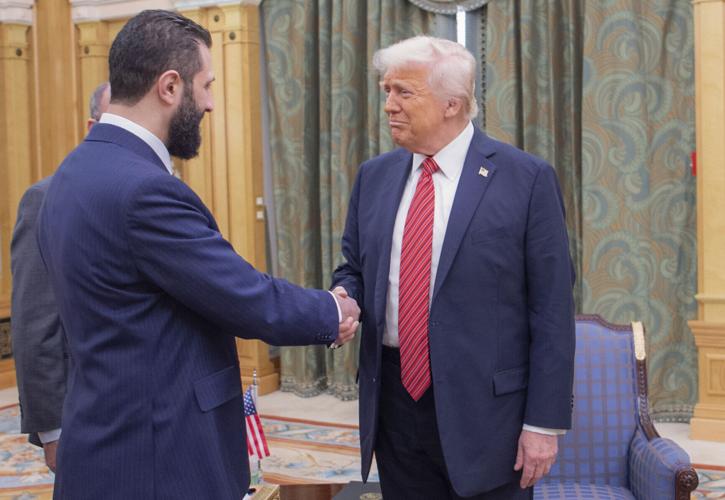
Trump also met with Syria’s interim President Ahmad al-Sharaa — who once had a $10 million U.S. bounty for his arrest — in the first such encounter between the two nations’ leaders in 25 years. The meeting was on the sidelines of Trump's get-together with the leaders of the Gulf Cooperation Council. It marks a major turn of events for a Syria still adjusting to life after the over 50-year, iron-gripped rule of the Assad family.
Under the nom de guerre Abu Mohammed al-Golani, al-Sharaa had ties to al-Qaida and joined insurgents battling U.S. forces in Iraq before entering the Syrian war He even was imprisoned by U.S. troops there for several years.
After the meeting, Trump praised al-Sharaa to reporters on Air Force One. “He’s got a real shot at holding it together," Trump said. "He’s a real leader. He led a charge, and he’s pretty amazing.”
As he kicked off his three-nation Middle East tour in Riyadh the prior day, Trump said he would move to lift U.S. sanctions imposed on Syria under autocrat Bashar Assad, who was ousted from power in December.
Trump told the council after his meeting with al-Sharaa that he was “ordering the cessation of sanctions against Syria to give them a fresh start."
Israeli Prime Minister Benjamin Netanyahu earlier asked Trump not to lift the sanctions, underscoring a growing discontent between the White House and the Israeli government as its war on Hamas in the Gaza Strip rages on. Trump said al-Sharaa agreed to join the Abraham Accords and eventually recognize Israel, but Syria hadn't confirmed that.
Trump also discussed Iran's rapidly advancing nuclear program in one-on-one talks with Qatar's emir, Sheikh Tamim bin Hamad Al Thani. The American president expressed measured confidence that the U.S. effort with Tehran would "work out."
Earlier, at the council meeting hosted by Saudi Arabia's Crown Prince Mohammed bin Salman in Riyadh, Saudi Arabia, Trump made clear he expected Tehran to end its role as the chief financial backer of the militant groups.
Iran "must stop sponsoring terror, halt its bloody proxy wars and permanently and verifiably cease pursuit of nuclear weapons," Trump told the GCC leaders. "They cannot have a nuclear weapon."
Al Thani did not directly address the Iran issue after his session with Trump in Doha. But the emir said U.S.-Qatar cooperation on a broad range of issues was lifting their partnership to "another level of relations."
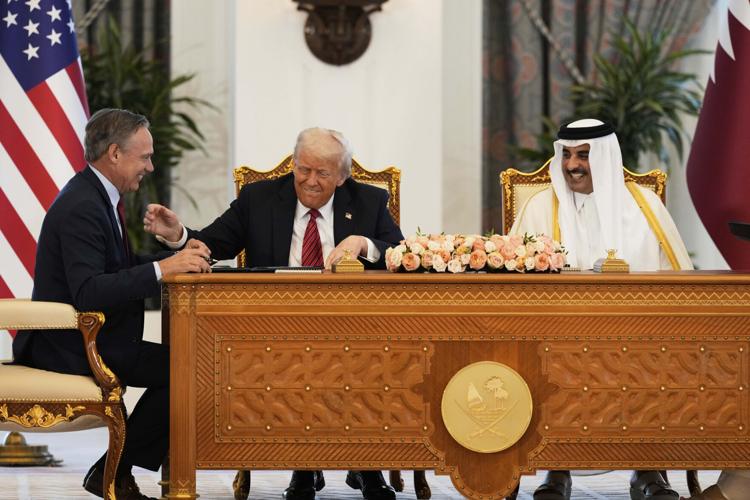
The two leaders, and others from their respective delegations, signed a series of agreements, including one between U.S. aircraft company Boeing and Qatar Airways. The White House said the deal was worth $96 billion.
The U.S. and Iran engaged in four rounds of talks since early last month, and Trump said he believes brokering a nuclear deal is possible but the window is closing.
The U.S. and Iran brokered a nuclear deal in 2015, during Democrat Barack Obama's administration, in which Iran agreed to drastically reduce its stockpile of uranium and only enrich up to 3.67%. Trump scrapped that deal during his first administration.
Today, Iran enriches up to 60%, a short, technical step from weapons-grade levels, and has enough stockpiled for multiple nuclear bombs.
The Qatari emir did not directly address the Iran issue in his public appearances with Trump. Instead, he focused on the potential to expand the U.S.-Qatar defense and economic partnership to “another level of relations.”
The Republican president's latest push on Iran to cease support of Hamas in Gaza, Hezbollah in Lebanon and the Houthis in Yemen come as that proxy network faced significant setbacks in the 19 months since Hamas launched its Oct. 7, 2023, attack on Israel.
Iran's Foreign Minister Abbas Araghchi called Trump's remarks "deceitful" but did not directly address Trump's demand.
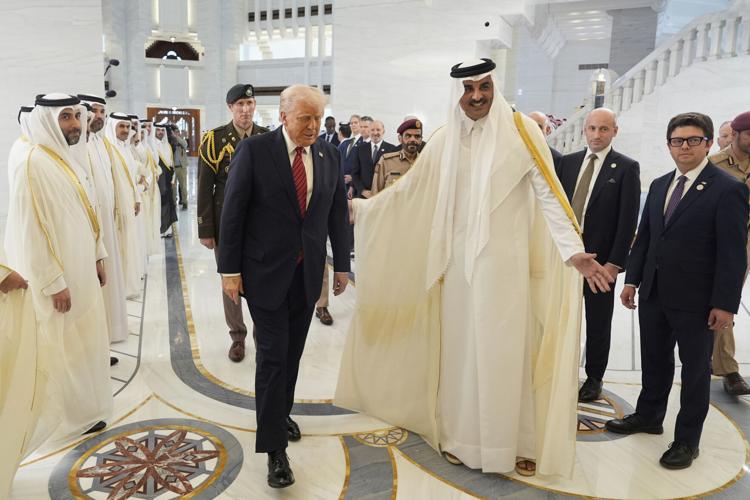
In Qatar, Air Force One was escorted by Qatari F-15 jets as it neared Doha, the capital city.
Al Thani welcomed him. He said he had high hopes for Trump's efforts with Iran and at ending the war in Gaza.
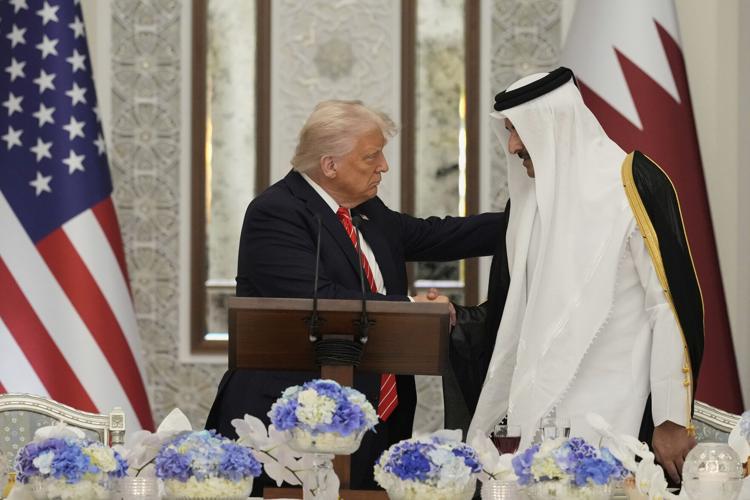
"I know that you are a man of peace," said Al Thani, who later Wednesday honored Trump with a state dinner. "I know that you want to bring peace to this region."
At the dinner, Trump urged Qatar to use its influence over Iran to persuade the country's leadership to reach an agreement with the U.S. to dial back its rapidly advancing nuclear program.
He heads to the United Arab Emirates on Thursday for the final stop of his tour.
Qatar, like the other Gulf Arab states, is an autocratic nation where political parties are banned and speech is tightly controlled. The country also played a central role in scandals around the globe.
Qatar also served as a valuable partner to the U.S. Qatar is also home to Al-Udeid Air Base, which hosts the forward headquarters of the U.S. military's Central Command.
It's a key mediator, particularly with Hamas.
The oil-and-gas rich country is also in the center of a controversy over its offer to provide Trump with the gift of a luxury Boeing 747-8 that the U.S. could use as Air Force One. The Qatari government said a final decision hadn't been made.

