

CARACAS, Venezuela — Hours after an brazen military operation that plucked leader Nicolás Maduro from power and removed him from the country, President Donald Trump said Saturday that the United States would run Venezuela at least temporarily and tap its vast oil reserves to sell to other nations.
The dramatic action capped an intensive Trump administration pressure campaign on the South American nation and its autocratic leader and months of secret planning resulting in the most assertive American action to achieve regime change since the 2003 invasion of Iraq.
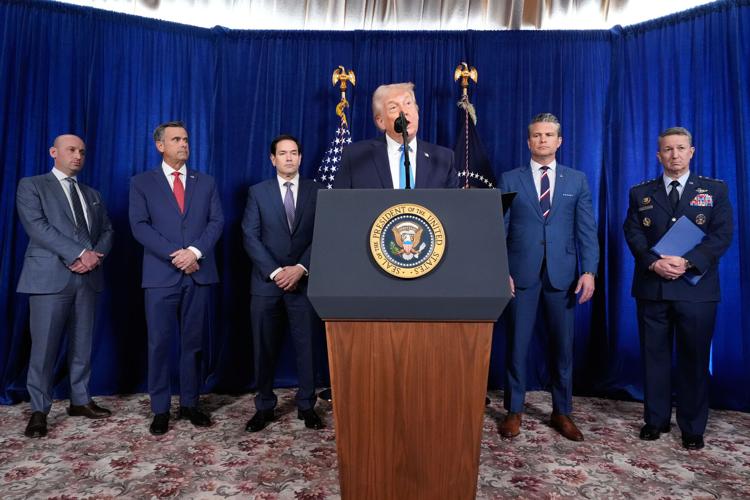
Speaking to reporters hours after Maduro's capture, Trump revealed his plans to exploit the leadership void to “fix” the country’s oil infrastructure and sell “large amounts” of oil to other countries.

President Donald Trump speaks at his Mar-a-Lago club, Saturday, Jan. 3, 2026, in Palm Beach, Fla. (AP Photo/Alex Brandon)
A plane believed to be carrying the deposed leader landed late Saturday afternoon in New York, where he was expected to face criminal charges. Earlier, Trump posted a photo of Maduro wearing a sweatsuit and blindfolded on the USS Iwo Jima.
The legal authority for the operation was not immediately clear, though the Trump administration described it — and earlier deadly strikes on boats in the Caribbean Sea — as necessary to stem the flow of dangerous drugs.
The Trump administration did not notify congressional leaders about the military action until after it was underway, which Secretary of State Marco Rubio said was necessary to preserve the operation's integrity.
Trump also claimed the U.S. government would help run the country and was already doing so, though there were no immediate signs of that. Venezuelan state TV continued to air pro-Maduro propaganda, broadcasting live images of supporters taking to the streets in Caracas in protest.

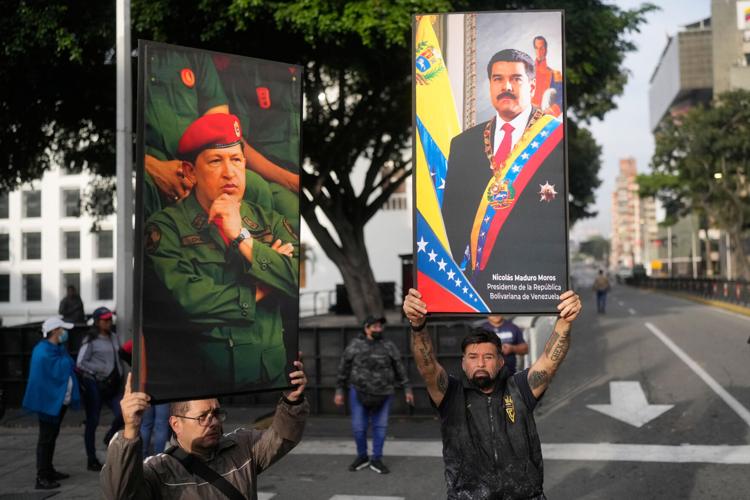
Government supporters display posters of Venezuelan President Nicolás Maduro, right, and former President Hugo Chávez in downtown Caracas, Venezuela, Saturday, Jan. 3, 2026, after U.S. President Donald Trump announced that Maduro had been captured and flown out of the country.
“We're going to run the country until such time as we can do a safe, proper and judicious transition,” Trump said at a Mar-a-Lago news conference where he boasted that this “extremely successful operation should serve as warning to anyone who would threaten American sovereignty or endanger American lives.”
Maduro and other Venezuelan officials were indicted in 2020 on “narco-terrorism” conspiracy charges, but the Justice Department released a new indictment Saturday of Maduro and his wife, Cilia Flores, that painted the regime as a “corrupt, illegitimate government” fueled by a drug trafficking operation that flooded the U.S. with cocaine. The U.S. government does not recognize Maduro as the country's leader.

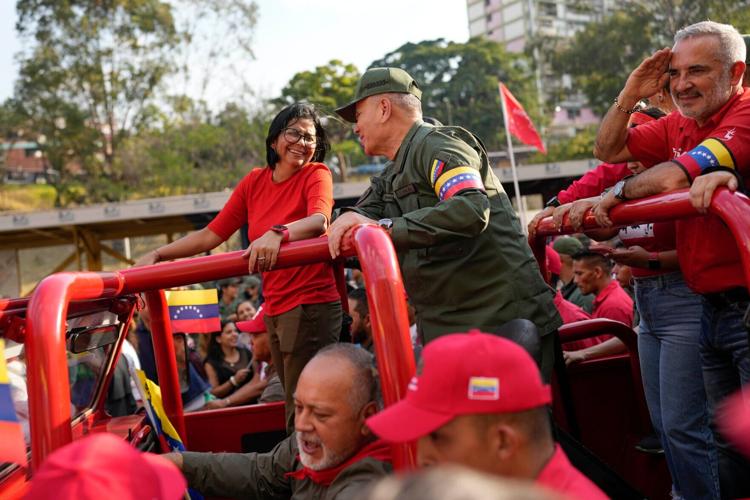
FILE - Vice President Delcy Rodriguez, left, smiles at Venezuelan Defense Minister Padrino Lopez, as they take the route that the body of late President Hugo Chavez was transported to his final resting place, during the activities marking the 10th anniversary of Chavez's death, in Caracas, Venezuela, March 15, 2023. (AP Photo/Matias Delacroix, File)
Vice president calls for Maduro's release
Delcy Rodríguez has served as Maduro's vice president since 2018, overseeing much of Venezuela's oil-dependent economy as well as its feared intelligence service. Under Venezuelan law, she would take over from Maduro.
She faced U.S. sanctions during Trump’s first administration for her role in undermining Venezuelan democracy. Still, she is someone the Trump administration apparently is willing to work with, at least for now.
“She’s essentially willing to do what we think is necessary to make Venezuela great again,” Trump told reporters. He said Rodríguez had a long conversation with Rubio, claiming she said, “‘We’ll do whatever you need.’”
In a major snub, Trump said opposition leader Maria Corina Machado, who was awarded last year's Nobel Peace Prize, didn't have the support to run the country. “I think she was quite gracious,” he added. “We can’t take a chance that somebody else takes over Venezuela that doesn’t have the good of the Venezuelan people in mind.”
Rodríguez tried to project strength and unity among the ruling party's many factions, downplaying any hint of betrayal. In remarks on state TV, she demanded the immediate release of Maduro and his wife and denounced the U.S. operation as a flagrant violation of the United Nations charter.
“There is only one president in this country, and his name is Nicolás Maduro," Rodríguez said, surrounded by top civilian officials and military commanders.
Here's what to know about the large-scale U.S. strike on Venezuela, and the claim by U.S. President Donald Trump that Venezuelan President Nicolás Maduro and his wife have been captured in an operation conducted with U.S. law enforcement.
Early morning attack
The operation followed a monthslong Trump administration effort to push the Venezuelan leader, including a major buildup of American forces in the waters off South America and attacks on boats in the eastern Pacific and Caribbean accused of carrying drugs. Last week, the CIA was behind a drone strike at a docking area believed to have been used by Venezuelan drug cartels — the first known direct operation on Venezuelan soil since the U.S. began strikes in September.
Maduro had decried prior military operations as a thinly veiled effort to oust him from power.
Taking place 36 years to the day after the 1990 U.S. invasion of Panama that led to the surrender and seizure of leader Manuel Antonio Noriega, the Venezuela operation unfolded under the cover of darkness early Saturday as Trump said the U.S. turned off “almost all of the lights" in the capital city of Caracas while forces moved in to extract Maduro and his wife.
Gen. Dan Caine, the chairman of the Joint Chiefs of Staff, said U.S. forces rehearsed their maneuvers for months.
How the US captured Venezuelan leader Nicolás Maduro

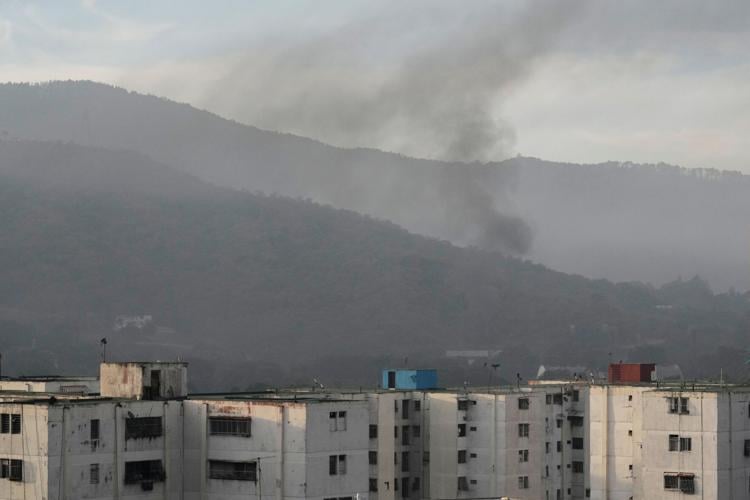
Smoke rises from Fort Tiuna, the main military garrison in Caracas, Venezuela, after multiple explosions were heard and aircraft swept through the area, Saturday, Jan. 3, 2026.
Early Saturday, multiple explosions rang out and low-flying aircraft swept through Caracas. Maduro's government accused the U.S. of attacking civilian and military installations, calling it an “imperialist attack” and urging citizens to take to the streets.
The attack lasted less than 30 minutes and the explosions — at least seven blasts — sent people rushing into the streets, while others took to social media to report what they saw and heard. Some Venezuelan civilians and members of the military were killed, said Vice President Delcy Rodríguez, without giving a number. Trump said some U.S. forces were injured but none were killed.
Video obtained from Caracas and an unidentified coastal city showed tracers and smoke clouding the landscape as repeated muted explosions illuminated the night sky. Other footage showed cars passing on a highway as blasts illuminated the hills behind them. The videos were verified by The Associated Press.
Smoke was seen rising from the hangar of a military base in Caracas, while another military installation in the capital was without electricity.
Earlier in the day, the United States hit Venezuela with a “large-scale strike” and said Maduro had been captured and flown out of the country after months of stepped-up pressure by Washington — an extraordinary nighttime operation announced by President Donald Trump on social media hours after the attack.
Some streets in Caracas fill up
Venezuela’s ruling party has held power since 1999, when Maduro’s predecessor, Hugo Chávez, took office, promising to uplift poor people and later to implement a self-described socialist revolution.
Maduro took over when Chávez died in 2013. His 2018 reelection was widely considered a sham because the main opposition parties were banned from participating. During the 2024 election, electoral authorities loyal to the ruling party declared him the winner hours after polls closed, but the opposition gathered overwhelming evidence that he lost by a more than 2-to-1 margin.
In a demonstration of how polarizing a figure Maduro is, people variously took to the streets to protest his capture or celebrate it.
At a protest in the Venezuelan capital, Caracas Mayor Carmen Meléndez joined a crowd demanding Maduro’s return.
“Maduro, hold on, the people are rising up!” the crowd chanted. “We are here Nicolás Maduro. If you can hear us, we are here!”
From bus driver to president: Venezuela's Maduro never escaped his predecessor's shadow
Earlier, armed people and uniformed members of a civilian militia took to the streets of a Caracas neighborhood long considered a stronghold of the ruling party.
In other parts of the city, the streets remained empty hours after the attack, as residents absorbed events. Some areas remained without power, but vehicles moved freely.
“How do I feel? Scared, like everyone,” said Caracas resident Noris Prada, who sat on an empty avenue looking down at his phone. “Venezuelans woke up scared, many families couldn’t sleep.”
In the Chilean capital of Santiago, people waved Venezuelan flags and banged pots and pans as vehicles passed by honking at them.
In Doral, Florida, home to the largest Venezuelan community in the U.S, people wrapped themselves in Venezuelan flags, ate fried snacks and cheered as music played. At one point, the crowd chanted “Liberty! Liberty! Liberty!”
President Donald Trump says Cuba is "going to be something we'll end up talking about," after the US takes action in Venezuela. “If I lived in Havana and I was in the government, I'd be concerned at least a little bit,” Sec. of State Marco Rubio says.
Questions of legality
Some legal experts raised immediate concerns about the operation's legality.
Lawmakers from both political parties in Congress raised reservations and flat-out objections to the U.S. attacks on boats suspected of drug smuggling near the Venezuelan coast. Congress has not specifically approved an authorization for the use of military force for such operations in the region.
Connecticut Rep. Jim Himes, the top Democrat on the House Intelligence Committee, said he had seen no evidence that would justify Trump striking Venezuela without approval from Congress and demanded an immediate briefing by the administration on "its plan to ensure stability in the region and its legal justification for this decision.”
House Speaker Mike Johnson, a Republican, called it a “decisive and justified operation that will protect American lives" and said the Trump administration was working to schedule briefings.
___
Toropin and Tucker reported from Washington. Associated Press writers Jorge Rueda in Caracas, Venezuela, Lisa Mascaro, Michelle L. Price, Seung Min Kim and Alanna Durkin Richer in Washington, and Larry Neumeister in South Amboy, New Jersey, contributed to this report.
US captures Venezuela's leader in military operation

Men watch smoke rising from a dock Saturday, Jan. 3, 2026, at La Guaira port, Venezuela, after explosions were heard.

Pedestrians walk past destroyed containers Saturday, Jan. 3, 2026, at La Guaira port, Venezuela, after explosions were heard.

Venezuela's President Nicolas Maduro, then Constituent National Assembly President Delcy Rodriguez, left, and first lady Cilia Flores, wave May 24, 2018, as they arrive at the National Assembly in Caracas, Venezuela.

Residents evacuate a building Saturday, Jan. 3, 2026, near the Miraflores presidential palace in Caracas, Venezuela, after explosions and low-flying aircraft were heard.

Soldiers guard the area around the Miraflores presidential palace Saturday, Jan. 3, 2026, in Caracas, Venezuela, after explosions and low-flying aircraft were heard.

Pedestrians walk past the Miraflores presidential palace Saturday, Jan. 3, 2026, in Caracas, Venezuela, after explosions and low-flying aircraft were heard.

Supporters of Venezuelan President Nicolás Maduro embrace Saturday, Jan. 3, 2026, in downtown Caracas, Venezuela, after U.S. President Donald Trump announced Maduro was captured.

Venezuelans celebrate Saturday, Jan. 3, 2026, in Lima, Peru, after U.S. President Donald Trump announced Venezuelan President Nicolas Maduro was captured.

Pro-government armed civilians patrol Saturday, Jan. 3, 2026, in La Guaira, Venezuela, after U.S. President Donald Trump said President Nicolás Maduro was captured.

Smoke rises Saturday, Jan. 3, 2026, from Fort Tiuna, the main military garrison in Caracas, Venezuela, after aircraft swept through the area and multiple explosions were heard.

A destroyed armored vehicle sits Saturday, Jan. 3, 2026, at La Carlota airport in Caracas, Venezuela, after explosions were reported at the site.

Pro-government armed civilians deploy Saturday, Jan. 3, 2026, in Caracas, Venezuela, after U.S. President Donald Trump announced that President Nicolás Maduro was captured.

Police and pro-government armed civilians block streets Saturday, Jan. 3, 2026, in Caracas, Venezuela.

National Guard armored vehicles block an avenue Saturday, Jan. 3, 2026, leading to Miraflores presidential palace in Caracas, Venezuela.

