

President Donald Trump's deployment of the National Guard to Los Angeles to stop protests against his immigration crackdown isn't the first time an elected U.S. official sent troops to thwart unrest over civil rights.
National Guard troops typically are deployed for a variety of emergencies and natural disasters with the permission of governors in responding states. Trump, a Republican, sent about 1,000 California National Guard troops to Los Angeles despite the objections of California Gov. Gavin Newsom and Los Angeles Mayor Karen Bass, both Democrats.
Confrontations began when dozens of protesters gathered outside a federal detention center demanding the release of more than 40 people arrested by federal immigration authorities across Los Angeles as part of Trump's mass deportation campaign.
Trump said he had to federalize the troops to "address the lawlessness" in California. Newsom said Trump's order was a "complete overreaction" that was "purposely inflammatory and will only escalate tensions."
Some previous National Guard deployments restored peace after violent crackdowns from local law enforcement or vigilante violence, but sometimes troops intensified tensions in communities and with people who were protesting for civil rights or racial equality.
"The people's right to peacefully exercise their collective power and challenge this administration's unjust policies targeting Black and Brown communities must be protected," leaders of eight legacy civil rights groups, including the NAACP, the National Action Network and the Legal Defense Fund, said.

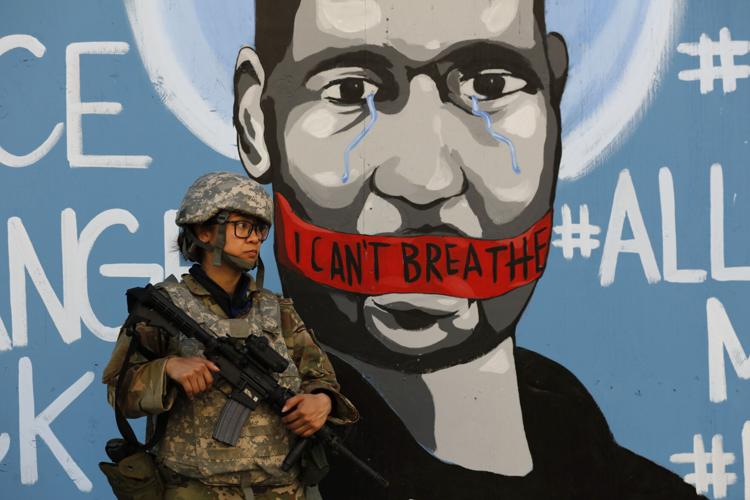
A member of the California National Guard stands in front of a mural depicting George Floyd on June 4, 2020, in Los Angeles.
At the Movement for Black Lives, a coalition of racial justice organizations, Amara Enyia expressed concern that the federal troop deployment could result in disproportionate arrests and more severe charges for the Black protestors, as was true during protests in 2020 after the police murder of George Floyd, an unarmed Black man, in Minneapolis.
Military and police officers will have an "everything is a target" mentality, said Enyia, co-executive director of the coalition's programs, campaigns and policy work.
"It is a very frightening proposition, one that does not bode well for the rights of people in this country," she said.
On rare occasion, presidents invoked an 18th-century wartime law called the Insurrection Act, which is the main legal mechanism that a president can use to activate the military or National Guard during times of rebellion or unrest. Other times they relied on another federal law that allows the president to federalize National Guard troops under certain circumstances, which is what Trump did.
Still, some experts say the current standoff in Los Angeles is not comparable, from a legal perspective, to past situations.
"I think that the provision that Trump is using is really an exception to the norm," said Bernadette Meyler, a professor of constitutional law at Stanford University.
Here's a look at some notable past deployments:

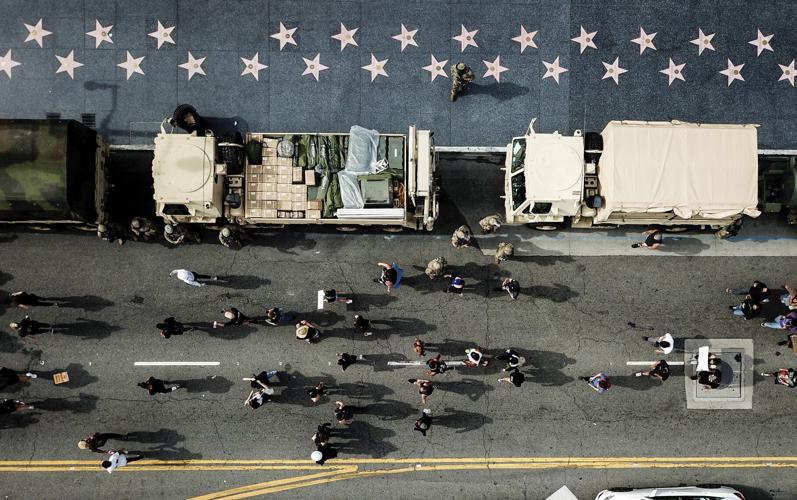
Members of the National Guard watch June 2, 2020, as demonstrators march along Hollywood Boulevard in Los Angeles during a protest over the Minneapolis police killing of George Floyd, an unarmed Black man.
2020: George Floyd protests
Almost five years ago, Newsom deployed about 8,000 National Guard troops to quell protests over racial injustice inspired by Floyd's killing in Minnesota. Well over half the troops deployed in California were sent to Los Angeles County, where police arrested more than 3,000 people. City officials, including then-Los Angeles Mayor Eric Garcetti, supported Newsom's decision.
Yale historian Elizabeth Hinton, who wrote a book about race-related uprisings and police violence, said the 2020 protests were characterized as violent but for the most part were not.
That's even truer today, she said.
"There is no imminent threat that would require the mass deployment of militarized troops," Hinton said.

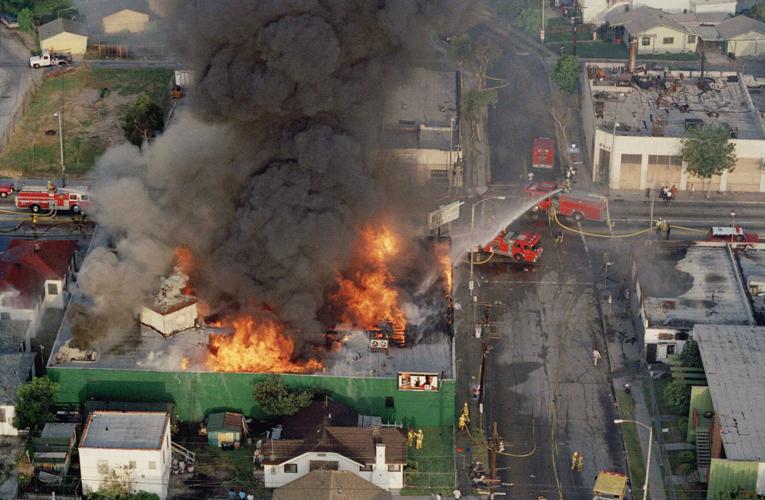
A fire burns out of control April 30, 1992, at the corner of 67th Street and West Boulevard in south-central Los Angeles.
1992: Rodney King protests

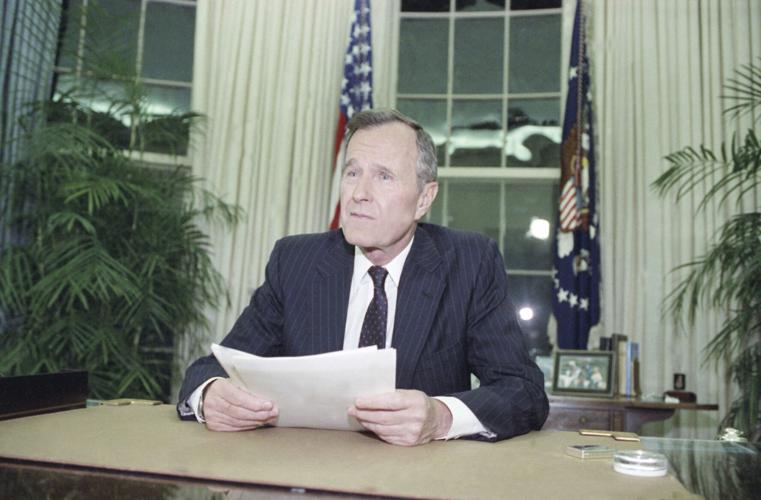
President George H.W. Bush addresses the nation May 1, 1992, from the Oval Office in Washington.
Some compared Trump's decision to George H.W. Bush's use of the Insurrection Act to respond to the 1992 uprising in Los Angeles after the acquittal of white police officers who were videotaped severely beating King, a Black motorist. In just six days, the protests became among the deadliest in American history. Sixty-three people died, nine of whom were killed by police.
Syreeta Danley, a teacher from South Central Los Angeles, said she vividly remembers as a teen seeing black smoke from her porch during the 1992 uprisings.
She said some people in her neighborhood were still more afraid of the police than the National Guard because once the troops left, city police "had the green light to continue brutalizing people."
The National Guard can enforce curfews like it did in 1992, but that won't stop people from showing up to protest, Danley said.
"I have lived long enough to know that people will push back, and I'm here for it," she said.
1965: Watts protests
There were deadly protests in the Watts neighborhood of Los Angeles in 1965 in response to pent-up anger over an abusive police force and lack of community resources. More than 30 people were killed, two-thirds of whom were shot by police or National Guard troops. Many say the neighborhood never fully recovered from fires that leveled hundreds of buildings.
Breeze McDonald, a doctoral student and school district employee from South Central Los Angeles, says she is still haunted by scars her aunt sustained after she was hosed down during the 1965 protests, and her own memories of the 1992 uprisings.
"A lot of the anger happened because our voices weren't being heard," McDonald said, "Because instead of stopping to listen, you decided to employ the National Guard."

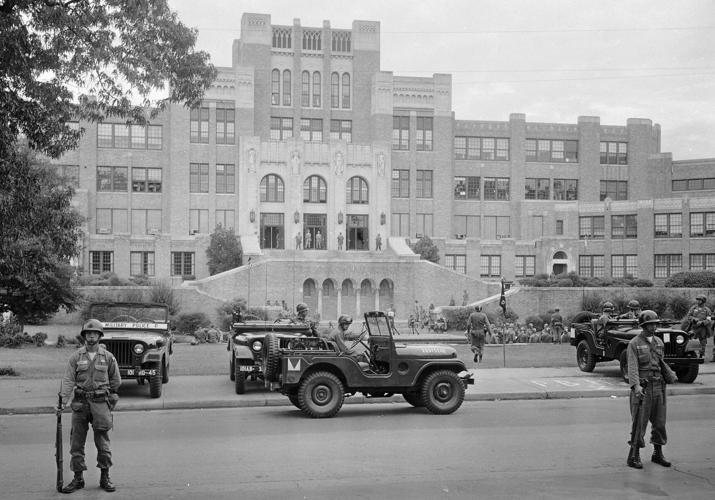
Members of the 101st Airborne Division take up positions Sept. 26, 1957, outside Central High School in Little Rock, Ark., to enforce integration at the school.
1950 and 1960s: Integration protests
In 1956, the governor of Tennessee assigned National Guard troops to help enforce integration in Clinton, Tennessee, after white supremacists violently resisted federal orders to desegregate.
President Dwight Eisenhower called the Arkansas National Guard and the 101st Airborne Division of the U.S. Army in 1957 to escort nine Black students to integrate a white-only school.
In 1963, Maryland's Democratic Gov. J Millard Tawes deployed the Maryland National Guard to the small town of Cambridge to mediate violent clashes between white mobs and Black protesters demanding desegregation. The troops remained there for two years.

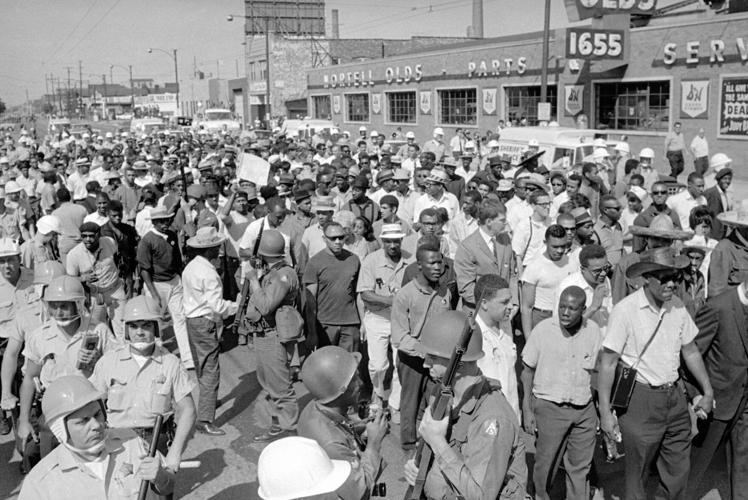
Demonstrators take part in a civil rights march Sept. 4, 1966, in a Chicago suburb near police, left, and National Guardsmen with bayonets on their rifles.
1965: Voting rights protest
National Guard troops played a pivotal role in the march often credited with pressuring the passage of the Voting Rights Act of 1965.
Nonviolent protesters calling for the right to vote — including the late Congressman John Lewis — were brutally assaulted by state troopers in Selma, Alabama.
Two weeks later, then-President Lyndon B. Johnson sent National Guard troops to escort thousands of protesters along the 50-mile march to the state Capitol. Johnson's decision was at odds with then-Gov. George Wallace, who staunchly supported segregation.
Photos: Protesters clash with law enforcement in Los Angeles

California National Guard guard the Federal Building on Tuesday, June 10, 2025, in downtown Los Angeles. (AP Photo/Eric Thayer)

Diego Coloma rests on a railing as he looks on at law enforcement officers during a protest on Tuesday, June 10, 2025, in Los Angeles. (AP Photo/Eric Thayer)

A man raises his fist as California National Guardsmen look on during a protest on Tuesday, June 10, 2025, in Los Angeles. (AP Photo/Eric Thayer)

Demonstrators march during a protest Tuesday, June 10, 2025, in Los Angeles. (AP Photo/Eric Thayer)

Protesters gather to denounce ICE, U.S Immigration and Customs Enforcement, operations Tuesday, June 10, 2025, in Los Angeles. (AP Photo Damian Dovarganes)

California Highway Patrol officers clash with protesters on Tuesday, June 10, 2025, in Los Angeles. (AP Photo/Eric Thayer)

California Highway Patrol push protesters back along a street during a protest on Tuesday, June 10, 2025, in Los Angeles. (AP Photo/Eric Thayer)

A protester yells at police and federal agents in an action to denounce the ICE, U.S. Immigration and Customs Enforcement, operations in the area Tuesday, June 10, 2025, in downtown Los Angeles. (AP Photo/Eric Thayer)

A protester is arrested by California Highway Patrol near the federal building in downtown Los Angeles on Tuesday, June 10, 2025. (AP Photo/Eric Thayer)

Protesters are detained by law enforcement near the federal building in downtown Los Angeles on Tuesday, June 10, 2025. (AP Photo/Eric Thayer)

A protester is arrested by California Highway Patrol near the federal building in downtown Los Angeles on Tuesday, June 10, 2025. (AP Photo/Eric Thayer)

A protester offers a flower to Los Angeles police officers in riot gear while they attempt to clear a street in downtown Los Angeles on Monday, June 9, 2025. (AP Photo Jae Hong)

A person carrying multiple flags walks past a burning car during protests over the Trump administration's immigration raids in Los Angeles, Monday, June 9, 2025. (AP Photo/Ethan Swope)

Protesters jump over a fence to avoid being kettled by police during protests over the Trump administration's immigration raids in Los Angeles, Monday, June 9, 2025. (AP Photo/Ethan Swope)

An injured protester is tended to by another during protests over the Trump administration's immigration raids in Los Angeles, Monday, June 9, 2025. (AP Photo/Ethan Swope)

Protesters gather outside the federal building to denounce the ICE, U.S. Immigration and Customs Enforcement, operations in the area Tuesday, June 10, 2025, in downtown Los Angeles. (AP Photo/Eric Thayer)

Tear gas fills the street as protesters confront Border Patrol personnel during a demonstration over the dozens detained in an operation by federal immigration authorities a day earlier, in Paramount, Calif., on Saturday, June 7, 2025. (AP Photo/Eric Thayer)

A car burns during a protest in Compton, Calif., Saturday, June 7, 2025, after federal immigration authorities conducted operations. (AP Photo/Eric Thayer)

A person carries an injured protester to cover during a protest in Compton, Calif., Saturday, June 7, 2025, after federal immigration authorities conducted operations. (AP Photo/Ethan Swope)

Authorities stand in tear gas while trying to clear protesters at the metropolitan detention center in downtown Los Angeles, Sunday, June 8, 2025, following last night's immigration raid protest. (AP Photo/Jae Hong)

A protester is detained by police in downtown Los Angeles, Sunday, June 8, 2025, following last night's immigration raid protest. (AP Photo/Eric Thayer)

A protester is detained in downtown Los Angeles, Sunday, June 8, 2025, following last night's immigration raid protest. (AP Photo/Eric Thayer)

A police officer's face is covered in pepper spray outside the Metropolitan Detention Center of downtown Los Angeles, Sunday, June 8, 2025, following last night's immigration raid protest. (AP Photo/Jae Hong)

Maribel Parra screams as protesters confront a line of police near the metropolitan detention center of downtown Los Angeles, Sunday, June 8, 2025, following last night's immigration raid protest. (AP Photo/Jae Hong)

Protesters are seen on the 101 Freeway near the Metropolitan Detention Center of downtown Los Angeles, Sunday, June 8, 2025, following last night's immigration raid protest. (AP Photo/Eric Thayer)

A protester throws a smoke canister on the 101 Freeway near the Metropolitan Detention Center of downtown Los Angeles, Sunday, June 8, 2025, following last night's immigration raid protest. (AP Photo/Eric Thayer)

Protesters confront police on the 101 Freeway near the Metropolitan Detention Center of downtown Los Angeles, Sunday, June 8, 2025, following last night's immigration raid protest. (AP Photo/Jae C. Hong)

A protester holds a sign as a Waymo taxi burns near the metropolitan detention center of downtown Los Angeles, Sunday, June 8, 2025, following last night's immigration raid protest. (AP Photo/Eric Thayer)

A police officer fires a soft round near the metropolitan detention center of downtown Los Angeles, Sunday, June 8, 2025, following last night's immigration raid protest. (AP Photo/Eric Thayer)

Protesters take cover behind chairs near the Metropolitan Detention Center in downtown Los Angeles, Sunday, June 8, 2025, following last night's immigration raid protest. (AP Photo/Eric Thayer)

Officers make their way down a ramp to the 101 Freeway near the Metropolitan Detention Center in downtown Los Angeles, Sunday, June 8, 2025, following last night's immigration raid protest. (AP Photo/Jae C. Hong)

Matt Hobbs uses milk after being teargassed near the Metropolitan Detention Center in downtown Los Angeles, Sunday, June 8, 2025, following last night's immigration raid protest. (AP Photo/Jae C. Hong)

Two California Highway Patrol officers try to dodge rocks being thrown near the Metropolitan Detention Center in downtown Los Angeles, Sunday, June 8, 2025, following last night's immigration raid protest. (AP Photo/Jae C. Hong)

A protester throws a scooter at a police vehical near the metropolitan detention center of downtown Los Angeles, Sunday, June 8, 2025, following last night's immigration raid protest. (AP Photo/Jae C. Hong)

EDS NOTE: OBSCENITY A flash bomb explodes on the 101 Freeway near the metropolitan detention center of downtown Los Angeles, Sunday, June 8, 2025, following last night's immigration raid protest. (AP Photo/Eric Thayer)

People take cover as a fire work explodes during a protest near the Metropolitan Detention Center in downtown Los Angeles, Sunday, June 8, 2025. (AP Photo/Ethan Swope)

A woman waves the Mexican flag as flames erupt from a burning dumpster during a protest in downtown Los Angeles, Sunday, June 8, 2025. (AP Photo/Ethan Swope)

A California Highway Patrol officer pulls an electric scooter off a vehicle on a highway as protesters throw objects at the police vehicles near the Metropolitan Detention Center in downtown Los Angeles, Sunday, June 8, 2025. (AP Photo/Ethan Swope)

