

Earlier this month, three independent scientific analyses — from NASA, NOAA and CopernicusEU — examined the global temperature for September 2023. Each of them reported last month as the hottest September on record.
While it has been warmer in Earth’s distant past, it is increasingly likely that 2023 will be the hottest calendar year since human civilizations began to develop — once the last ice age ended around 10,000 years ago.
Figuring out the global climate before thermometers involves an understanding of geology and chemistry to decode the temperature of the planet — a study known as paleoclimatology.

Mann
Digging deep into coastal sediments and glaciers reveals mud and ice that is hundreds of thousands of years old. Sediment samples drilled from deep seabeds can go back ever further. Examining the chemistry of the samples tells us about the previous climate.
For starters, oxygen atoms have naturally occurring isotopes, meaning they have different numbers of neutrons within their atomic structure. And there are two stable versions: oxygen-16 (light) and oxygen-18 (heavy).
Climate scientist Michael Mann is the director of Science, Sustainability and the Media at the University of Pennsylvania, and he is among the many scientists using this method to reconstruct Earth’s climate.

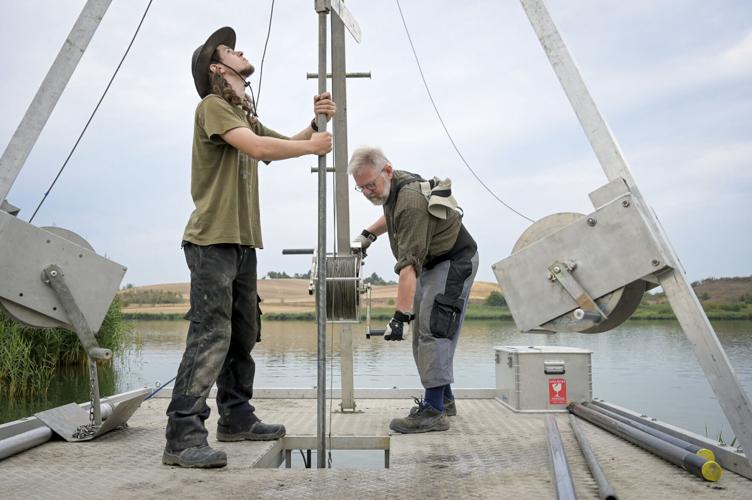
Finn Oejen, left, and Georg Heumann lower a drill pipe from a platform Aug. 18, 2022, into Germany's Lake Binder. The drilling in the lake is the start of a four-year project to obtain reliable data on climate history.
Mann described the basic premise: “When you form precipitation, you condense water vapor into a droplet, there is what we call fractionation, where the heavy and the light isotopes behave differently during that process. That's true for evaporation, it's true for condensation.”
In effect, the ratio of those isotopes within a sample directly relates to the temperature at the time they were created.
“We can say something about temperature from oxygen isotopes in sediment cores. We can say something about temperature from ice cores on land,” Mann said.
There are other elements that can be used to crack the climate code.
“It isn't just oxygen. We can look at carbon isotopes because there's carbon-12 and carbon-13, two different stable isotopes of carbon. And that allows us to figure out what happened with carbon dioxide and ocean acidification — how much carbon dioxide was dissolved in the ocean,” Mann said.

Climate is always changing. But it’s the rate of change right now that is most concerning to the scientific community. The fossil fuels being used to power our society are returning carbon to the atmosphere and oceans at an alarming rate compared to geological records.
“We're taking carbon that was buried over 100 million years and we're putting it back up in the atmosphere over 100 years,” Mann said.

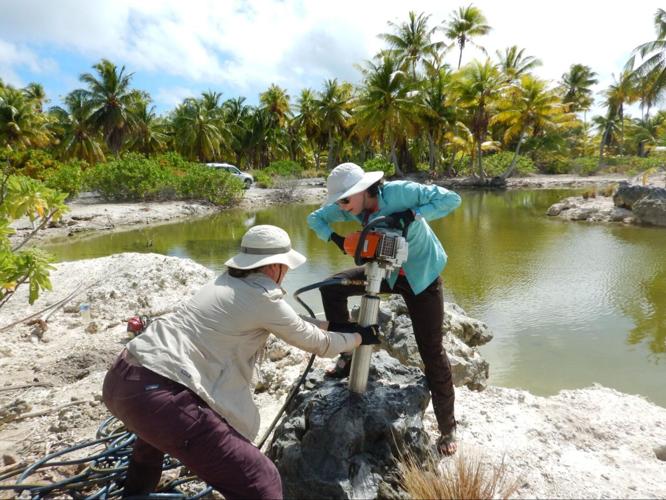
Pamela Grothe, an assistant professor at the University of Mary Washington in Fredericksburg, Va., with help from Florida State University assistant professor Alyssa Atwood, drills into 5,000-year-old coral as part of their research in 2018 on Christmas (Kiritimati) Island.
The ability to adapt is the concern.
“It's not so much how warm the planet is or what the CO2 levels are," Mann said. "It's what climate are you adapted to and how rapidly are you moving away from that climate.”
About the Across the Sky podcast. The weekly weather podcast is hosted on a rotation by the Lee Weather team: Matt Holiner of Lee Enterprises' Midwest group in Chicago, Kirsten Lang of the Tulsa World in Oklahoma, Joe Martucci of the Press of Atlantic City, N.J., and Sean Sublette of the Richmond Times-Dispatch in Virginia.
Mann points to how temperatures stabilized after the ice age. "It turns out, global temperatures were remarkably stable for six, seven, eight thousand years, during which we developed all of this infrastructure that supports eight billion people. And we are dependent on the stability of that climate and its ability to continue to support that infrastructure which we've created,” he said.
Repeatedly, he invokes both urgency and agency regarding the warming climate. To caution against doomism, he has reviewed the paleoclimate record for geological evidence suggesting a rapid, runaway warming has happened in the past.
Within that record, Mann shares comforting news.
“The science certainly doesn't support the notion that we can't do something about the climate crisis. And the paleoclimate record certainly doesn't support that either,” he said.
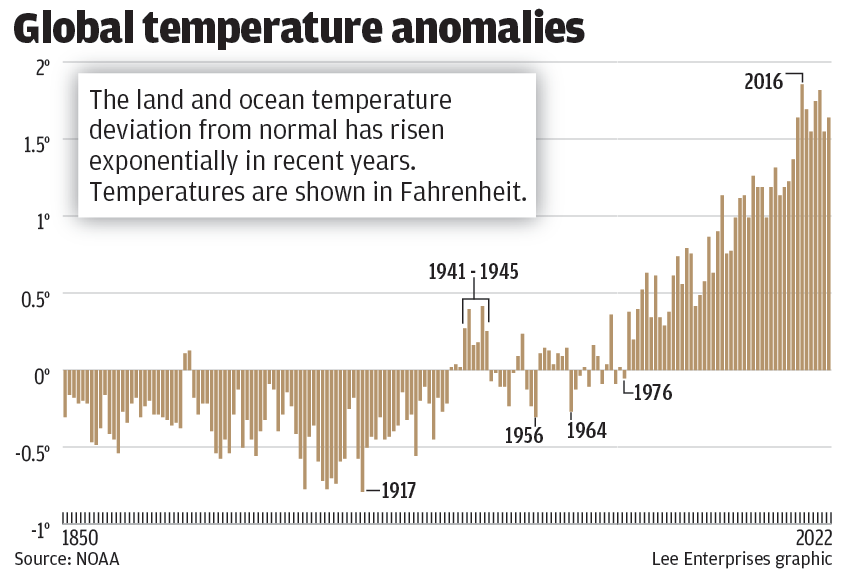
In the end, it is about time.
“Life has learned to adapt to climate changes that take place over tens of millions of years. That's pretty easy. Adapting to climate changes of similar magnitude that take place over tens of years, that's much more difficult,” Mann said.
Sean Sublette is the chief meteorologist for the Richmond Times-Dispatch in Virginia.

