

SALT LAKE CITY (AP) — The largest natural lake west of the Mississippi is shrinking past its lowest levels in recorded history, raising fears about toxic dust, ecological collapse and economic consequences. But the Great Salt Lake may have some new allies: conservative Republican lawmakers.
The new burst of energy from the GOP-dominated state government comes after lake levels recently hit a low point during a regional megadrought worsened by climate change. Water has been diverted away from the lake for years, though, to supply homes and crops in Utah. The nation's fastest-growing state is also one of the driest, with some of the highest domestic water use.
This year could see big investment in the lake that's long been an afterthought, with Gov. Spencer Cox proposing spending $46 million and the powerful House speaker throwing his weight behind the issue. But some worry that the ideas advancing so far at the state Legislature don't go far enough to halt the slow-motion ecological disaster.
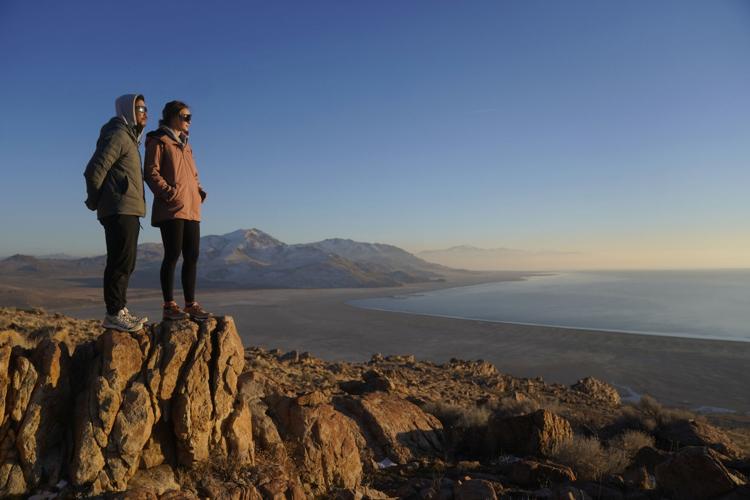
Experts say growing demand for water, drought, and impacts from climate change are taking a toll on the Great Salt Lake in Utah.
One proposal would tackle water use in homes and businesses, by measuring outdoor water that's considered some of the country's cheapest. Another would pay farmers for sharing their water downstream, and a third would direct money from mineral-extraction royalties to benefit the lake.
"I long took for granted the lake. It's always been there, and I've assumed it always would be there," said House speaker Brad Wilson at a summit he convened on the issue. But learning about the lake's precarious position this summer left him terrified. "The Great Salt Lake is in trouble. ... We have to do something."

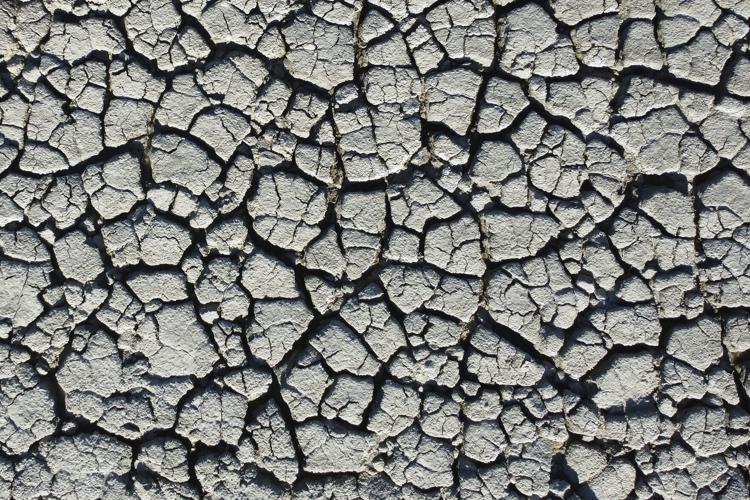
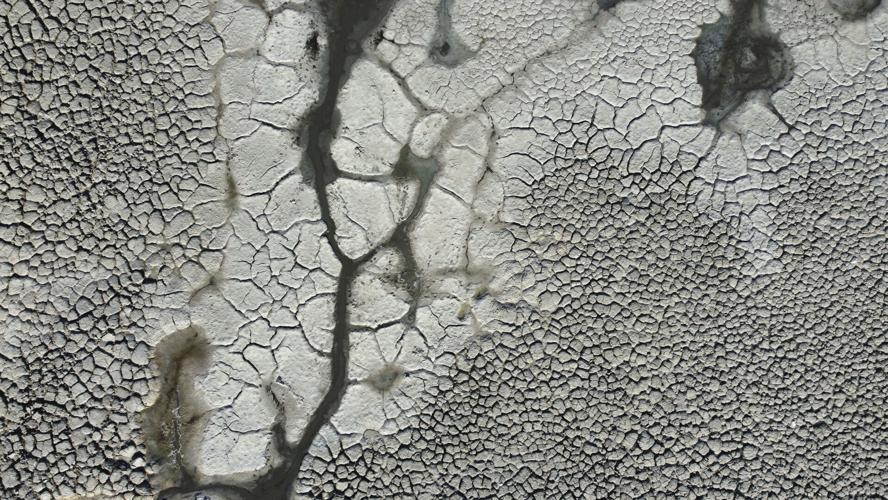
Water pools on cracked mud along the Great Salt Lake Saturday, Jan. 29, 2022, at Antelope Island, Utah.
The shrinking of the lake poses serious risks to millions of migrating birds and a lake-based economy that's worth an estimated $1.3 billion in mineral extraction, brine shrimp and recreation. Health risks exist too: The massive dry lakebed could send arsenic-laced dust into the air that millions breathe.
"The Great Salt Lake needs some leaps to be saved. It's not going to do it with baby steps," said Zach Frankel, executive director of the nonprofit Utah Rivers Council. "These are tiny baby steps that should have been taken 20 years ago."
The lake took a pummeling last year, with especially devastating effects on its microbialites, the Great Salt Lake's version of a coral reef. The mushroom-like structures are formed by furry, deep green mats of microbes, which are the base of the lake's food chain and main sustenance for brine shrimp.

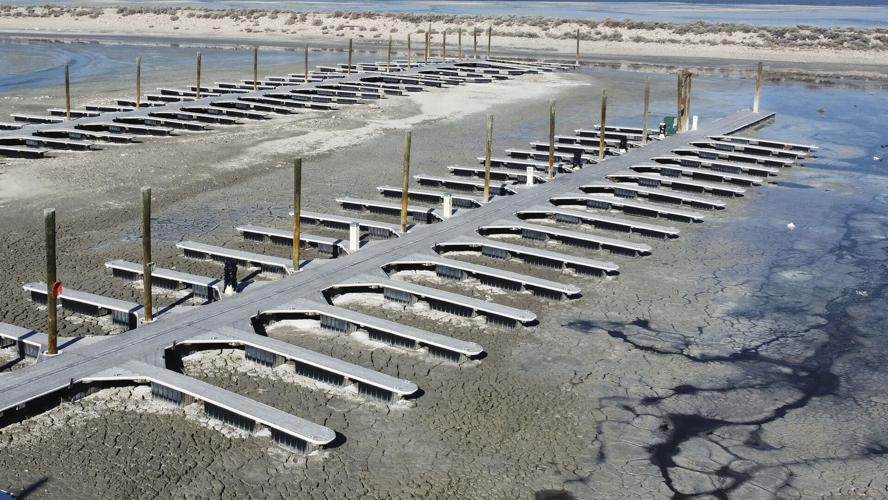
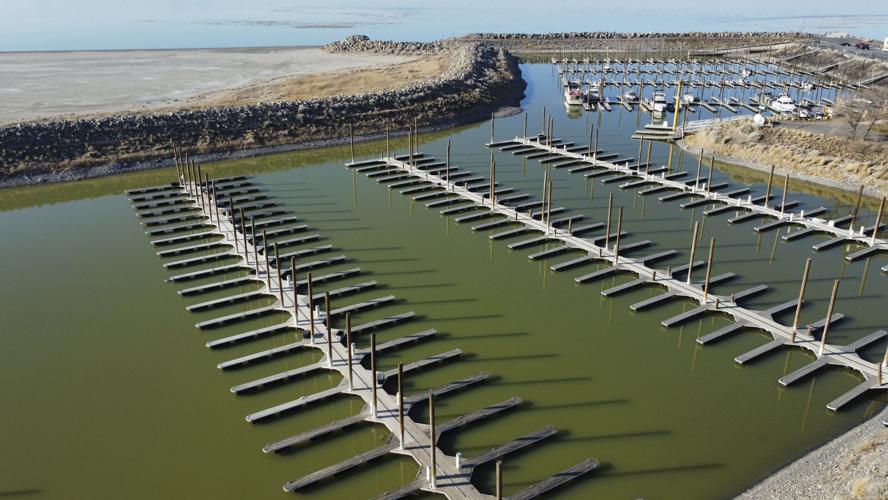
Mud surrounds the boat dock Saturday, Jan. 29, 2022, at Antelope Island, Utah.
The shrimp both support a multimillion-dollar industry supplying food for fish farms and nourish millions of migrating birds whose massive flocks can show up on radar. The lake is also the nation's biggest source of magnesium and could soon provide lithium, a key mineral for renewable energy batteries.
But last year the lake matched a 170-year record low and kept dropping, hitting a new low of 4,190.2 feet (1,277.2 meters) in October. A significant portion of the microbialites were exposed to air, killing the vital microbes. The die-off will likely take years and years to repair even if they are fully submerged again, said Michael Vanden Berg, a state geologist.
And if the water levels continue to drop, the lake could get too salty for the edible microbes to survive, something that's already happened in the bright pink waters of the lake's north arm.

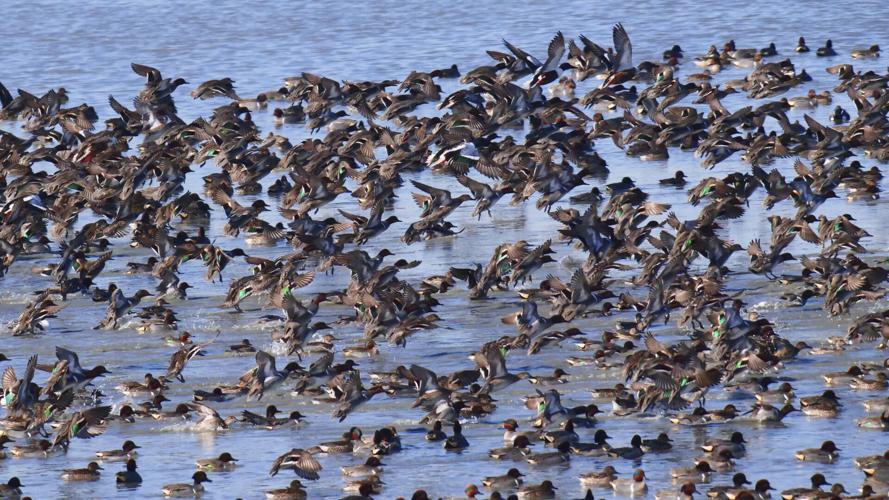
Migrating birds are shown at the Great Salt Lake Saturday, Jan. 29, 2022, in Antelope Island, Utah.

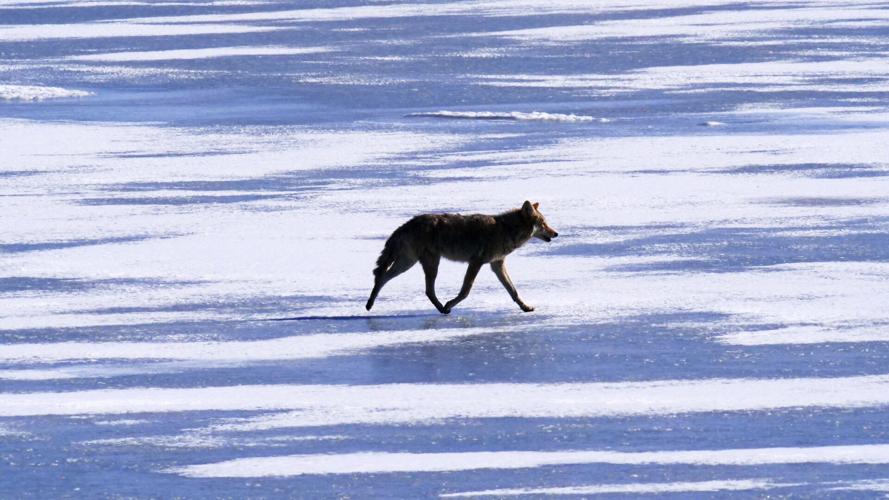
A coyote travels across ice formed on the Great Salt Lake Monday, Jan. 31, 2022, on Antelope Island, Utah. Millions of migrating birds stop at the Great Salt Lake, and American white pelicans nest there on what had long been a remote island. But now they are facing new challenges, including declining lake levels that have exposed a land bridge to the island, allowing coyotes and foxes to cross.
Still, Vanden Berg is cautiously optimistic for the south arm, where a portion of the green microbialites did survive last year's lake drop.
"It's bad but not catastrophic yet," he said. "There is still time to fix and mitigate the situation."
In some ways, the fix is simple: More water needs to flow into the lake.
But that's no small task in the state that grew by 18.4% over the past decade, to nearly 3.28 million people.
Utah has relatively inexpensive water overall. A 2015 state audit found Salt Lake City water prices were lower than almost every other city surveyed, including Phoenix, Las Vegas and Santa Fe.
But a subset of homes have access to especially low-price water — the cheapest in the nation, according to the Utah Rivers Council.

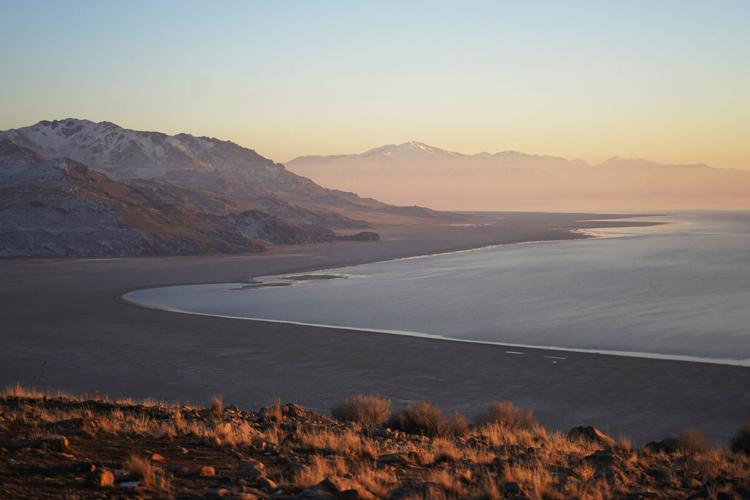
Antelope Island State Park visitors view a dry lake bed at the receding edge of the Great Salt Lake Friday, Jan. 28, 2022, at Antelope Island, Utah.
About 200,000 homes and businesses pay a flat fee for an entire season of irrigation water. It's called a secondary water system, made from converted agricultural supply in communities that are now largely suburban. Those account for a disproportionately large segment of the state's water use — and many of them are on the Great Salt Lake watershed, Frankel said.
"It's like an all-you-can-eat buffet," he said. While most people have a water meter on the side of their homes, usage isn't measured for secondary-water users.
But small-scale projects have shown that simply being aware of how much they're using makes people cut back by 20%, said GOP Utah Rep. Tim Hawkes.
There's been pushback to change the system before, and part of the reason is the per-meter cost of about $1,500, but the governor has backed spending about $250 million in federal pandemic relief money to install them.
The Utah Rivers Council would like to see people pay more for that water, but there's been little public discussion of that this year. Hawkes argues that even conserving 20% through awareness would dramatically increase the chances that the lake stays healthy.
This year is shaping up to be a wetter year than 2021, but that doesn't immediately translate to more water for the lake. First comes replenishing drinking water supplies. Then comes the lake.
And homes and businesses aren't the only ones that need moisture. About 65% of the water on the Great Salt Lake watershed goes to agriculture. Farmers have a right to that water, and under historic laws they could lose the water they don't use.

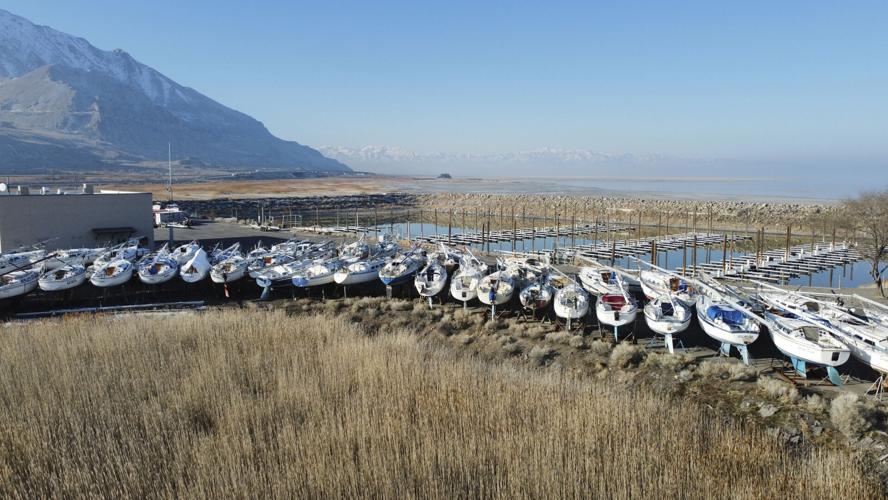
Sailboats sit in dry dock at the Great Salt Lake Marina Saturday Jan. 29, 2022, near Salt Lake City. The boats were removed last year to keep them from getting stuck in the mud.
"Right now, there's actually a disincentive for agriculture to conserve, or optimize, the water they're using," said Republican Rep. Joel Ferry.
He's sponsoring legislation that would let farmers get paid for water they let flow to the Great Salt Lake and other bodies. Because each farm is so much larger than the average home, even slight adjustments can have a major impact.
Under his plan, which has advanced at the state Legislature, it would be up to each farm to decide whether to sell water in a given year. The fund would also likely start with some federal pandemic money, and backers would hope to get donations as it continues.
"This is going to be a slow start," said Ferry, who is a farmer himself. "We recognize there's a problem, and farmers want to be part of the solution. ... Ultimately the solutions to this are going to be expensive."
The costs of doing nothing may be even higher. The draining of California's Owens Lake as Los Angeles grew has cost billions. Overseas, the Aral Sea became as source of toxic dust after its water was diverted away by the former Soviet Union. Experts estimate a drying Great Salt Lake could cost Utah more than $2 billion every year.
"There's a real question about what happens next. Are we going to break through some critical thresholds here in the next little bit if we continue to go lower?" Hawkes said. "If we act now and we are thoughtful about it ... there's a good chance we can keep the lake healthy and happy — and us along with it."
***
History of droughts in the U.S.
10th century–14th century: Megadrought
Updated
According to a report from the Proceedings of the National Academy of Sciences of the United States of America, the year 900 launched the start of a dry spell so significant that scientists refer to it as the "Megadrought." The event, which choked the Sierra Nevada and northwestern Great Basin, lasted centuries until tapering off around 1300. A variety of data back up this claim, but tree-ring studies provide the best and most accurate timeline of the catastrophe.
14th century–19th century: Mississippi River Valley drought
Updated
Massive earthen mounds still stand where the city-states of the Mississippian American Indian culture once thrived in the Mississippi River Valley 1,000 years ago. Unfortunately for the corn-based society, according to NPR, a "profound drought" set in around 1350, triggering the Little Ice Age in Europe and setting off an intense dry spell triggered by dry Arctic air pouring in through the Gulf of Mexico. The catastrophic drought would last as long as 500 years, much longer than the culture whose crucial corn crops were obliterated by the changing climate.
1841: Sonoma drought
Updated
Before the 1849 Gold Rush brought masses of pioneers pouring into California, early settlers grappled with extreme environmental conditions. Today, California's Sonoma County is one of the most fertile and productive agricultural landscapes in the world. In 1841, however, a severe drought rendered Sonoma "unsuitable for agriculture," according to the California Climate and Action Network, and the entire Sacramento Valley was little more than "a barren wasteland."
1850s–1860s: Civil War drought
Updated
By the middle of the 19th century, huge numbers of people, horses, and farm animals had already flooded into the Great Plains—enough to affect the land and its ability to tolerate drought. According to the Earth Institute at Columbia University, drought is exactly what the region got starting in the mid-1850s. The so-called Civil War drought annihilated entire herds of bison—which once numbered in the millions—that were already being hunted to near extinction by pioneers and settlers.
1864: Central Valley drought
Updated
In one of the most dramatic environmental flip-flops in American history, California's Central Valley was flooded so severely between 1861 and 1862 that it turned into a 300-mile long, 20-mile wide "inland sea," according to Scientific American. The floods submerged Sacramento under 10 feet of water, killing thousands of people and hundreds of thousands of cattle while triggering widespread and deadly mudslides. Just two years later in 1864, however, the region was gripped in a drought so severe that a lack of water was a great danger to people and animals.
1874: Year of the Locusts
Updated
In 1874, a relatively modest drought led to a catastrophe of truly biblical proportions across much of the American Plains and the West. When a dry spell set in at the end of 1873, most of the Colorado Territory, Montana Territory, Wyoming Territory, Dakota Territory, Minnesota, Iowa, Nebraska, Missouri, Texas, and present-day Oklahoma were inundated with clouds of Rocky Mountain locusts so thick that they blocked out the sun for up to six hours at a time. Locusts thrive in drought conditions, and when they descended, the insects devoured every crop in sight, causing widespread starvation and terror, and forcing waves of countless settlers to pack up, reverse course, and head back East. Kansas alone lost one-third of its population.
1890–96: 1890s drought
Updated
The 1890s drought, which affected the Plains and much of the West, actually started in the late 1880s on the heels of a severe winter that had already killed scores of cattle. The catastrophe, however, led to reform. The drought ended the prevailing wisdom that hardy, determined settlers alone were enough to convert wilderness into farmland. The environmental and social disaster would lead to the federalization of American settlement in the West and the federalization of water management and irrigation.
1928–34: Seven-year California drought
Updated
The year 1928 was the beginning of one of several distinct and significant 20th-century California droughts. According to the California Water Science Center, the seven-year California drought predated most of the state's major water projects, like the State Water Project and the Federal Central Valley Project. The drought was so severe that it compelled officials to begin planning reservoir operations and to establish shortage criteria for water supply contracts in the state.
1931–41: Dust Bowl
Updated
The Dust Bowl is the most famous environmental catastrophe in U.S. history, and although irresponsible farming practices and land mismanagement contributed to the disaster, the Dust Bowl—which coincided with the already devastating Great Depression—was essentially the result of drought. According to the National Drought Mitigation Center, the calamity—which turned millions of tons of topsoil into dust that went airborne in massive storms—was actually caused by four distinct droughts that ravaged the South Central portion of the United States in the 1930s.
1950–57: Great Dry Up
Updated
Sometimes known as the Texas Drought, the Great Dry Up devastated most of the Lone Star State for seven brutal years—years that still are vivid in the memories of those who survived it, according to the San Antonio Express-News. Across the state, crops withered, cattle died, farms turned to dust, and farmers burned the thorns off of cactuses to feed their herds. In the end, 236 of Texas's 254 counties were declared disaster areas, but the episode became the catalyst for the modern era of conservation.
1961–69: New England drought
Updated
In 1965, the Northeast suffered the worst year of a nearly decade-long drought that crushed New England farms, forced severe water rationing measures, and sent the region into a panic about drinking water shortages. What started as a dry spell in western Massachusetts quickly transformed into a regional disaster that destroyed golf courses, turned deep ponds to mud, triggered widespread fires, and killed millions of herring that could no longer swim from the ocean to fresh water to spawn.
1976–77: Two-year California drought
Updated
California's water agencies were not prepared for the 1976–77 drought. The event obliterated the widespread belief that the state's many impressive water projects were enough to insulate residents from the threat of water shortages. By the time relief came from the sky one year later, many of California's reservoirs had been dangerously depleted.
1987–92: Six-year California drought
Updated
In 1987, California once again found itself at the onset of a significant and dangerous shortage of water. According to the California Water Science Center, most of the state's major reservoirs were completed by then, but even that massive human effort proved insufficient. By 1991, the drought compelled the state to initiate a drought water bank to make water available for sale to the most desperate municipalities.
1988: Pacific La Niña drought
Updated
In 1988, a Pacific weather pattern known as La Niña triggered changes in the atmosphere and temperature, which culminated in widespread reductions of precipitation across the Central United States. One of the costliest natural disasters in American history and the worst drought on record since the Dust Bowl, it destroyed at least half of the crops on the Great Plains.
1998–2002: Florida drought
Updated
Florida entered the 21st century in the throes of one of the worst droughts in the state's recorded history. Freshwater withdrawals, record-low stream flows, hundreds of sinkholes, and persistent wildfires defined the crisis, which was particularly bad in the southwest, northeast, and northwest regions of the state.
2011–2019 California drought
Updated
In March 2019, authorities officially declared the end to more than seven years of severe drought in California. It was a long time coming. For 376 consecutive weeks, Californians suffered a grinding dry spell characterized by dangerously low water reserves, raging fires, the death of 102 million trees on 7 million acres, snowless mountain ranges, and millions of dollars of damage to highways. When the rains finally came, they resulted in a stunning blossom of wildflowers—and raging mudslides.
2012: National drought
Updated
According to a report by the National Oceanic and Atmospheric Administration (NOAA), a full 33% of the contiguous United States spent 2012 in the grip of a severe to extreme drought—"severe" and "extreme" are NOAA's most serious official classifications on the drought scale. NOAA outlined causes ranging from decreased precipitation to changes in atmospheric pressure, but the results of the report were clear and undeniable: The drought was the inevitable result of a warming planet.
2016: New York drought
Updated
In 2016, New York suffered one of the worst droughts in the state's history, but it went largely unnoticed compared with the attention given to the drought on the other side of the country. That's because New York wasn't engulfed in the dramatics beamed from California to TV screens worldwide—raging fires, empty reservoirs, and pitched political battles over water rights. Still, with rainfall down by 25% across much of the state, and with widespread crop failure and devastation to waterways and marine life, the end results in the Empire State were much the same as on the West Coast.
2016: Southeast drought
Updated
In 2016, parts of Alabama received no rainfall at all for six weeks, farmers were selling cattle they could no longer feed, and topsoil had turned to powder. It was a drought that engulfed much of the Southeast and then spread as far west as Texas and as far north as Kentucky. By the end of the year, 40% of the Southeast was suffering moderate to exceptional drought conditions, and when the rains finally came, they fell on parched land that couldn't absorb the water, resulting in widespread flooding.
2020: California wildfires linked to drought—and climate change
Updated
The effects of climate change on the weather of the U.S. became an undeniable reality for millions of people, and state and federal policymakers, in 2020. Devastating wildfires in California raged across the state because of the cycle between drought and rainfall, caused by climate change and increasing the risks of wildfire. Other states, meanwhile, broke records for the hottest days on record, and close to half of the U.S. ended 2020 at some level of drought, according to the United States Drought Monitor.
History of droughts in the U.S.
Updated
Defined by the National Weather Service as "a shortage of water over an extended period of time," droughts are a normal and natural part of Earth's weather cycle. Sometimes, however, a lack of water is far more significant than just a cyclical dry spell. Although tornadoes, hurricanes, tsunamis, and fires are more dramatic and alarming, severe droughts are often far more widespread, more devastating, more expensive, and harder to manage than the violent natural disasters that tend to grab headlines. Making matters worse, droughts can create or encourage a range of secondary environmental catastrophes like fires, crop failures, mudslides, sinkholes, destroyed roadways, massive fish kills, locust swarms, and—although it seems counterintuitive—severe floods.
Throughout U.S. history, droughts have turned vast swaths of farmland to dust, created panic, killed millions of cattle and other animals, and forced widespread human migration, financial depression, and starvation. The worst droughts, however, have also sparked major reforms. In California, for instance, droughts led to creation of the Central Valley Project, the State Water Project, the urban conservation movement, and the Drought Emergency Water Bank.
The direct and indirect costs of drought total more than $9 billion a year in the United States alone, and that expense is set to rise as droughts become more prevalent and severe. Although global warming is often portrayed in the media as a debate, there is direct and irrefutable evidence linking climate change to increased instances of severe drought beyond the dry spells that are a natural part of the planet's cycles. Warming temperatures over the past century have directly contributed to major droughts across the country, but particularly in the American West. It was only in 2019 that California finally got relief from a catastrophic dry spell that defined the state's ecology throughout much of the past decade.
Stacker dived into the worst droughts in U.S. history, starting with the "megadrought" of the 10th century and ending with the droughts that plague us today.
You may also like: Counties projected to have the most extreme heat days in 2050

