

OMAHA, Neb. — The ongoing bird flu outbreak has cost the government roughly $661 million and added to consumers’ pain at the grocery store after more than 58 million birds were slaughtered to limit the spread of the virus.
In addition to the cost of the government response and rising prices for eggs, chicken and turkey, farmers who raise those animals have easily lost more than $1 billion, said an agricultural economist, though no one has calculated the total cost to the industry yet.

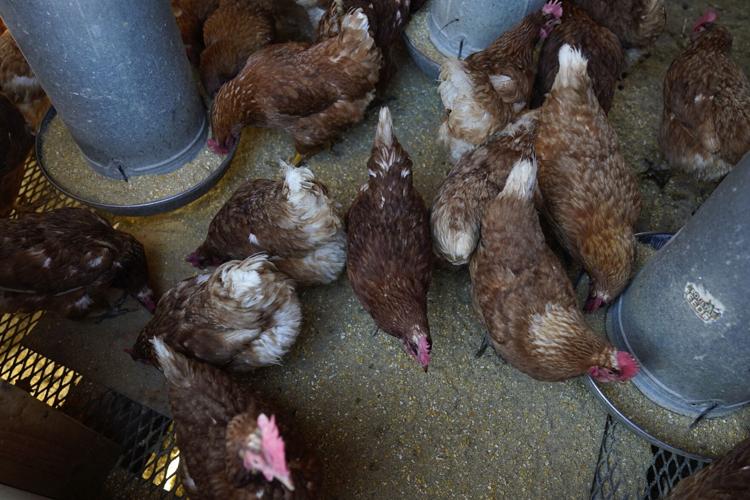
Red Star chickens feed in their coop Jan. 10 at Historic Wagner Farm in Glenview, Ill.
The bad news is that with the outbreak entering its second year and the spring migratory season looming, there is no end in sight. And there is little farmers can do beyond the steps they have already taken to try to keep out the virus.
Unlike past years, the virus that causes highly pathogenic avian influenza found a way to survive through the heat of last summer, leading to a rise in cases reported in the fall.
The outbreak is more widespread than the last major bird flu outbreak in 2015 but hasn’t proven as costly yet, partly because the government and industry applied lessons learned eight years ago.
“The past year has been devastating for the turkey industry as we experience, unequivocally, the worst HPAI (highly pathogenic avian influenza) outbreak in the industry’s history,” National Turkey Federation spokeswoman Shelby Newman said.
In the current outbreak, 58.4 million birds have been slaughtered on more than 300 commercial farms in 47 states. That is because any time the virus is detected, the entire flock on that farm — which can number in the millions — must be killed to limit the spread of the disease. Only Hawaii, Louisiana and West Virginia have yet to report a case of bird flu. Iowa — the nation’s biggest egg producer — leads the nation with nearly 16 million birds slaughtered.

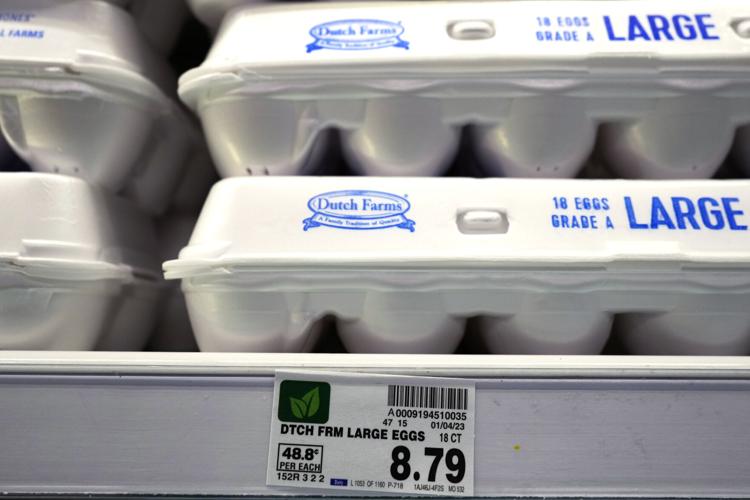
The price of a dozen eggs on Jan. 10 at a grocery store in Glenview, Ill.
In 2015, about 50 million chickens and turkeys were slaughtered on more than 200 farms in 15 states.
That previous outbreak remains the most expensive animal health disaster in U.S. history. The federal government spent nearly $1 billion to deal with infected birds, clean up barns and compensate farmers. It cost the industry roughly $3 billion as farmers incurred additional costs and lost money when they didn’t have any birds.
Still, bills continue to pile up this year as cases spread, and that includes the cost to consumers.
Egg prices shot up to $4.82 a dozen in January from $1.93 a year earlier, according to the latest government figures. That prompted calls for a price-gouging investigation, though the industry maintains that the combination of bird flu and significantly higher feed, fuel and labor costs are driving up prices.
The price for a pound of chicken breast was $4.32 in January. That’s down slightly from last fall when the price peaked at $4.75, but up significantly from $3.73 per pound the year before.
The Bureau of Labor Statistics doesn’t track retail turkey prices the same way as part of its inflation data, but the Agriculture Department says the wholesale price of turkey went from $1.29 per pound last January just before the bird flu outbreak began to $1.72 per pound last month.
The number of birds slaughtered peaked last spring at almost 21 million in March, leaving farmers leery of what they must face in the months ahead. University of Georgia virus researcher David Stallknecht said there is some hope that this spring might not be quite as bad because turkeys and chickens may have developed some immunity to the virus.
The highly contagious virus is spread easily by wild birds through droppings and nasal discharges.
Bird flu outbreak could lead to new poultry vaccinations.
“We recommend all producers redouble their efforts to protect their birds through good biosecurity practices,” said Lyndsay Cole, a spokeswoman for the USDA’s Animal and Plant Health Inspection Service that’s leading the government’s response.
Farmers have gone to great lengths by requiring workers to shower and change clothes before entering barns, sanitizing trucks that enter a farm and investing in separate sets of tools for every barn. Some farms have even upgraded barn ventilation and installed laser systems to discourage wild birds from congregating.
Farmers began following those steps after the 2015 outbreak, and this outbreak reinforced the need to tighten biosecurity.
“America’s egg farmers continue to double-down on biosecurity protocols to protect our flocks and maintain a stable egg supply. We are grateful that there has been little to no farm-to-farm spread in this current outbreak,” said Oscar Garrison, senior vice president of food safety and regulatory affairs at the United Egg Producers trade group.
Poultry and egg producers, partnering with the government, are parsing this outbreak for new lessons in keeping birds healthy.
“That’s really the key — early detection. It’s kind of like a forest fire — the earlier you detect it, the easier it is to contain and eradicate,” National Chicken Council spokesman Tom Super said.
Officials say bird flu doesn’t represent a significant threat to human health. Human cases are extremely rare, no infected birds are allowed into the nation’s food supply. Properly cooking poultry to 165 degrees Fahrenheit will kill any viruses.
Popular videos from the past week you may have missed
The wreckage of a ship nicknamed for its bad luck was rediscovered for the first time in more than 150 years, a Turkish earthquake survivor describes her rescue, and more popular videos from the past week you may have missed.

The wreckage of a ship nicknamed for its bad luck is rediscovered for the first time in more than 150 years. The Nucleus, aka "Bad Luck Barque…

The CBC's Briar Stewart in Diyarbakir, Turkey speaks to Özlem Ayna, who survived five days under her crushed apartment building before she was…

Comfort dogs offer some relief after shooting tragedy at Michigan State University. Veuer’s Elizabeth Keatinge has more.

These cubs are just as important as they are adorable. Yair Ben-Dor has more.

And it’s telling us a whole lot about the evolution of modern day sperm whales.

Unbelievable drone footage shows massive cracks left behind by the 7.8 magnitude quake that struck Syria and Turkey. Veuer’s Maria Mercedes Ga…

Age won’t stop this lady from riding the fastest zipline in the world. Yair Ben-Dor has the story.

A wild elephant charged at trucks to steal sugar cane along a forest road in Thailand.

In Turkey, a 17-year-old girl was rescued after spending more than 10 days trapped under rubble. Veuer’s Maria Mercedes Galuppo has the story.

London Zoo’s veterinary team have shared a new series of amazing x-ray images of some of their residents.

