


As five Memphis police officers attacked Tyre Nichols with their feet, fists and a baton, others milled around at the scene, even as the 29-year-old cried out in pain and then slumped limply against the side of a car.
Just like the attack on George Floyd in Minneapolis nearly three years ago, a simple intervention could have saved a life. Instead, Nichols is dead and the five officers are charged with second-degree murder and other crimes.

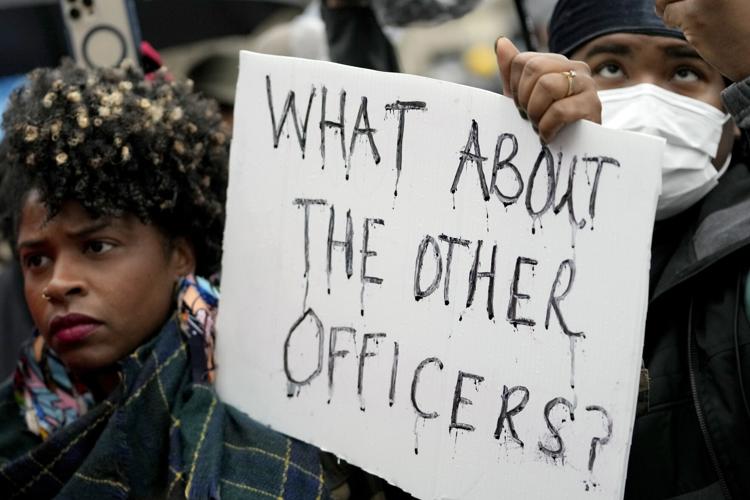
FILE - Protesters march Saturday, Jan. 28, 2023, in Memphis, Tenn., over the death of Tyre Nichols, who died after being beaten by Memphis police during a traffic stop. As Memphis police officers attacked Nichols, others held him down or milled about, even as he cried out in pain before his body went limp. Just like the attack on George Floyd in Minneapolis nearly three years ago, a simple intervention could have saved a life. Memphis and Minneapolis police departments are among many with “duty to intervene” policies. It’s also the law. (AP Photo/Gerald Herbert, File)
More disciplinary action may be coming now that the harrowing video of Nichols' treatment has been released. Memphis police suspended two other officers Monday and say the department is still investigating what happened. The Memphis Fire Department also fired three emergency response workers who arrived on the scene for failing to assess Nichols' condition.
The Memphis and Minneapolis police departments are among many U.S. law enforcement agencies with "duty to intervene" policies. The Memphis protocol is clear: "Any member who directly observes another member engaged in dangerous or criminal conduct or abuse of a subject shall take reasonable action to intervene."
It's not just a policy, it's the law. The three Minneapolis officers who failed to step in and stop former Officer Derek Chauvin from kneeling on Floyd's neck as the Black man said he couldn't breathe were all convicted of federal civil rights violations.
Experts agree peer pressure, and in some cases fear of retribution, is on the minds of officers who fail to stop colleagues from bad actions.

"They're afraid of being ostracized," said George Kirkham, a criminology professor emeritus at Florida State University and former police officer. "You've got to depend on those guys. It's the thin blue line. When you get out there and get in a jam, you've got nobody else to help you but other cops."
Nichols was pulled over in a traffic stop the night of Jan. 7. Body camera video shows he was beaten as officers screamed profanities, even as Nichols seemed confused about what he did wrong. Amid the chaos, he ran and was eventually caught at another intersection, a short distance from his mother's house.
Security camera images from that scene show two officers holding Nichols to the ground as a third appears to kick him in the head. Later, another officer strikes Nichols repeatedly with a baton as another officer holds him.
Officers pull Nichols to his feet, though he's barely able to stand. An officer punches him in the face, and Nichols stumbles, still held up by two officers. After more punches, he collapses. But the attack continues.
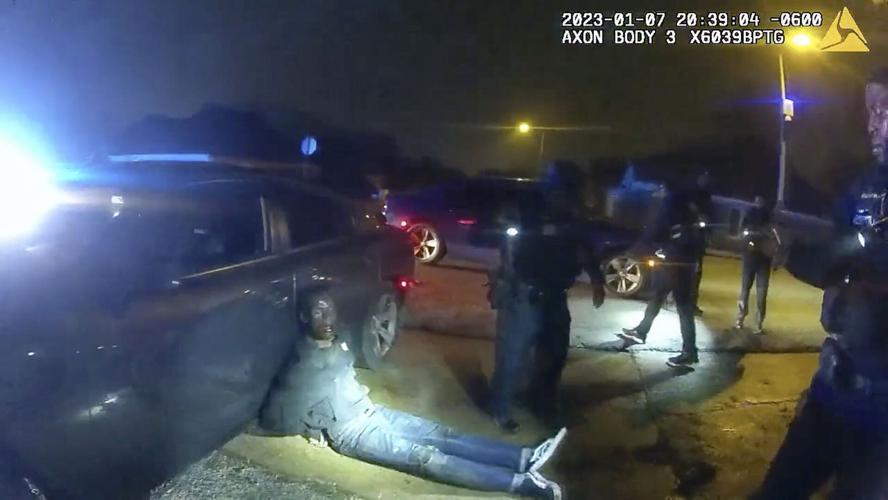
When it ends, Nichols is slumped against a car. It would be more than 20 minutes before medical attention was rendered, though three members of the fire department arrived on the scene with medical equipment within 10 minutes. Those workers, two medics and a lieutenant who was with them, were the personnel fired late Monday.

FILE - In this image taken from video released by the City of Memphis, Tyre Nichols sits leaning against a car following a brutal attack by Memphis police during a traffic stop on Jan. 7, 2023, in Memphis, Tenn. Nichols died days later. As Memphis police officers attacked Nichols, others held him down or milled about, even as he cried out in pain before his body went limp. Just like the attack on George Floyd in Minneapolis nearly three years ago, a simple intervention could have saved a life. (City of Memphis via AP, File)
Chuck Wexler, executive director of the Police Executive Research Forum, a Washington-based think tank, said duty to intervene policies became common after officers attacked and badly injured Rodney King in Los Angeles in 1992.
"But having a policy and overcoming what many would argue is the culture in policing are two different things," Wexler said. "It's not enough to simply have a policy. You need to practice. You need to talk through it."
In some cases, concerns by officers about retaliation for intervening have proven true.
In Buffalo, New York, Officer Cariol Horne was a year away from collecting her pension when she faced departmental charges after pulling a fellow officer's arm from around the neck of a domestic violence suspect in 2006. She was fired. In 2021 a state Supreme Court judge reinstated her pension and overturned her dismissal.

Last year in Sunrise, Florida, Sgt. Christopher Pullease was criminally charged after an incident caught on video in which an unidentified female officer pulled Pullease by the belt away from a handcuffed suspect after Pullease pointed pepper spray at him. Pullease responded by putting a hand on his colleague's throat and pushing her away, the video showed.
Experts were also perplexed that no police department supervisors were present during the Memphis incident. Had there been, they said, the outcome might have been different.
“I was a supervisor for a long time, and you showing up on the scene even unannounced keeps people from doing, for lack of a better adjective, stupid things,” said former New York City Police Sgt. Joseph Giacalone, who teaches at the John Jay College of Criminal Justice in New York.

Memphis Police Director Cerelyn "CJ" Davis said the police department has a supervisor shortage and called the lack of a supervisor at the incident "a major problem." Davis on Saturday disbanded the city's so-called Scorpion unit, whose officers were involved in the beating.
University of Missouri-St. Louis criminologist David Klinger said decisions on whether to intervene in a police colleague's actions are not always cut and dried. He said one officer may see a weapon that is blocked from the view of another, for example, and stepping in at the wrong time could jeopardize the lives of officers at the scene.
"Training has to be precise about the sorts of circumstances that would warrant an intervention," Klinger said.
Here is the timeline of events in the arrest and death of Tyre Nichols — and what's followed
Jan. 7, 2023
Updated
Jan. 7: Tyre Nichols is pulled over by police for an alleged traffic violation after photographing a sunset, according to accounts his family would give later. A confrontation ensues, and he is brutally beaten by five Memphis police officers in an encounter that is recorded by police body cameras.
Jan. 8
Updated
Jan 8: Memphis police say in a statement that officers attempted to stop a man for reckless driving on Jan. 7 and he was taken to a hospital in critical condition after two confrontations. The first description of what happened says one confrontation occurred when officers approached the vehicle and the suspect fled on foot. Officers pursued, and another confrontation occurred when they took him into custody, police said. The subject complained of shortness of breath and was taken to a hospital. Due to his condition, police contacted the Shelby County District Attorney General’s Office, which asked the Tennessee Bureau of Investigation to conduct a use-of-force investigation.
Jan. 15
Updated
Jan. 15: Police Chief Cerelyn Davis says she has reviewed information on the encounter and has decided to take immediate action by serving notice of policy violations to the officers involved.
Jan. 16
Updated
Jan. 16: Civil rights attorney Ben Crump announces he is representing Nichols’ family and calls on police to release body camera and surveillance video from the traffic stop. Meanwhile, protesters gather at the Civil Rights Museum to push for the release of police video and call for officers to be charged.
Jan. 18
Updated
Jan. 18: The U.S. Justice Department announces that it has opened a civil rights investigation.
Jan. 20
Updated
Jan. 20: The five officers involved in the arrest are fired after an internal investigation finds they used excessive force, failed to intervene and failed to render aid. They are identified as Tadarrius Bean, Demetrius Haley, Emmitt Martin III, Desmond Mills Jr. and Justin Smith. All five are Black.
Jan. 23
Updated
Jan. 23: Nichols' family views the police video with their attorneys, who say it shows Nichols being beaten for three minutes in a “savage” encounter reminiscent of the infamous 1991 police beating of Los Angeles motorist Rodney King. The video shows Nichols was shocked, pepper-sprayed and restrained after he was pulled over minutes from his home while returning from a suburban park where he had taken photos of the sunset. Crump says the family has agreed to investigators’ request to delay making the video public so as not to risk compromising the criminal investigation.
Jan. 24
Updated
Jan. 24: Shelby County District Attorney Steve Mulroy says the release of police video will be carefully timed to avoid the chance that suspects or witnesses tailor their statements to what they saw in it and asks the public for patience. The timetable rankles activists who had expected the video to be released after Nichols’ family viewed it. Meanwhile, the Memphis Fire Department says two employees involved in the initial care of Nichols the night of his arrest have been removed from duty while the agency conducts an investigation.
Jan. 25
Updated
Jan. 25: Davis, the police chief, calls the officers' actions “heinous, reckless and inhumane” and makes a plea for people to protest peacefully when the video is made public. She says in a statement issued on social media that other officers are still being investigated for violating department policy and that “a complete and independent review” will be conducted of the department’s specialized units.
Jan. 26
Updated
Jan 26: The five officers are charged with murder, aggravated assault, aggravated kidnapping, official misconduct and official oppression. Mulroy says they each played different roles in the killing but “they are all responsible.” Mulroy also announces that video of the traffic stop will be released to the public the following evening. Nichols' parents say they are satisfied with the charges against the officers. At an evening candlelight vigil, Nichols' mother pleads with supporters to “protest in peace” when the “horrific” video footage is released.
Jan. 27
Updated
Jan. 27: Memphis authorities release video footage showing Nichols being beaten by five officers who repeatedly strike him with their fists, boots and batons as he screams for his mother. The video is filled with violent moments showing the officers, who are also Black, chasing and pummeling Nichols and leaving him on the pavement propped against a squad car as they fist-bump and celebrate their actions. Protesters gather for mostly peaceful demonstrations in multiple cities including Memphis, New York and Washington.
Jan. 28
Updated
Jan. 28: The Memphis police chief disbanded the city's so-called Scorpion unit after some of its officers beat to death Tyre Nichols, reversing an earlier statement that she would keep the unit intact. The unit is composed of three teams of about 30 officers who target violent offenders in areas beset by high crime. It had been inactive since Nichols' Jan. 7 arrest.

