

LAS VEGAS — Avocados can be tricky. Their ripeness window is so narrow that a slew of memes poke fun at the fine art of deciding when to eat them.
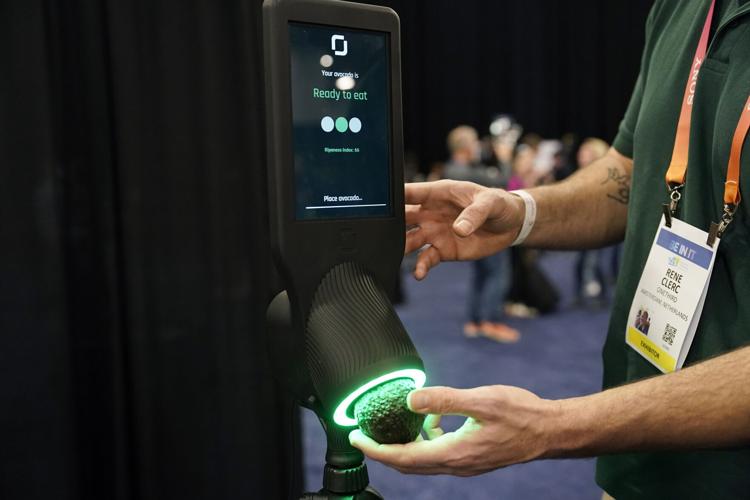
Dutch entrepreneur Marco Snikkers aims to solve that problem with an avocado scanner unveiled last week at the CES tech show in Las Vegas and designed for use in supermarkets. It uses optical sensing and AI technology to determine ripeness, displaying on a screen whether an avocado is firm or ready to eat.

An exhibitor demonstrates the OneThird avocado ripeness checker during CES Unveiled before the start of the CES tech show Tuesday in Las Vegas. More than 1,000 startups showcased their products at the annual show.
Snikkers' startup, OneThird, isn't just trying to reduce frustration in the kitchen. According to the United Nations, about one-third of food is wasted globally. That means all the carbon emitted to grow, ship and distribute that food was for naught.
"That's a huge problem," Snikkers said. "That's a trillion dollar issue for our world and it has a huge impact on C02 emissions and water usage."
OneThird was one of several start-ups at this year's CES working to solve different components of the problem, from helping the food industry limit what it throws away to offering rapid composting solutions to help keep food scraps out of methane-producing landfills.
OneThird already works with growers, distributors and others along the supply chain to predict the shelf life of avocados, tomatoes, strawberries and blueberries. It will further expand its ability to determine ripeness for more produce later this year, aiming to help reduce the amount of food that is wasted around the world. And it's testing the consumer-friendly avocado scanner at a supermarket in Canada this month.
Avocados can be tricky produce. Their ripeness window is so narrow, that a slew of memes were created to poke fun at the fine art of timing when to eat its creamy green flesh. Entrepreneur Marco Snikkers just released his company's latest produce checker at the Consumer Electronics Show this year, which tells an avocado's ripeness after scanning it. But it goes beyond aiming to reducing frustration in the kitchen. The Dutch start-up OneThird already predicts the shelf life of tomatoes, strawberries and blueberries, and says it will further expand its ability to determine ripeness for more produce later this year, aiming to help reduce the amount of food that is wasted around the world.
Another Dutch entrepreneur, Olaf van der Veen, is working to empower restaurants to reduce food waste, the majority of which happens in a kitchen before a meal is even served to customers.
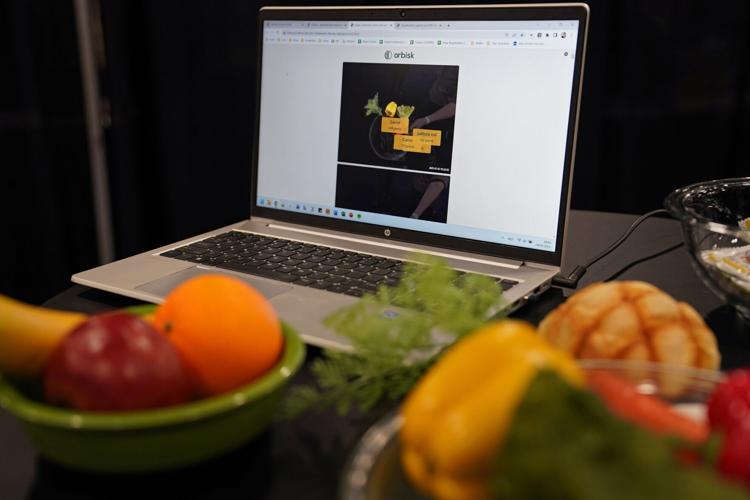
His device, Orbisk, uses a camera positioned over a trash can to scan whatever food is about to be tossed. In addition to seeing the type of food, amount and time of day, "we can see if it's on a plate, in a pan, on a cutting board, which gives circumstantial information on why it was lost," van der Veen said.
Orbisk organizes and shares that insight with the restaurant so they can understand their disposal patterns, helping them save money and reduce food waste, and with it, emissions and water use.
The startup's devices are positioned in commercial kitchens in about 10 European countries, with some clients as far as India.

An image from the Orbisk food waste monitor is displayed on a computer during CES Unveiled, before the start of the CES tech show, Tuesday, Jan. 3, 2023, in Las Vegas. The device uses AI image recognition to track food as it is thrown away, displaying the data on a computer dashboard. (AP Photo/John Locher)
He said that even after some surplus food is donated, there's more food waste per restaurant in the U.S. than in Europe. That's why the company was at CES, he said, hoping to expand its nascent market further.
Reducing the amount of wasted food is preferable, but keeping tossed food out of landfills is the next best option.
When food scraps are properly composted, they release carbon dioxide as part of the biological process of turning into nutrient-rich soil. When food is trapped in landfills, the decomposition process produces methane — a potent greenhouse gas that contributes significantly to global warming because it packs a stronger short-term punch more than 80 times stronger than even carbon dioxide.
The 2006 London Protocol banned dumping food waste into the ocean, prompting South Korea to set up a system of mandatory composting. While the infrastructure allows the country to properly dispose of nearly all its food waste, residents have to haul bags of food to designated curbside bins.
Reencle is designed to make that process easier. The metal bin is a hyper-fast composting system showcased at CES this year, and helps households reduce one kilogram (2.2 pounds) of food scraps by 90% volume in just 24 hours.
While the product has sold tens of thousands of units in South Korea, Reencle's parent company Hanmi Flexible hopes to expand to overseas markets, marketing director Jinhwi Bang said.
How is it so fast? The device uses self-replicating microorganisms to turn scraps into compost. Its competitor, Lomi, grinds and dehydrates food scraps, requiring the byproduct to be mixed with soil before composting, whereas Reencle says its byproduct can be composted directly.
Mark Murray, Executive Director of Californians Against Waste, says he hopes people don't think advanced technology is needed to be able to compost.

But he says he understands that not everyone has a yard or a patio, and that "all of the tools in the toolbox have to be on the table."
Technology is part of the solution. But Murray says economic incentives and systemic change are the other key components to reducing global food waste.
"We need to make it more expensive to waste food," he said. "That'll create the incentive for commercial enterprises, for restaurants, for stores, for even consumers to invest in systems and technology for making sure that we don't waste food."
The best of CES 2023
Pokémon, but make it birds
Updated
Bird Buddy showed off a smart bird feeder that takes snapshots of feathered friends as they fly in to eat some treats. The startup says its AI technology can recognize more than 1,000 species of birds, allowing users to share through a mobile app what kind of birds they're feeding.
"We try to kind of gamify the collection so it's a really fun game that you can play — almost like a real life Pokémon Go with real animals and wildlife in your backyard," said Kyle Buzzard, the company's co-founder and chief hardware officer.
The product has already sparked some interest from consumers who want to show the world what birds are coming into their backyards.
The company, which began as a Kickstarter project in 2020, says it started shipping its bird feeders in September and has already sold all 100,000 in its inventory. The price for the basic feeder is $199.
Electric skates
Updated
Journalists had fun zipping around the exhibit hall on remote-controlled, electric inline skates from French startup AtmosGear.
The battery lasts for 20 miles (32 kilometers), said founder Mohamed Soliman, who hopes people will see them as a viable way to commute, like electric bikes or scooters.
"My goal is for everyone to go skating again because it's so much fun, every time you see people skating you see them with a big smile," Soliman said.
A waist bag holds the battery and cables connected to the skates. They also can be used as regular skates when they need to be charged or skaters simply want to travel under their own power.
The $500 skates are available for pre-order. The company has taken orders for 150 pairs so far and is aiming for 200 orders to start production.
Digital temporary tattoos
Updated
A handheld device displayed by South Korean company Prinker allows you to quickly and easily apply temporary tattoos.
The device uses cosmetic-grade ink with a library of thousands of designs or the option to make your own with the company's app. After picking a tattoo, you just wave the device over wherever you want it applied. The tattoos are waterproof but wash off with soap.
The flagship model is $279 and a smaller model is $229. Ink cartridges good for 1,000 tattoos are $119.
Helping find your way
Updated
Japan-based Loovic has created a device designed to solve the challenges of those who have difficulty navigating while they walk.
The device worn around the neck employs sounds and vibrations to guide users to destinations, enabling them to look at what's around rather than focusing on a phone's map app.
Loovic co-founder and CEO Toru Yamanaka said he was inspired to create the device for his son, who has a cognitive impairment making it difficult for him to navigate.
The prototype device is not yet available to the public.
A fitness tracker for your dog
Updated
If you wonder what your dog is doing while you're not home, French startup Invoxia has a product for you. The company's smart dog collar monitors your pet's activity and sleep, sending the data to your phone.
The latest version unveiled at CES, which has a GPS tracker, includes more advanced heart health monitoring.
The collar is $149 in the U.S. while a monthly $8.25 subscription to the app monitors the data and shares it with your veterinarian.
Metaverse for kids
UpdatedThe creators of Roybi, an educational AI robot that helps children learn about STEM topics and new languages, are venturing into the metaverse.
The RoybiVerse is expected to offer stations where K-12 and higher education students can learn about a wide range of educational topics.
Users walking around the RoybiVerse will be able to visit an area where they’ll learn about dinosaurs or walk over to the virtual library where they can pick a book and read it.
The RoybiVerse, which is expected to launch by mid-2023, will be available in virtual reality headsets and on a website. No robot needed.

