

NEW YORK — It was small, as Washington celebrations go — two senior Biden administration advisers gathered with program participants near the White House on a Thursday afternoon in December to mark the end of a little-known initiative with a budget of less than $8 million.
The impact of The Community Violence Intervention Collaborative (CVIC), though, may yet be larger, both in the fight to slow the growth of gun violence and in the way philanthropy and government work together. The Biden administration used CVIC to get public funding to fight gun violence to 50 grassroots organizations that would normally be too small to get federal funding directly, as well as training and other support for 18 months to prepare them to receive even more funding.

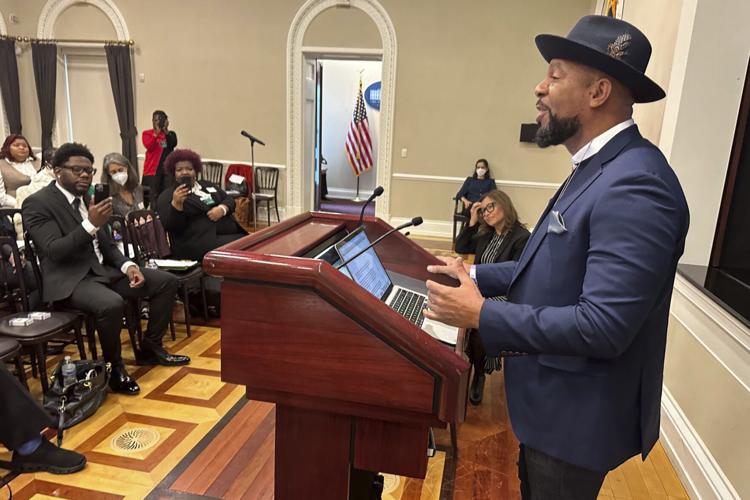
Aqeela Sherrills, an adviser to the nonprofit Hyphen, addresses a gathering of participants of the Community Violence Intervention Collaborative at the Eisenhower Executive Office Building on Dec. 8 in Washington, D.C.
It's an effort some participants applauded, while others argued the president could have backed it more forcefully.
There was a feeling of momentum at the CVIC celebration, said Nancy Fishman, director at the Schusterman Family Philanthropies, toward what she and other advocates hope is the beginning of a shift in governmental approaches public safety. And it went beyond the attendance of nonprofit leaders, whose workers often go without recognition or pay, in a “rarefied space with others being celebrated,” she said.
Daamin X Durden, executive director of the Newark Community Street Team, called it surreal “to be with one another, to hear the testimony and the journey experience and just to share that camaraderie and fidelity for one another.”
On top of that, each of the 50 community violence interruption organizations at the celebration in the office building across from the White House also received $20,000, as a final “mini-grant,” which Durden said was much appreciated because it came with few strings attached.
A nonprofit, Hyphen, coordinated the initiative, which included peer exchanges, training and mentorship, provided by five national nonprofits.

Aqeela Sherrills, the adviser for the initiative at Hyphen, thinks many more officials and communities now understand violence interruption is a compliment to policing, not a strategy that is anti-police.
“We’re not expecting our cops will be everything, to be teachers, lawyers, therapists and counselors,” he said.
President Joe Biden announced the initiative in June 2021 shortly after the one year anniversary of George Floyd’s killing by Minneapolis police. During the second summer of the pandemic, hundreds were being shot daily, as the jump in gun homicides that started in 2020 across the country continued.
As one piece of the administration's response, Biden urged local governments to use coronavirus relief funds to strengthen public safety through investments in police as well as community-based programs.
CVIC was another part of this public safety plan aimed to prepare grassroots groups to be accept more public funding by strengthening their infrastructure and sharing best practices to design programs.

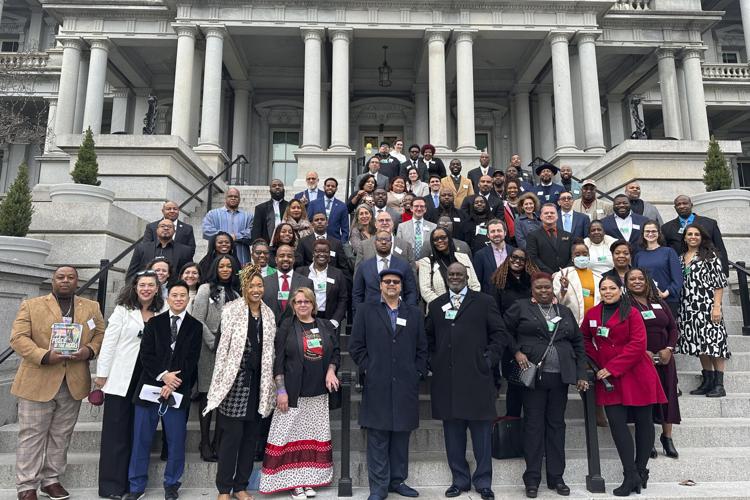
Participants and funders of the Community Violence Intervention Collaborative gather for a photo at the Eisenhower Executive Office Building on Dec. 8 in Washington, D.C.
“The theory of change for this collaborative was to focus on community groups that were the hardest to reach, that were doing incredible work locally and had very little support,” said Fatimah Loren Dreier, who leads the Health Alliance for Violence Intervention, one of the organizations providing training.
Decades of research has documented that small groups of people drive a disproportionate amount of gun violence and homicides in any given community. Violence interruption programs seek to identify those people, with some working out of hospitals, others offering a carrot-and-stick approach along with the police, while others provide cognitive behavior therapy and mentoring.
If people agree to participate, the programs often also provide economic aid like paying for food or rent and connecting them to job trainings or other skills development — interventions that reveal the close connection between poverty and violence.
Measured in terms of funds delivered to the grassroots organizations, the collaborative’s record is mixed. Six of the cities participating have so far not reported that they plan to spend coronavirus relief funds on violence interruption as of June, according to an academic analysis of Treasury Department data.
Community violence interruption programs could be funded by about $350 billion included in the American Rescue Plan available for states, cities and municipalities to use for a broad range of programs, as well as another $120 billion in aid for schools.
Alex Johnson, of the California Wellness Foundation, which funded early models of violence interruption in the 1990s, said many officials who control local budgets still do not understand the value of the approach.
Four cities, including Newark, along with several of the grassroots organizations, recently won grants from the Department of Justice.
Amanda Kass, of DePaul University, and Philip Rocco, of Marquette University, have been studying the use of coronavirus relief funds with support from The Joyce Foundation. They warn that numerous factors make it difficult to track spending, especially since municipalities have until 2026 to finalize their plans.
So far, Kass and Rocco found participating cities allocated $71.7 million toward violence interruption programs — less than 1% of the $7.8 billion in coronavirus relief funds available. Their study excluded participating counties, Washington, D.C., and Rapid City, South Dakota.
Some CVIC participants said they expected more money to come to them through the initiative. Dujuan Kennedy, who leads the violence interruption work for FORCE Detroit, felt Biden wasn't sincere in his support.
“It may be a talking point for him. It may be a campaign, but for us, it’s our little brothers, our sons, our daughters, our babies," he said. "People are really dying out here.”
Key terms you should know to understand the gun control debate
Key terms you should know to understand the gun control debate
Updated
In a country where three in 10 adults own a gun and nearly half of households have at least one gun in the home, 100 Americans die every day from gunshot wounds. Nearly half of all U.S. adults grew up in a household with guns, more than half have friends who own guns, and nearly three-quarters have fired a gun. The prevalence of gun violence and gun ownership has made gun control among the most hotly (and frequently) contested issues in the United States.
Advocates for gun control want tighter restrictions on the sale, possession, and use of firearms, while advocates of gun rights see ownership as an essential right protected by the Second Amendment to the U.S. Constitution. The debate heats up each time a mass shooting—defined as a shooting involving the death or injury of four or more people—occurs, which now happens, on average, every day in the United States. Seven of the 10 deadliest U.S. shootings have happened in the past decade, including the Robb Elementary School shooting in Uvalde, Texas, in May 2022.
Reform advocates point to evidence showing fewer people die from gun violence in states with strong gun laws. Case in point: Alaska has one of the highest gun death rates and some of the weakest gun laws, while Hawaii has the lowest gun death rate and some of the strongest gun laws. Advocates for reform have steadily gathered momentum: Some young survivors of the Parkland, Florida, school shooting, for example, proposed a blueprint for comprehensive gun control. Everytown for Gun Safety, founded by former New York City Mayor Michael Bloomberg, has spent millions of dollars to promote gun control through ballot initiatives and state elections. An August 2022 study conducted by the University of Chicago Harris School of Public Policy and The Associated Press-NORC Center for Public Affairs Research found that 71% of Americans say gun laws should be stricter.
Meanwhile, more hardline groups such as Gun Owners of America fight hard in Washington D.C. for lawmakers' support. Gun advocates argue that more guns, not less, will help to prevent or stop shootings—and that stricter gun-control laws will only keep guns out of the hands of honest people. But this has not stopped the current administration from responding to public appeal as regards gun ownership.
In June 2022, just over a month after the horrific shooting at Uvalde, President Joe Biden signed the Bipartisan Safer Communities Act, which incentivizes states to pass "red flag" laws, expands background checks for those under age 21, and closes what is known as the "boyfriend loophole." Previous legislation had prevented those convicted of domestic abuse from owning a firearm; the new bill now includes dating partners under that restriction, in addition to spouses and former spouses. In some respects, this bill is a rebuttal to the Supreme Court's ruling, which had been handed down just days before the signing of the bill, that effectively nullified New York state's concealed carry law.
Seeing as gun control will continue to be a major legislative issue for years to come, here are 25 terms critical to understanding and participating in the conversation.
You may also like: 50 facts about guns in America

Gun Control Act of 1968
Updated
The Gun Control Act of 1968 set the legal precedents for the sale of guns in the United States. It determined licensing requirements, restrictions on who could purchase firearms, and regulation of interstate trading.
Firearm Owners Protection Act
Updated
Enacted in 1986, the Firearm Owners Protection Act addressed aspects of the 1968 law that were seen by many as going too far. It loosened regulations of interstate transfers, some gun sales, and record keeping.
Title II, NFA weapons
Updated
By federal law, Title II and National Firearm's Act weapons are heavily regulated. They include short-barreled shotguns and rifles, automatic shotguns, submachine guns, machine guns, rocket launchers, and grenade launchers. The acquisition of these weapons requires approval by the federal Bureau of Alcohol, Tobacco, Firearms and Explosives.
You may also like: Gun control legislation that passed and failed over the last 20 years
Assault weapons ban
Updated
The Public Safety and Recreational Firearms Use Protection Act of 1994 aimed to get certain semiautomatic weapons off the streets. It expired 10 years later. Gun control advocates complained that the act was weak, marred by loopholes that allowed manufacturers to evade the law with minor changes, and failed to ban all semiautomatic weapons. Gun rights advocates said it infringed on their constitutionally guaranteed right to bear arms and did little to deter violence.
Second Amendment
Updated
The Second Amendment of the U.S. Constitution says, "A well regulated Militia, being necessary to the security of a free state, the right of the people to keep and bear Arms, shall not be infringed." Seemingly endless debates revolve around its intent, what comprises such a militia, and the extent of its protection of individual rights to own guns.
National Rifle Association
Updated
The NRA was founded following the Civil War by Union Army veterans to promote and encourage rifle marksmanship. The modern-day NRA claims 5 million members, and its lobbying arm fights for gun rights and against gun restrictions. The NRA spent more than $30 million to support Donald Trump's bid for the presidency in 2016.
You may also like: History of the NRA
March for Our Lives
Updated
Survivors of the 2018 mass school shooting created the March for Our Lives organization at Marjory Stoneman Douglas High School in Parkland, Florida. It has called for a reduction in the number of firearms in civilian hands by 30%, a mandatory federal gun buyback program for assault weapons, an Internal Revenue Service investigation into the National Rifle Association, and a re-examination of the 2008 U.S. Supreme Court ruling allowing handguns to be kept in homes.
Gunowners of America
Updated
Founded in 1975, the Gunowners of America (GOA) calls itself the "no compromise" gun lobby. It believes that "gun control of all forms is ineffective and unconstitutional." The GOA positions itself as a rival to the NRA which it claims is weak at protecting the Second Amendment. The GOA is suing the Bureau of Alcohol, Tobacco, Firearms and Explosives, and is leading the legal challenge to a ban on bump stocks, an attachment sometimes used with assault weapons.
Assault weapon
Updated
An assault rifle can fire in fully automatic mode, meaning when the trigger is pulled and held down, the weapon will shoot continuously until the trigger is released or the gun runs out of ammunition. Machine guns are assault rifles. It is a politically laden term, as major gun groups say it was made up by the anti-gun lobby and that guns don't assault people.
Automatic weapon
Updated
An automatic weapon loads another round mechanically after the first round has been fired. It can be semiautomatic, firing one shot per single pull of the trigger, or fully automatic, loading and firing ammunition until the trigger is released, the ammunition is exhausted, or the weapon jams.
Semiautomatic weapon
Updated
Semiautomatic rifles fire one bullet each time the trigger is pulled, automatically loading the next round from the magazine into the chamber. They also are called self-loading rifles or auto-loading rifles.
Caliber
Updated
Caliber is the measure of the internal diameter of a gun's barrel and the outside diameter of its bullet. It is measured in hundredths or thousandths of an inch—.45 handgun has a barrel diameter of 0.45 inches. It also may be measured in metrics, such as a 9mm handgun.
International gun control
Updated
Other developed nations have far more stringent gun laws than the United States. For instance, Canada recently banned the sale and import of handguns. The United Kingdom bans handguns, while purchasing a gun in Japan is allowed only for hunting, professional use, and gun competitions. Gun owners must document where their weapon and ammunition are stored and may not fire their guns except for the reasons they obtained them.
Brady Law
Updated
The Brady Handgun Violence Prevention Act of 1993, known as the Brady Law, imposed a five-day waiting period after a person applies to purchase a gun. It was passed after then-White House Press Secretary Jim Brady was shot and badly wounded during an assassination attempt on President Ronald Reagan in 1981. Now, the waiting period is streamlined to take just minutes under the FBI's National Instant Criminal Background Check System.
National Instant Criminal Background Check System
Updated
The National Instant Criminal Background Check System, mandated by the 1993 Brady Law, is a database containing information to determine if a buyer is eligible to purchase a gun. It is used by licensed dealers before ringing up a sale. More than 1.3 million sales have been denied under this system, according to the FBI.
Gun show loophole
Updated
The so-called gun show loophole refers to the legal exemption that allows private sellers, such as gun show vendors, to sell weapons without conducting background checks. While federally licensed gun sellers must run background checks, not all sellers must be licensed. Those sales are known as the secondary market.
The Gun Show Loophole Closing Act of 2021 was introduced in the U.S. House in 2021, but has yet to proceed out of committee.
Strawman purchase
Updated
Considered a loophole in gun control, with a strawman purchase, someone who is ineligible and seeking a gun can use someone eligible to obtain the weapon. Prosecutors say it's difficult to prove the intent of a strawman not to keep the gun, and few states have laws regulating secondhand purchases.
Mass shootings
Updated
The United States has more mass shootings than any other developed nation. Among the most horrific was in 2012, when a gunman killed 20 children and six adults at Sandy Hook Elementary School in Newtown, Connecticut. A shooting in 2016 at a nightclub in Orlando, Florida, that left 50 dead, was the deadliest until the following year when a gunman killed 59 people at a Las Vegas music festival. In 2018, a gunman killed 17 people at a Parkland, Florida, high school, and 22 people were killed in August 2019 at a Walmart in El Paso, Texas.
While these deadly events were less frequent during the height of the COVID-19 pandemic, 2022 has seen more than 650 mass shootings as of late October, the deadliest of which was at Robb Elementary School in Uvalde, Texas, on May 24, which left 22 dead and another 18 injured. It took place just 10 days after a gunman opened fire at a supermarket in Buffalo, New York, killing 10 people.
Bump stocks
Updated
A bump stock is an attachment designed to make a semiautomatic rifle fire faster. It replaces the weapon's stock—the part held against the shoulder—freeing it to slide back and forth rapidly and harness the recoil energy. A dozen of the rifles used by the gunman in the 2017 Las Vegas mass shooting were modified with bump stocks, allowing him to fire over 1,100 rounds in 11 minutes. Bump stocks are illegal for almost all U.S. civilians; despite suits filed by gun rights groups to reverse this law, the U.S. Court of Appeals upheld the federal ban on bump stocks in August 2022.
Binary trigger
Updated
Like a bump stock, a binary trigger increases a weapon's firing speed. Unlike a bump stock, it is legal in many states. A binary trigger allows the firearm to shoot one bullet when the trigger is pulled and one when it releases. Using a binary trigger, a 30-round magazine can be emptied in about three seconds.
Pistol grip
Updated
A pistol grip is considered a defining feature of an assault weapon. It is used to improve stability against a weapon's recoil. Gun control advocates say a pistol grip helps shooters who are spray firing from the hip, and the feature was prohibited under the assault weapons ban, but since the ban expired, this type of grip has been difficult to regulate. For example, California has been undergoing challenges to its assault weapons ban, which affects the use of pistol grips; gun manufacturers also alter the design of their weapons in order to circumvent regulation.
Flash suppressor
Updated
A flash suppressor also is a feature of assault-style weapons. It allows hot air and gas to escape from the gun barrel, creating a smaller flash as the bullet is fired. It is designed to improve visibility for the shooter.
High-capacity magazine
Updated
Definitions vary, but generally a magazine that holds more than 10 rounds of ammunition is considered high capacity. The gunman in the August 2019 Dayton, Ohio, mass shooting that killed nine people had a 100-round magazine. Using high-capacity magazines is legal in many states. Gun control advocates say that while restrictions on magazine size may not stop mass shootings, they may limit the carnage if the shooter must pause to reload.
Background checks
Updated
Under federal law, background checks are required to buy guns from a licensed vendor, which includes retailers. Among those ineligible to buy a gun are felons, those dishonorably discharged from the military, and people convicted of domestic violence. A background check is not federally required to buy a gun from a private, unlicensed seller, including online and at gun shows. Gun control advocates want background checks expanded, while the NRA opposes expanded checks, saying they would not stop criminals who obtain weapons through theft, the black market, relatives, or friends.
You may also like: A history of police violence in America
Open carry
Updated
Open carry refers to the practice of carrying openly visible firearms in public. Five states and Washington D.C. forbid the open carry of handguns in public places. Thirty-one states allow open carry without any license or permit, although in some cases the weapon cannot be loaded. Forty-seven states allow the open carry of a long gun, such as a rifle or shotgun, although some states do not allow the weapons to be loaded.

