

WASHINGTON — Going into Tuesday’s State of the Union address, President Joe Biden sees a nation with its future aglow.
Republicans take a far bleaker view — that the country is beset by crushing debt and that Biden is largely responsible for inflation. And the GOP now holds a House majority intent on blocking the president.

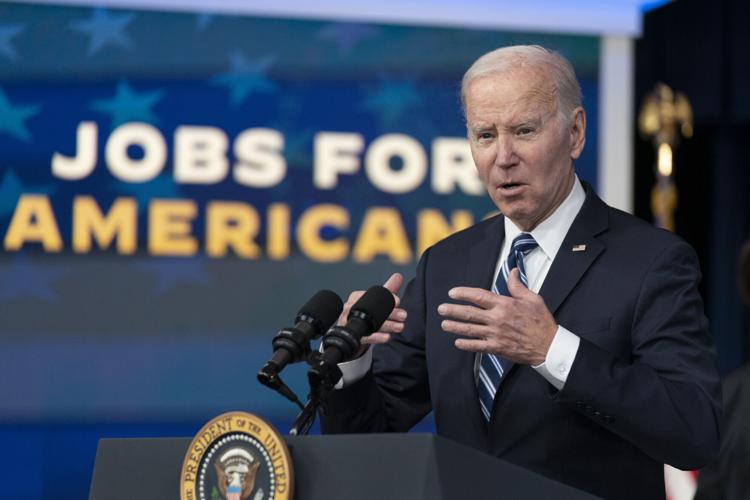
President Joe Biden speaks on the January jobs report Friday in the Eisenhower Executive Office Building in Washington. Going into Tuesday’s State of the Union address, Biden sees a nation with its future aglow. Republicans take a far bleaker view.
The harder reality is that the United States is on a tight rope, trying to balance efforts to reduce inflation with the need to stay upright and avoid falling into a recession. That’s with the seemingly inherent contradiction of a soaring job market and the unemployment rate at a near 54-year low.
Based on past speeches, Biden believes the policies adopted under his watch can fill the U.S. with new factories and protect against climate change. Roads, bridges, sewer systems, ports and internet service would be improved. The middle class would be more financially secure. So would America’s place in the global economy’s hierarchy.
On Friday, the president said the proof was in the January employment report. It showed 517,000 jobs were added as the unemployment rate fell to 3.4%, making it “crystal clear” that his “chorus of critics” were wrong.
“Here’s where we stand: The strongest job growth in history,” Biden said. “Put simply, I would argue the Biden economic plan is working.”
Republicans are pushing back. They blamed Biden’s trillion-dollar plus spending for high inflation and surging gas and food prices. GOP lawmakers want to repeal his tax increases and additional money for the IRS. They oppose his forgiveness of student debt and blame him for the migrants seeking to enter the country at the U.S.-Mexico border.

Neither side captures the fullness of the actual state of the economy.
One group of experts can read the data and claim a recession is on the horizon. A different group can focus on a separate set of figures and see reason to rejoice. It’s a disorienting moment.
Biden can celebrate the low jobless rate even as Republicans bemoan inflation that is still running dangerously hot.
“It’s the best of times and the worst of times for the U.S. economy, to borrow a phrase,” said Mark Zandi, chief economist at Moody’s Analytics. “The economy is full of contradictions as it struggles to get beyond the massive global shocks of the pandemic and the Russian invasion of Ukraine.”
Zandi said he expects the U.S. economy will “skirt” a recession this year, though many economists believe a downturn will come.
Gus Faucher, PNC Financial Services’ chief economist, pegs the odds of a recession this year at 60%. But he said any downturn would be “mild” because “worker shortages will limit layoffs, consumer balance sheets are in great shape, the banking system is solid.”
Most people in the U.S. assume the nation is already in a recession, even if they personally feel fine.

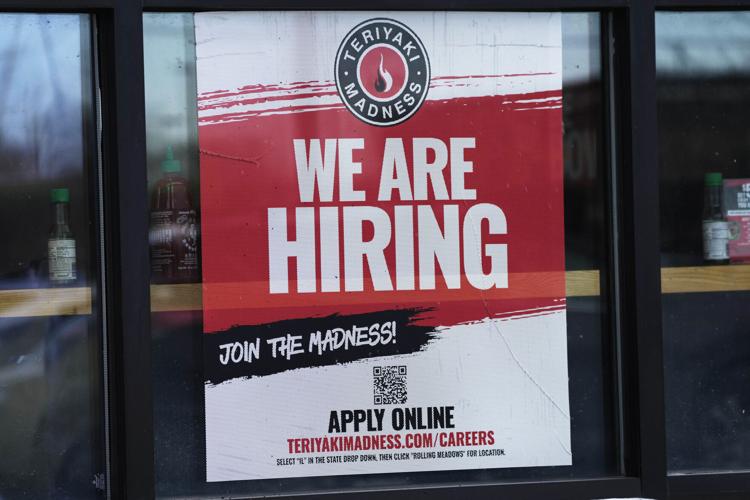
A hiring sign is displayed Jan. 30 at a restaurant in Rolling Meadows, Ill. America’s employers added a robust 517,000 jobs in January.
Only 24% of adults call the national economy good and 76% say conditions are poor, according to a poll by The Associated Press-NORC Center for Public Affairs Research. At the same time, 57% say their personal financial situation is good. That’s unchanged since December, but it has eroded slightly since earlier last year when 62% felt positively about their finances.
The key force shaping the economy right now is the Federal Reserve, which has the mission of keeping prices stable and inflation at around 2%. Consumer prices jumped 6.5% last year.
To bring down inflation, the Fed has tried to slow down hiring and growth by raising its benchmark interest rate over the past year. When Biden delivered the State of the Union Address in 2022, the Fed’s benchmark rate was effectively near-zero. It’s now over 4.5%, the fastest increase in four decades, and Fed Chairman Jerome Powell said Wednesday that the rate will likely go higher.
“Without price stability, the economy does not work for anyone,” Powell told reporters after the Fed board’s most recent meeting.
The Fed rate increases mark a major reversal in how the economy operates.
Ever since the 2008 financial crisis, the U.S. central bank had held its benchmark rate near historic lows to bring back growth. That made it easier for tech start-ups because cheap money meant investors expected them to focus on growth instead of profits. Consumers got used to historically cheap rates for mortgages and auto loans.
The past year’s rate jumps produced a sudden whiplash. The stock market fell. Prominent tech companies such as Google and Microsoft recently announced layoffs. Even as computer chip companies began building new plants and crediting Biden’s policies, the world economy swung from a dearth of semiconductors to a glut. Mortgage rates initially doubled to over 7%, before falling back a bit to 6% last week. The big increase meant monthly payments became unaffordable for would-be homebuyers, forcing many to stay in rentals.
Glenn Kelman, CEO of the real estate brokerage Redfin, said the housing market is stronger than many people expected. But the years of low rates worsened generational inequality. Baby boomers became wealthy as their homes increased in value, but then rates jumped at the time when more millennials wanted to buy and they found themselves priced out.

“A generation ago, boomers owned 21% of U.S. wealth,” Kelman said. “For millennials, that number is 7%. They’re still on the outside looking in.”
Carl Tannenbaum, chief economist for Northern Trust, said he is surprised that the rate increases have hit housing but not employment. Traditional models assumed that efforts to lower inflation would automatically include job losses. But when he talks to companies, most are reluctant to fire their workers because businesses had trouble finding skilled employees during the pandemic.
“Because the supply of labor has been so starved for the past two years, firms are holding on to who they have,” Tannenbaum said. “The prevailing wisdom is if we have a recession it’s going to be shallow. Firms are going to want to be ready to go.”
By the numbers: President Biden at the two-year mark
6.5% annual inflation
Updated
6.5%: Annual inflation remains stubbornly high, but is slowly falling after reaching a four-decade high of 9.1% in June.
10.46 million job vacancies
Updated
10.46 million: The latest Labor Department figures show more than 10 million job vacancies in the U.S., nearly 1.8 jobs for every unemployed person. Jobless rate at 3.5%, matching a 53-year low. Zero recessions — so far.
$31.38 trillion national debt
Updated
$31.38 trillion: The federal debt stood at $27.6 trillion when Biden took office.
$24.2 billion in security aid to Ukraine
Updated
$24.2 billion: The amount of U.S. security assistance committed to Ukraine since the Russian invasion nearly 11 months ago.
38: The number of High Mobility Artillery Rocket Systems, known as HIMARS, committed to send to Ukraine. A gamechanger, allowing Ukrainian forces to fire at Russian targets from far away, then drive away before artillery can target them.
2.38 million migrants stopped at border
Updated
2.38 million: For the 12 months ending Sept. 30, 2022, Customs and Border Protection reported stopping migrants at the U.S. border nearly 2.4 million times, a record surge driven by sharp increases in Venezuelans, Cubans and Nicaraguans. The previous high was 1.66 million in 2021.
97 federal judges confirmed
Updated
97: Confirmation of Biden's picks to the federal bench, including Supreme Court Justice Ketanji Brown Jackson, outpacing the president's two immediate predecessors.
89 pardons and commutations
Updated
89: The president has granted nine pardons and 80 commutations, far more than any of his recent predecessors at this point. Donald Trump had granted 11 by this time, George W. Bush seven. Barack Obama didn't take any clemency action in his first two years.
$3.36 average gas price
Updated
$3.36: The average price per gallon that American motorists are paying at the pump has fallen since peaking at $5.02 per gallon in June. Motorists were paying a $2.39 per gallon average the week Biden took office.
666 million vaccines administered
Updated
666 million: The number of COVID-19 vaccines administered to Americans under Biden. Twenty million had received the jab before Biden took office. The vaccine was not approved until late in Trump's presidency.
15.9%: The percentage of Americans 5 and older who have gotten updated bivalent vaccine.
680,000 COVID-19 deaths
Updated
680,000: The recorded death toll from the coronavirus pandemic during Biden's term. The worst pandemic in more than a century had already taken more than 400,000 American lives by Biden's inauguration and has taken 1.1 million total since March 2020.
36 states visited
Updated
36: Biden has spread his travel across 36 states (shown here in Pennsylvania) to promote his agenda, but still needs to cross off Arkansas, Indiana, Kansas, Maine, Mississippi, Montana, Nebraska, North Dakota, South Dakota, Tennessee, Utah, Vermont, West Virginia and Wyoming.
197 days in Delaware
Updated
197: There's no place like home. The president spent all or part of 197 days in his home state of Delaware, traveling most weekends to either his home near Wilmington or his vacation home at Rehoboth Beach, according to an AP tally. Beyond the weekend visits, he's also made quick trips for funerals, policy events and to cast his ballot in a Democratic primary.
6 chats with Xi
Updated
6: Biden has spoken with Chinese President Xi Jinping a half-dozen times since the start of his term. All but one of those were phone or video calls. They met in person on the sidelines of a summit in Indonesia in November.
22: The minimum number of times that Biden has publicly lapsed into a nostalgic recollection of an intimate conversation he had with Xi during a visit to China when Biden was vice president. Biden said Xi asked him to define America and he responded with one word: Possibilities. Biden even managed to squeeze in the anecdote during a celebration this week for the NBA champion Golden State Warriors.
21 news conferences
Updated
21: Biden held fewer solo or joint news conferences than his three most recent predecessors at the same point in their presidencies.
$1 trillion in infrastructure
Updated
$1 trillion: The amount allocated for roads, bridges, ports and more in Biden's bipartisan infrastructure legislation, arguably the most significant legislative achievement of his first two years in office.
$40 billion for bridges
Updated
$40 billion: The amount in the infrastructure bill dedicated to repair and rebuild the nation's bridges, the single largest dedicated investment in bridges since the construction of the Eisenhower-era interstate highway system.
43,000: The number of bridges in the U.S. rated as poor and needing repair, according to the White House.
1 state dinner
Updated
1: The president's lone state dinner to date honored French President Emmanuel Macron. Biden held back on some of the the traditional pomp — and partying — at the White House in the early going of his presidency because of COVID-19 concerns.
0 Cabinet departures
Updated
0: Not one of Biden's original Cabinet appointees has left the administration.
A closer look
Updated
Taking stock of President Joe Biden's first two years in office compared to his three most recent predecessors.

