


5 questions that remain in the 2020 presidential election
A collection of answers to commonly asked questions around the U.S. presidential election this year.
How soon will we know the election outcome?
Updated
Deadline dates by state for absentee ballots to be returned by mail
How soon will we know the election outcome?
Answer: A shift to mail voting is increasing the chances that Americans will not know the winner of the 2020 presidential race on election night, Nov. 3. But that doesn't mean the results will be flawed or fraudulent.
President Donald Trump has repeatedly raised unsubstantiated fears of fraud involving mail-in voting, which is expected to be more widely used in the November election out of concern for safety given the coronavirus pandemic.
Election officials in some key battleground states have warned that it might take days to count the votes given what they expect will be a surge of ballots sent by mail.
Because processing mail ballots is more laborious than in-person voting, states that haven't updated their laws and systems for the different workload can see delays. But a presidential election hasn't been left in limbo since 2000, when ballot irregularities in Florida led to weeks of chaos and court fights.
While each state runs its own process, mail ballots can take longer to count. In some states, the ballots can be accepted several days after Election Day, as long as they are postmarked before polls closed. And while some states count the ballots as they come in, others — notably the critical battlegrounds of Wisconsin and Pennsylvania — have laws that forbid processing mail ballots until Election Day, guaranteeing the count will extend well past that night.
Does voting in a non-battleground state make any difference?
Updated
Map shows states in which political redistricting is handled by legislatures and commissions.
Will voting in a non-battleground state make a difference?
Answer: There are still plenty of other races where your vote makes a difference. In fact, voters in almost every state will have a chance to influence both national and local decisions through down-ballot races.
Voters in two-thirds of the states will be a electing a U.S. senator. Each one of those races matters for control of the chamber, because Republicans currently hold only a slim majority of 53 of the 100 seats.
The importance of controlling the Senate is evident in the confirmation hearings for President Donald Trump's nominee to the U.S. Supreme Court, Amy Coney Barrett. Because they control the Senate, Republicans are pressing to quickly confirm the conservative jurist. She would replace the late liberal icon, Ruth Bader Ginsberg, and Democrats are virtually powerless to stop it.
Voters in 11 states also will be electing governors, who will shape the state's response to the coronavirus pandemic and other contentious issues, including abortion, crime, climate change and racial inequalities.
And voters in almost all states will be electing state lawmakers who will determine spending for such things as public schools and colleges, infrastructure and health care for low-income residents.
This year's legislative elections are even more important than usual. That's because they are the last before new round of redistricting based on the results of the 2020 census. There are more than 5,000 legislative races in 35 states where the winners will have a role in redrawing U.S. House and state legislative districts for the next decade. How they draw those voting districts could determine which party has an advantage in future elections, and thus which policies are pursued.
Why can one candidate win the popular vote but another wins the electoral vote and thus the presidency?
Updated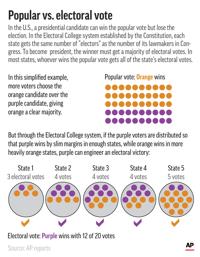
Why can one candidate win the popular vote but another wins the electoral vote and thus the presidency?
Answer: That's how the framers of the Constitution set it up.
This unique system of electing presidents is a big reason why Donald Trump won the presidency in 2016. Four candidates in history have won a majority of the popular vote only to be denied the presidency by the Electoral College.
The Electoral College was devised at the Constitutional Convention in 1787. It was a compromise between those who wanted direct popular elections for president and those who preferred to have Congress decide. At a time of little national identity and competition among the states, there were concerns that people would favor their regional candidates and that big states with denser populations would dominate the vote.
The Electoral College has 538 members, with the number allocated to each state based on how many representatives it has in the House plus its two senators. (The District of Columbia gets three, despite the fact that the home to Congress has no vote in Congress.)
To be elected president, the winner must get at least half plus one — or 270 electoral votes.
This hybrid system means that more weight is given to a single vote in a small state than the vote of someone in a large state, leading to outcomes at times that have been at odds with the popular vote.
In fact, part of a presidential candidate's campaign strategy is drawing a map of states the candidate can and must win to gather 270 electoral votes.
In 2016, for instance, Democrat Hillary Clinton received nearly 2.9 million more votes than Trump in the presidential election, after racking up more lopsided wins in big states like New York and California. But she lost the presidency due to Trump's winning margin in the Electoral College, which came after he pulled out narrow victories in less populated Midwestern states like Michigan and Wisconsin.
It would take a constitutional amendment to abolish the Electoral College — an unlikely move because of how difficult it is to pass and ratify constitutional changes. But there's a separate movement that calls for a compact of states to allocate all their electoral votes to the national popular vote winner, regardless of how those individual states opted in an election. That still faces an uphill climb, though.
Is it possible we won't have a president by Inauguration Day?
UpdatedIs it possible we won't have a president by Inauguration Day: Jan. 20, 2021?
Answer: Even if the election is messy and contested in court, the country will have a president on Inauguration Day. The Constitution and federal law ensure it. Here's what happens after voters go to the polls on Nov. 3:
First, states have more than a month to count ballots, including the expected surge of mail-in ballots, and conduct recounts if necessary. But states' electoral votes have to be cast on Dec. 14.
Courts will be mindful of that in refereeing any disputes. During the 2000 election, the U.S. Supreme Court ultimately ended Florida's vote recount, saying time had run out before electors were set to meet.
When the electors meet, the candidate who gets at least 270 of the 538 electoral votes wins. But what happens if election issues still prevent a winner from being named? The Constitution has an answer.
The 12th Amendment says that in that case, the House of Representatives elects the president and the Senate elects the vice president. The new Congress that enters in January is the one tasked with carrying out the so-called "contingent election." The president has only been selected this way once, in 1825. The winner was John Quincy Adams.
In a contingent election, House members have to choose among the three people with the most electoral votes. Each state delegation gets one vote, and 26 votes are required to win. In the Senate, the choice is between the top two electoral vote-getters and each senator gets a vote, with 51 votes required to win.
What if that fails and the House hasn't elected a president by Inauguration Day? Then the 20th Amendment takes over. It says the vice president-elect acts as president until a president is picked. And if there's no vice president selected by Inauguration Day?
Well, then the Presidential Succession Act applies.
It says that the speaker of the House of Representatives, the Senate president or a Cabinet officer, in that order, would act as president until there's a president or vice president.
How will the 2020 election affect control of Congress?
Updated
The status of races for U.S. Senate in 2020.
How will the 2020 election affect control of Congress?
Answer: The makeup of Congress will be determined by the general election, with both parties needing a majority to control the House or Senate.
Democrats seem to have a good chance at winning a Senate majority, while their control of the House is not in serious doubt.
Republicans hold the Senate 53-47. Democrats must gain at least three seats to win control, or four if President Donald Trump is reelected and Vice President Mike Pence can break a tie.
Only one-third of the 100 Senate seats up are for reelection since senators serve six-year terms. This year, 35 Senate seats are up for grabs, and around a dozen GOP-held seats and two Democratic-held seats seem competitive.
In the 435-member House, Democrats are the ones defending the majority. Republicans currently hold 197 House seats and need 218 to win control. There are also four open seats that had been held by Republicans until they resigned and left office earlier this year.
A shift to mail voting is increasing the chances that Americans will not know which party won the White House on election night, Nov. 3., and it could also delay a final call on control of the Senate. But that doesn't mean the results will be fraudulent.
Election officials in some key battleground states have warned that it might take day s to count the votes given what they expect will be a surge of ballots sent by mail.
As featured on

The Associated Press called Wisconsin for Biden after election officials in the state said all outstanding ballots had been counted.

