


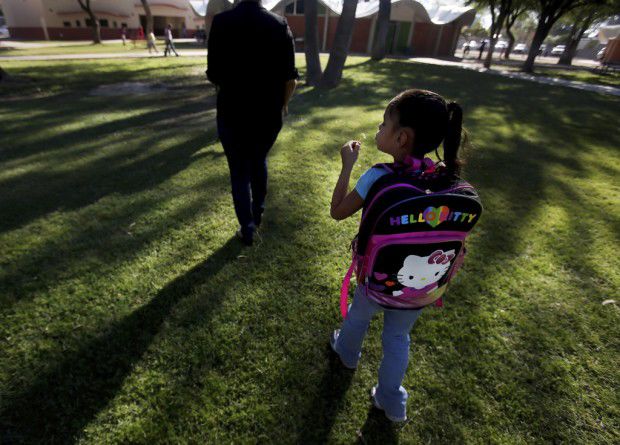

I have a young friend who I’ll call Tom. He’s a first-grader at Walter Douglas Elementary School, and we read together on Friday mornings.
He’s thoughtful and smart. He’s quick to use his hands to demonstrate driving directions that involve “Turn this way by the graveyard” and “Sometimes there’s trains.”
But most of all, Tom is a problem-solver. I would describe him as imaginatively practical, but to him, he’s just dealing in facts.
A few months ago, he told me that he has a story he wants to write. It’s a secret, though, because he doesn’t know how to write all the words yet.
But … BUT, he said, when he DOES know how to write his story, he is going to make sure I can read it as SOON as it’s ready.
I’m only at the school on Fridays. What happens if he finishes on a Tuesday?
Don’t worry. He has a plan:
Tom will write his story on paper at home. Then he will put the paper under his pillow.
The Tooth Fairy will fly in, find his story, pick it up and fly to my house. She will put it under MY pillow. So I should leave my bedroom window open, just a little bit.
A plan beautiful in its logic and simplicity.
Tom’s never told me the details of his story, or the plot. But he says he thinks about it. He’s also been working on a dance with a friend and he’s mentioned a construction project he has underway. Maybe I could come over, he said.
He’s a vibrant kid with curiosity and kindness. He likes to share. He asks how I am doing. He’s super proud of his mom and dad.
Looking at the big picture, what’s going to happen with Tom and his classmates as they grow? Will he continue to have the excellent teachers every child deserves? Will he find his way and remember that some words, like “thought” and “would,” you really can’t sound out?
While Republican lawmakers have long rejected requests from students, parents, teachers and community leaders to improve school funding, in a new survey of 400 CEOs in Arizona, more than half identified our state’s education system and the graduates it produces — read: workers — as one of the most significant barriers to economic growth. Three-quarters said local government can do the most to improve schools.
These leaders said education is more urgent than new tax breaks. They need better schools and universities. Let’s hope the Republican majority listens, and doesn’t default to using Proposition 123 as proof that they’re spending on education.
Prop. 123 would inject millions into the K-12 system, but voters have to approve it first, and they’re not voting until May. Even then, this isn’t new money — the dollars would come from a state land trust that is already legally required to be spent on schools.
But Republicans are talking as if Prop. 123 is a done deal. It has the widespread support of education groups and business leaders — but so did an education sales tax that voters rejected in 2012.
Today Arizona treats education as a commodity. Business is telling lawmakers that money matters in education.
Arizona must make substantive improvements in teacher pay, school funding, academic rigor and college preparation.
Education has tremendous value but it’s not a low-cost commodity you pick off a shelf and give to someone. As any child will show you, learning is a living action.
Maybe I’ll ask Tom how he’d solve Arizona’s education problem. Maybe, once he learns to write the words, he can figure out a way to convince those in power that his future is worth their investment.
Sarah Garrecht Gassen writes opinion for the Arizona Daily Star. Contact her at sgassen@tucson.com and follow her on Facebook.

