


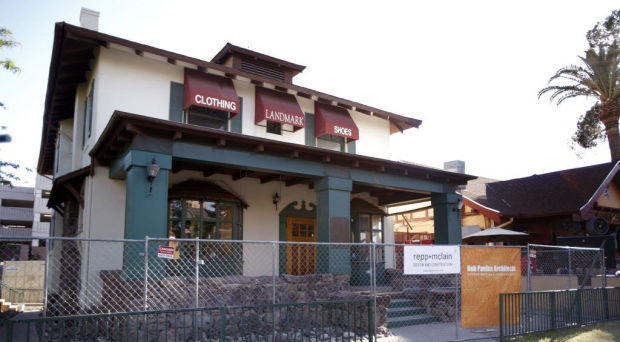
Friends Gaby Fichi and Toni Saia were looking forward to having a new place to eat in the neighborhood. They’d watched the transformation of the century-old building on University Boulevard from a clothing store to a restaurant and they were hopeful that the place, Illegal Pete’s, would be welcoming to all its customers.
That’s not what they found. Theirs is a tale of building codes, frustration, disrespect and some clueless customer service.
Illegal Pete’s made a name for itself in Tucson with its offensive moniker. People protested when it opened last year, the name didn’t change and now it’s popular with college students.
Saia lives nearby and uses a wheelchair. When she went to Illegal Pete’s she said all three tables that can accommodate a wheelchair were occupied, but not by people using wheelchairs.
The rest of the inside seating is at the bar or tall tables, and the open tables outside were picnic tables. She couldn’t try upstairs, because there’s no elevator. She had nowhere she could eat in a restaurant that had open tables.
“I asked the waiter ‘what am I supposed to do?’ ” she said. “He said I could order takeout.”
But she didn’t want to take her food and leave. The employee should have asked the patrons at the accessible tables to please move to a different table, but he didn’t.
“I got so mad, I just left,” Saia said.
Saia wasn’t asking for special treatment. She was asking for what she’s supposed to have – the same access to the restaurant as anyone else.
This is why building codes and the Americans with Disabilities Act have rules to make sure establishments are as accessible to as many people as possible. If people with disabilities weren’t seen as “other” or the exception, such regulations wouldn’t be necessary.
Saia and Fichi saw other accessibility problems at Illegal Pete’s. They mobilized a protest May 2, the first action by the newly formed local chapter of ADAPT. Fichi describes ADAPT as an “organization that helps fight discrimination and fights for disability rights.”
Saia said that at the protest she spoke with the owner of Illegal Pete’s directly, by phone, and explained their concerns and that this is a civil rights issue. She said he was dismissive.
(I contacted Illegal Pete’s corporate headquarters and was told the owner would follow up, but we did not connect before my deadline Wednesday afternoon.)
Some of ADAPT’s complaints don’t violate the building code Tucson uses, according to Clayton Trevillyan, Tucson’s interim building official. He and a deputy director responded to the May 2 protest, as did police.
Plus, the ADA is a federal law, and unless a municipality has adopted the ADA building regulations as its local code — which Tucson has not — only the U.S. Justice Department can enforce violations, he said.
So an establishment can be in compliance with the Tucson building code, but not with the ADA. The differences are minor, he said, but they do exist and rectifying the two isn’t as easy as it sounds.
Some of Fichi and Saia’s concerns reach beyond the rules and get into how disability is treated in a larger sense. The logistics of living with a disability creates an awareness and sense of equality that those who are temporarily abled-bodied don’t have to even acknowledge.
An example is ADAPT’s objection that the accessible entrance, with a ramp, is in the back of the building. Non-disabled customers can come in the front door, but disabled patrons are relegated to the back door. The message is potent.
But because of the height difference between the ground and the first floor, and requirements for ramp slope, a front-door ramp would take up the entire porch seating area of the restaurant, according to Trevillyan. That’s not reasonable.
Plus, the building code requires that a ramp be built as a close to disabled parking as possible, which means the back ramp would have to stay.
Trevillyan met with ADAPT members Tuesday. They agreed on accessibility violations that need to be corrected before Illegal Pete’s gets its final certificate of occupancy from the city.
The fountain soda machine is too high, it needs a sign telling customers the ramp is around back, and a handrail on the ramp must be changed.
Smart entrepreneurs do more than the minimum. It’s solid business in a country that is aging, and it sends a signal that every customer matters.
How simple it would be to put a sign on tables so everyone knows they, like the similarly marked bathroom stalls, are available to everyone, but when someone with a disability needs it, they get first dibs.
Accessibility is common sense — and good business.

