


Decades ago, information scientist Don R. Swanson reasoned that important scientific and medical breakthroughs could come not only from laboratories but from various electronic databases — but only if we can relate, retrieve, interpret and bring together such independently created information.
Should this union not be attained, discoveries, he rightly asserted, would be overlooked, a phenomenon he termed, “undiscovered public knowledge.”
Given the increased importance of interdisciplinary research, we are developing an online visual analytics system to match research scientists at the University of Arizona with research projects and calls for proposals. The prototype system is called MapMatch.
MapMatch is designed to answer complex questions such as how research officers or faculty at the University of Arizona can identify experts in a given field; how the university can identify gaps in our areas of expertise; how officers can forward calls for proposals to the correct experts; and how we can create a sound multi-disciplinary team to apply for integrative research proposals.
MapMatch integrates data from multiple sources. In particular, it relies on data gleaned from university databases such as those pertaining to current staff and research proposals; online databases that pertain to research publications and funding awards; and external ones such as Google Scholar that can be used to find collaborators.
The data are analyzed using machine learning methods, which automate analytical model building, and natural language processing, which allows computers to analyze and understand human language.
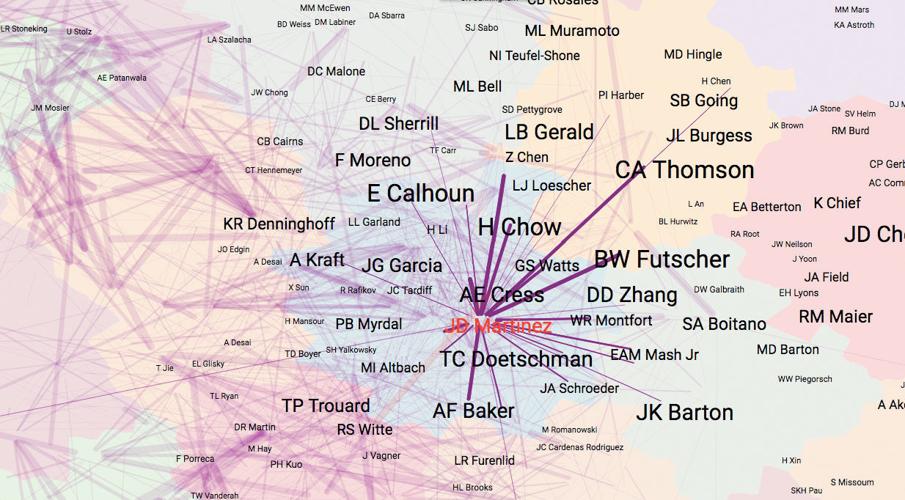
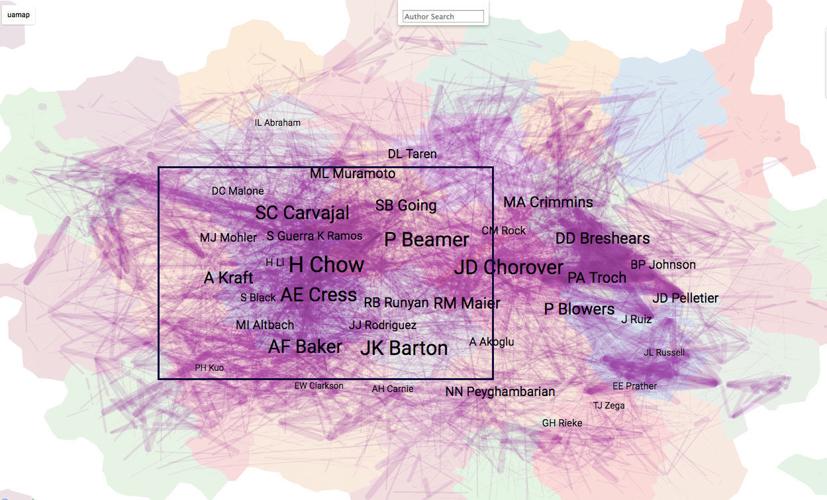
The results of this analysis are visualized using map-based networks and overlays. For example, given a call for a proposal, we can find UA research scientists and possible collaborators for that research project, based on the topics of the proposal and the expertise of the scientists.
This is not a trivial task, given that there are thousands of research scientists at the UA who work across multiple colleges and departments.
MapMatch is still in an early prototype stage, and we are working on formal validation of many of its components. Nevertheless, the UA Office of Research, Discovery and Innovation is using MapMatch to help build research teams to tackle large-scale, multi-disciplinary projects.
We are also planning to develop a streamlined, user-friendly version of MapMatch to help new research scientists find research collaborators at the UA.

