


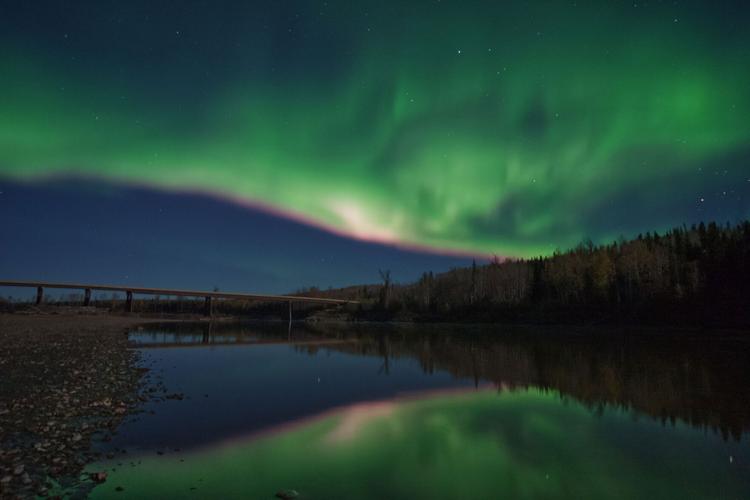
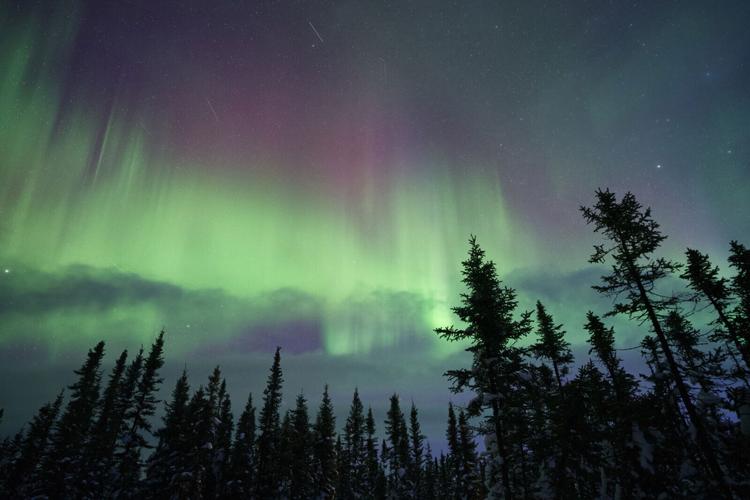
A spectacular northern lights show dominated the skyline above Lake Toras-Sieppi in northern Finland's Lapland region.
In the dead calm of a winter's night on a remote Canadian stretch of the Alaska Highway — without another soul in sight — the sound of something sizzling echoed down the MacDonald Valley, where Ryan Dickie had driven to photograph the northern lights.
It was the evening after a particularly active display of the celebrated celestial phenomenon above Dickie's home in northern British Columbia. The 36-year-old Indigenous Dene photographer and conservationist from Canada's Fort Nelson First Nation decided to go someplace far from any light pollution to shoot what he hoped would be a similarly spectacular show in the sky.
But as he stepped outside into the frozen night to adjust his camera settings, it was the sound — not just the sight — that stopped him in his tracks.
"When you're living up here you hear stories that they (the northern lights) make a sound, and if you whistle at them that they'll come closer to the ground," Dickie said. "My grandma told me a story when they were kids growing up on the land near the Liard River about how the northern lights made clicking sounds, like you'd make to call your dog."
But when Dickie finally heard it, it was different.
"It was kind of faint at first, but almost sounded like a piece of meat hitting a frying pan," Dickie said.

The aurora borealis, captured by Dene photographer and conservationist Ryan Dickie, shines bright over the Fort Nelson River in far northeast British Columbia, Canada.
Ears to the sky
Caused by solar flares on the surface of the sun, the northern lights — also known as the aurora borealis or an aurora — can appear in Earth's magnetic field as faint whitish or greenish cloudlike formations or even curtains of color and swirling explosions that erupt across the sky in greens, pinks and purple. In places like Arctic Alaska, Arctic Canada, northern Norway, Finnish Lapland and other northern reaches of the planet, where they're regularly seen, there are countless reports of people hearing sounds along with the aurora, too.
Mamie Williams, a member of the Tlingit tribe in Hoonah, Alaska, said that her grandmothers always told her to listen for the northern lights when she was a child.
"It's our ancestors letting us know, 'We crossed over but we're still here with you,'" said Williams, a cultural interpreter who works with Alaska Native Voices.
Williams first heard the aurora borealis make singing and crackling sounds when she was 14 years old and said she has heard it make similar noises since.
Once, when the sky was vibrant with purples and greens, she said she even heard the sound of drumming accompanying the lights in the sky.
"The brighter they get, the more you hear," Williams said.
But while accounts like those of Dickie and Williams are not unusual among both Indigenous and nonindigenous people living where the northern lights regularly can be seen, there so far has been little scientific research into the phenomenon.
"There's been years and years of anecdotal reporting of people hearing a whooshing or crackling sound," said Donald Hampton, a research associate professor at the Geophysical Institute at the University of Alaska Fairbanks who studies space physics and aurora and auroral interactions with the upper atmosphere.
"But if you think about it physically, there's no way you're actually getting sounds from the aurora itself."
That's because the northern lights occur between 60 and 100 miles above the Earth's surface and it takes sound several seconds to travel a mile, Hampton said.
"If you've ever counted after a lightning strike, it takes five seconds for sound to go a mile," he said, so if sounds were coming from the northern lights themselves they would take five to 10 minutes to be heard on the ground.
Still, Hampton does not discount the theory that the northern lights could be responsible for the sound people claim to hear.

An aurora borealis ignites the early morning sky shortly before sunrise near Fort Nelson in northeast British Columbia, Canada.
A theory illuminated
Unto K. Laine first heard a sound accompanying the aurora borealis while visiting the remote northern Finland village of Saariselkä in 1990 for a jazz festival.
Together with four friends, the professor emeritus in acoustics at Aalto University in Espoo, Finland, "made the proposal to listen to the quietness of Lapland," he said. With the northern lights filling the sky above them, three people in his group that night heard not silence but soft sounds "like bursting soap bubbles," Laine said.
"We really had to be very quiet over two minutes and concentrate to the listening," he said.
It was an experience that never left him, Laine said, especially with all of the stories of people reporting sounds associated with the northern lights, while no scientific research was being done into the phenomenon.
"This question mark was permanently in my mind," said Laine, who has spent most of his career studying the phenomenon of sounds. He has a theory about what people hear and associate with the northern lights.
Published in 2016, his temperature inversion layer hypothesis posits that the sound people associate with the northern lights actually comes from electric discharges at lower altitudes of around 70 and 90 meters (230 and 296 feet). Those sparks, he theorizes, emit from the aurora during calm and clear weather when a temperature inversion layer — or a layer in the atmosphere in which the air warms with height instead of cooling with height — is produced.
"In the evening of a sunny day warm air close to the ground starts to rise while the ground temperature drops. Finally, the rising of the warm air stops typically below an altitude of 100 meters (328 feet)," Laine said. "This layer of a warm air, having colder air above and below it, is called temperature inversion layer."
Laine has spent decades recording the sounds using a three-microphone setup and a VLF (very low frequency) loop antenna connected to a four-channel digital recorder.
During clear evenings, Laine said, the inversion layer accumulates space charges — positive ones from the upper atmosphere and negative ones from the ground. The magnetic storm that is the cause of auroral lights triggers and releases these discharges in the inversion layer, producing audible sounds, he said.
Hampton said that Laine's theory is "not out of the realm of possibility."
"He's going with the assumption it has to do with electricity," Hampton said. "A strong electric field could set up mechanisms by which you could get air vibrations or little discharges that could pop or snap."
Research, amplified
Laine's theory helped inspire a new citizen science project launching this summer near Jyväskylä, Finland, where volunteers at the Hankasalmi Observatory will begin continuously recording potential sounds associated with auroras 24 hours a day for the first time, using four microphones instead of Laine's three.
The project is funded in part by the European Union as well as the support of 200 local volunteers.
The hope is that the four microphones — which can pick up the same sounds as the human ear — will be able to pinpoint where the sounds are coming from, helping to prove or disprove Laine's theory, said Arto Oksanen, the observatory's president.
"We are trying to hear the same sound with three or four microphones located a few meters apart," he said. "By measuring the time delay in each recording, it is possible to calculate the three-dimensional position of the sound source — or at least the direction to the sound source."
Combining that result with the electromagnetic signal measured with a VLF antenna, Oksanen said, will also give the distance of the sound source.
Oksanen, who said he is "open to anything and making recordings," admitted being "a bit skeptical" that the northern lights are producing the sounds, having spent hundreds of hours watching auroras without hearing them.
"There have been so many stories of people hearing the sounds, I don't think they're making it up," he said. "But I don't know if it's true acoustic sounds. Nowadays, it should be very easy to record it since everyone has a phone. So why aren't there recordings?"
Compared to the portable setup Laine has used to make recordings so far, the observatory's setup will be permanent and "allow us to collect much more data," Oksanen said. Adding an additional microphone also "gives further confidence and error analysis," he said.
"Many universities and scientists don't believe in the sounds, and they aren't even applying for funding to make these recordings," he said. "So maybe we can find something that nobody has found before."
Not everyone needs a recording to be convinced the sounds exist, however.
"It was definitely the sound I'd always heard they made," Dickie said of the night along the Alaska Highway and the show in his sky — and in his ears — that he'll never forget.
"I was certain it was the sound of the northern lights."
Species that went extinct in 2020
Species that went extinct in 2020
Updated
We can all name our favorite endangered species—fan favorites tend to be the big, charismatic mammals like orangutans and tigers that captivate us at zoos. Some of us can even rattle off the more famous species that went extinct in recent centuries, like the passenger pigeon, whose last individual (a bird named Martha) died in captivity in 1914, or the dodo bird, already extinct by 1681. But the modern era has brought with it extinction on a new scale: We’re in the midst of the sixth mass extinction ever experienced by our planet, and humans are to blame.
All this extinction talk begs the question: Which species have gone extinct most recently? To find out, Stacker used a December 2020 press release from the International Union for Conservation of Nature, reporting from The Revelator’s John R. Platt, and other scientific sources to compile a list of 15 plants and animals that were declared extinct or extinct in the wild in 2020.
On the list you’ll find frogs and salamanders, birds and trees, and more. Some species on our list are down to the last of their kind, like rare plants now found only in botanical gardens. Others haven’t been spotted for decades, and are at long last being scratched off the list of the living. Why the lag? Conservationists want to be absolutely sure that a species is extinct before calling off the search, since the list also serves as a signal that conservation efforts can cease. It’s an especially tricky call to make, since some hard-to-find species have been known to turn up after years and years of hiding (like the Cebu flowerpecker, a bird spotted in 1992 after an 86-year drought of sightings). Biologists don’t want to declare a species extinct too early, but leaving an extinct species on the endangered list can waste precious conservation resources. In the end, it’s a judgement call made by the experts that know the species best.
Without further ado, here are 15 plants and animals we lost for good in 2020.
You may also like: Countries exporting the most endangered species to America
Splendid poison frog
Updated
- Scientific name: Oophaga speciosa
Central American frogs have had a terrible time for the past few decades, thanks to a fungal disease, chytridiomycosis, that’s been ravaging amphibian populations across the tropics. The splendid poison frog was no exception. Endemic to the forests of Panama, it was last spotted in the wild in 1992.
Jalpa false brook salamander
Updated
- Scientific name: Pseudoeurycea exspectata
This salamander was last seen in 1976, although it was once a common sight in its home forest in the Jalapa region of Guatemala (that's not a typo; it's the Jalpa from Jalapa). Since then, habitat destruction from farming, logging, and grazing left it without a home.
[Pictured: A similar species, Pseudoeurycea leprosa.]
Simeulue Hill myna
Updated
- Scientific name: Gracula religiosa miotera
Researchers reported in 2020 that this tropical bird went extinct in the wild in the past two or three years. This myna was only recently established as a distinct species from its close relatives in Southeast Asia after researchers conducted genomic analyses.
[Pictured: A similar species, Gracula religiosa.]
Lost shark
Updated
- Scientific name: Carcharhinus obsoletus
The lost shark has only been observed three times in the South China Sea, most recently in 1934. But the specimens weren’t identified as a new species until 2019—long after the shark presumably went extinct. The South China Sea is one of the most heavily fished areas in the world, so it’s unlikely any individuals remain.
Smooth handfish
Updated
- Scientific name: Sympterichthys unipennis
Perhaps the strangest-looking species on this list, this Australian ocean-dwelling fish is named for the handlike fins it uses to walk along the seafloor. Although the reason for the demise of this species is unknown since it hasn’t been spotted in 200 years, other handfish are susceptible to overfishing, habitat disturbances, and predation by invasive species like the northern Pacific seastar.
You may also like: American plants that have gone extinct
Lake Lanao freshwater fish
Updated
- Scientific name: Barbodes spp.
Fifteen fish species in the genus Barbodes were declared extinct in 2020, all of them endemic to the Philippines' Lake Lanao. One of the oldest lakes in the world, Lake Lanao has been in trouble since the predatory tank goby, Glossogobius giuris, was accidentally introduced in the early 1960s.
[Pictured: Lake Lanao.]
Chiriqui harlequin frog
Updated
- Scientific name: Atelopus chiriquiensis
Another amphibious victim of the chytrid fungus, this frog was actually a toad. Despite intensive search efforts, it hasn’t been observed in its native habitat, the rainforests of Costa Rica and Panama, since 1996.
Spined dwarf mantis
Updated
- Scientific name: Ameles fasciipennis
The only insect on our list, this praying mantis used to live in shrublands in central Italy. It was only recorded once in 1871, before its habitat was thoroughly cultivated.
Bonin pipistrelle bat
Updated
- Scientific name: Pipistrellus sturdeei
Another species only recorded once, the Bonin pipistrelle is a Japanese bat observed for the first and last time in 1915. Its former home, the Bonin, or Ogasawara, Islands are a biodiversity hotspot and a UNESCO World Heritage Site.
[Pictured: A similar species, Pipistrellus pipistrellus lateral.]
Lord Howe long-eared bat
Updated
- Scientific name: Nyctophilus howensis
Researchers found a single skull belonging to this bat in 1972 but never found any more specimens, so reasons for its decline are unknown. Its native habitat, Lord Howe Island, is off the coast of New South Wales, Australia.
[Pictured: A similar species, Nyctophilus geoffroyi.]
You may also like: How communities are dealing with invasive species across the U.S.
Wolseley conebush
Updated
- Scientific name: Leucadendron spirale
This South African shrub was last seen in 1933 and finally taken off the endangered species list last year. Though the reasons for its decline aren't certain, much of its habitat has been destroyed, and what's left has been overrun by invasive species.
[Pictured: A similar species, Leucadendron strobilinum.]
Agave lurida
Updated
- Scientific name: Agave lurida
This Mexican agave, a close relative of the plant that gives us tequila, was last spotted in the wild in 2001. Only a few individual specimens were ever identified, and the plant's tiny range in the Oaxacan shrublands has been heavily grazed, likely leading to its demise.
[Pictured: A similar species, Agave ferox.]
Alphonsea hortensis
Updated
- Scientific name: Alphonsea hortensis
The last specimens of this Sri Lanken tree live in the Peradeniya Royal Botanic Garden. It hasn’t been found in the wild since 1969, when it grew in lowland rainforests.
[Pictured: Similar species, Alphonsea lutea.]
Golden fuchsia
Updated
- Scientific name: Deppea splendens
This tropical beauty only ever grew in one spot in Mexico, so when its home was plowed under for cultivation, it went extinct in the wild. Luckily a botanist had collected the seeds, so the species lives on in a few botanical gardens, and gardeners can even order cultivars online for their home collections.
Hawaii yellowwood
Updated
- Scientific name: Ochrosia kilaueaensis
Once endemic to the island of Hawaii, this tropical plant witnessed its rainforest habitat devastated by invasive plant and animal species since its last sighting in 1927.
[Pictured: A similar species, Ochrosia borbonica.]
You may also like: Polar bears and 50 other species threatened by climate change

