

Australian scientists have begun vaccinating wild koalas against chlamydia in an ambitious field trial in New South Wales.
The aim is to test a method for protecting the beloved marsupials against a widespread disease that causes blindness, infertility and death.
"It's killing koalas because they become so sick they can't climb trees to get food, or escape predators, and females can become infertile," said Samuel Phillips, a microbiologist at the University of the Sunshine Coast who helped to develop the vaccine.

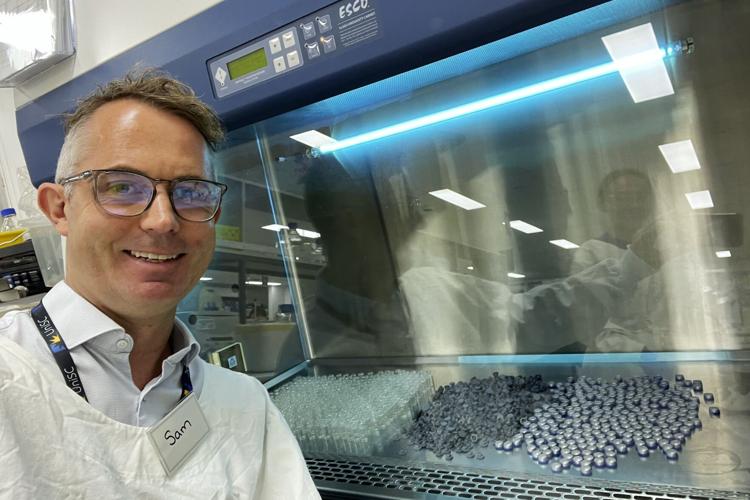
Samuel Phillips poses for a photo in the Laboratory making UniSC Koala Chlamydia vaccine doses for wildlife vaccine trials at the University of the Sunshine Coast in Sippy Downs, Queensland, Australia, on Nov. 15, 2022. Australian scientists have begun vaccinating wild koalas against chlamydia in an ambitious field trial. "It's killing koalas because they become so sick they can't climb trees to get food, or escape predators, and females can become infertile," said Phillips, who helped to develop the vaccine. (Ton Stewart/Samuel Phillips via AP)
The scientists' initial goal is to catch, vaccinate and monitor around half of the koala population in the Northern Rivers region of New South Wales — that means vaccinating around 50 animals.
The safety and effectiveness of the single-shot vaccine, which has been designed specifically for koalas, has previously been tested by vaccinating a few hundred koalas brought to wildlife rescue centers for other afflictions.
Now scientists want to understand the impact of vaccinating a population of wild koalas. "We want to evaluate what percentage of the koalas we need to vaccinate to meaningfully reduce infection and disease," said Phillips.
The first koalas were caught and vaccinated in March, and the effort is expected to last about three months.

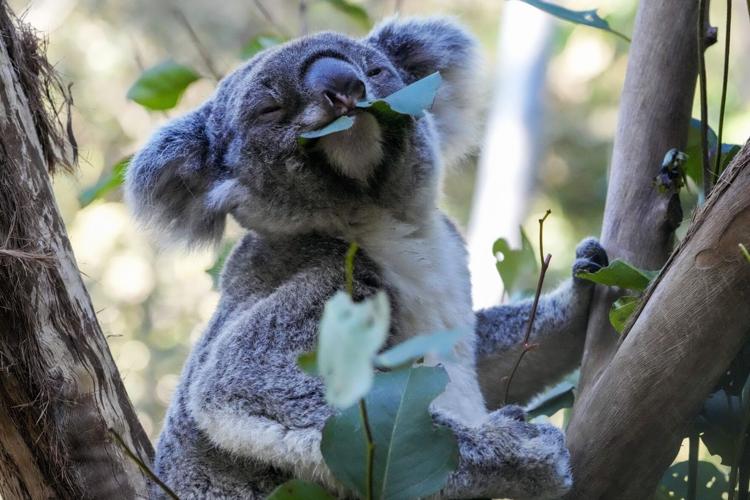
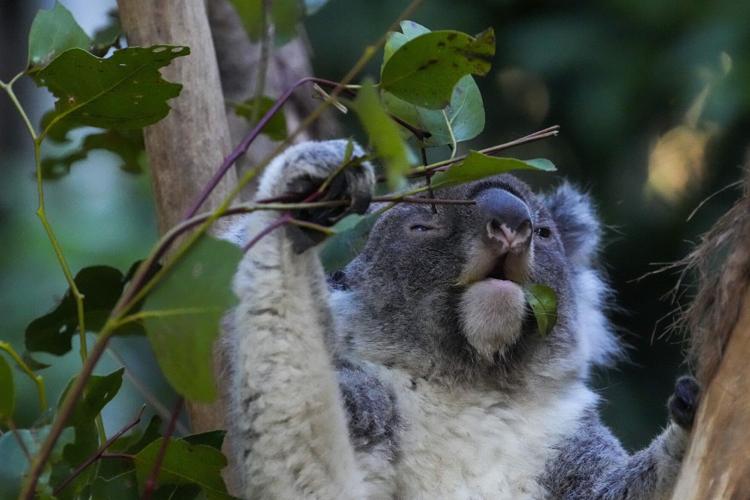
A koala eats gum leaves at a koala park in Sydney, Australia, Friday, May 5, 2023. Australian scientists have begun vaccinating wild koalas against chlamydia in a pioneering field trial in New South Wales. The aim is to test a method for protecting the beloved marsupials against a widespread disease that causes blindness, infertility and death. (AP Photo/Mark Baker)
Researchers use binoculars to spot koalas in eucalyptus trees, then construct circular enclosures around the tree bases with doors leading into cages. After a few hours or days, the koalas will eventually climb down from one tree to seek tasty leaves on another, and wander into the harmless traps.
"It's hard to confuse a koala with any other animals — they're pretty easy to spot," said Jodie Wakeman, veterinary care and clinical director at Friends of the Koala, a nonprofit that runs a wildlife hospital where the koalas are being brought for vaccination.
After a check-up to make sure the animals are in good condition, researchers administer anesthesia and shots of vaccine, then keep them under observation for 24 hours after they wake up, to confirm there are no unexpected side effects, said Wakeman.

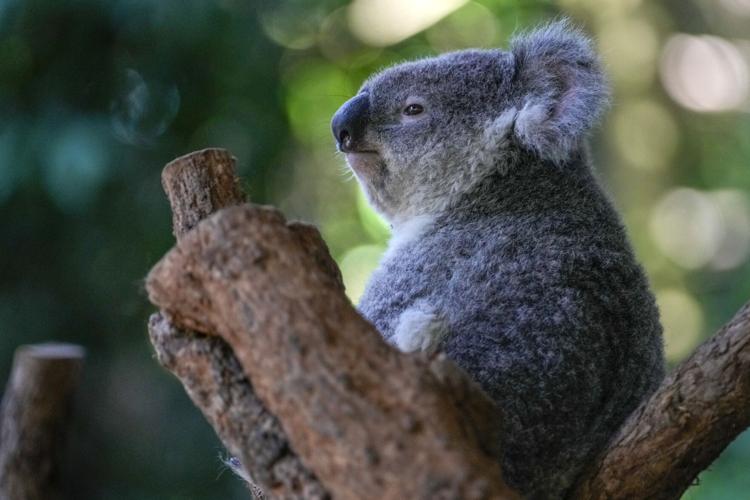
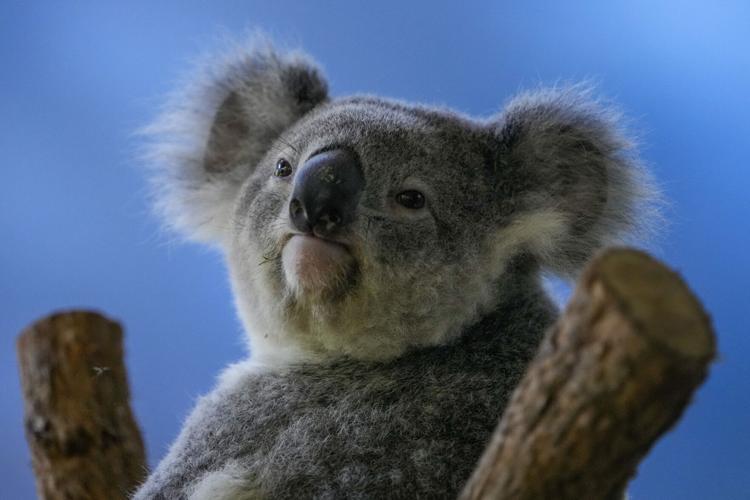
A koala sits in a tree at a koala park in Sydney, Australia, Friday, May 5, 2023. Australian scientists have begun vaccinating wild koalas against chlamydia in a pioneering field trial in New South Wales. The aim is to test a method for protecting the beloved marsupials against a widespread disease that causes blindness, infertility and death. (AP Photo/Mark Baker)
The goal is to vaccinate healthy koalas to prevent them from becoming infected with chlamydia.
Before release, the researchers mark the koalas with a dab of pink dye on their backs, to ensure the same animals aren't caught twice.
When the first vaccinated koala was returned to her habitat on March 9, the scientists placed her cage at the base of a tree and opened the door. She quickly emerged and bounded up the tree trunk.
Koalas are iconic Australian marsupials, like wombats and kangaroos. They spend most of their time eating and sleeping in eucalyptus trees, and their paws have two opposing thumbs to help them grasp and climb up trunks.
Australia's wild koala populations have declined steeply in the past two decades.

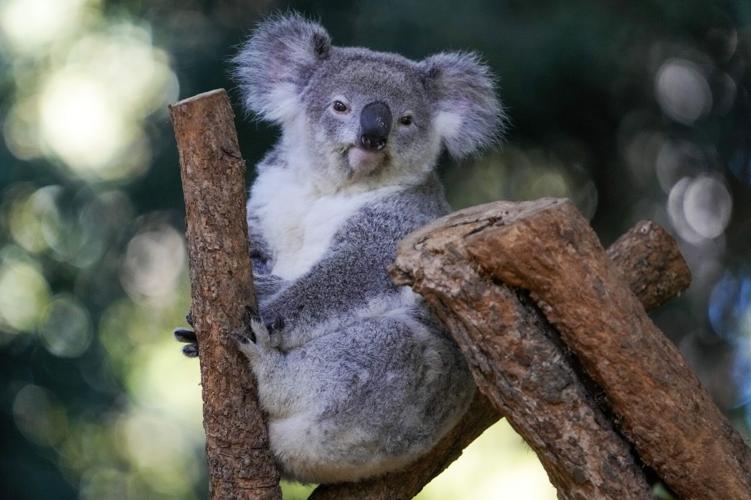
A koala sits in a tree at a koala park in Sydney, Australia, Friday, May 5, 2023. Australian scientists have begun vaccinating wild koalas against chlamydia in a pioneering field trial in New South Wales. The aim is to test a method for protecting the beloved marsupials against a widespread disease that causes blindness, infertility and death. (AP Photo/Mark Baker)
Last February, Australia's federal government declared koalas "endangered" in the eastern regions of New South Wales, Queensland and the Australian Capital Territory.
Facing compounded threats from disease, habitat loss and road collisions, koalas could become extinct by 2050, according to a 2020 assessment from the New South Wales government.
Around half of wild koalas in Queensland are already infected with chlamydia, scientists estimate.

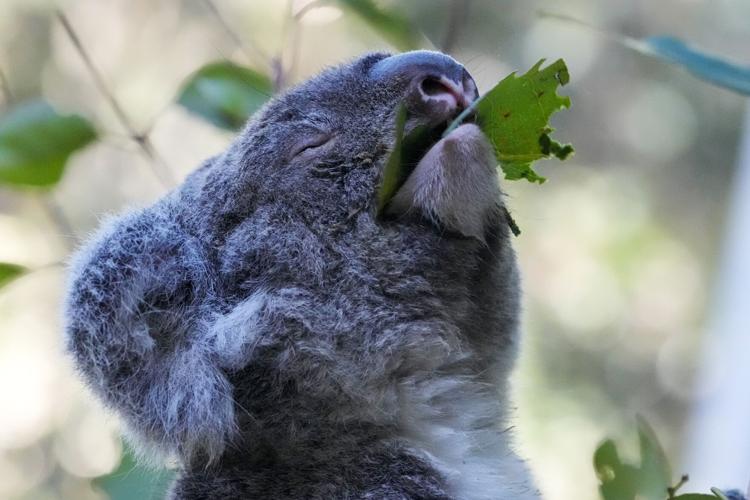
A koala eats gum leaves at a koala park in Sydney, Australia, Friday, May 5, 2023. Australian scientists have begun vaccinating wild koalas against chlamydia in a pioneering field trial in New South Wales. The aim is to test a method for protecting the beloved marsupials against a widespread disease that causes blindness, infertility and death. (AP Photo/Mark Baker)
In deciding to vaccinate, the scientists are balancing the risk of disturbing the animals against the danger of allowing the disease to spread. The trial was approved by multiple government bodies, including Australia's agriculture department and New South Wales' planning and environment department.
The origins of chlamydia in koalas aren't confirmed, but scientists believe it's likely the marsupials initially caught the disease from exposure to the feces of infected sheep and cattle. Then it's spread sexually, or passed from mother to offspring.
While humans and livestock infected with the bacteria that causes chlamydia can be treated with antibiotics, it's not so simple for koalas.
The "complex" microbes inside the stomachs of koalas are designed to neutralize toxins in eucalyptus leaves that are their main food source, said Mathew Crowther, a conservation biologist at the University of Sydney. But their digestive systems can also neutralize some medicines so "that means they don't respond well to antibiotics treatment," he said.

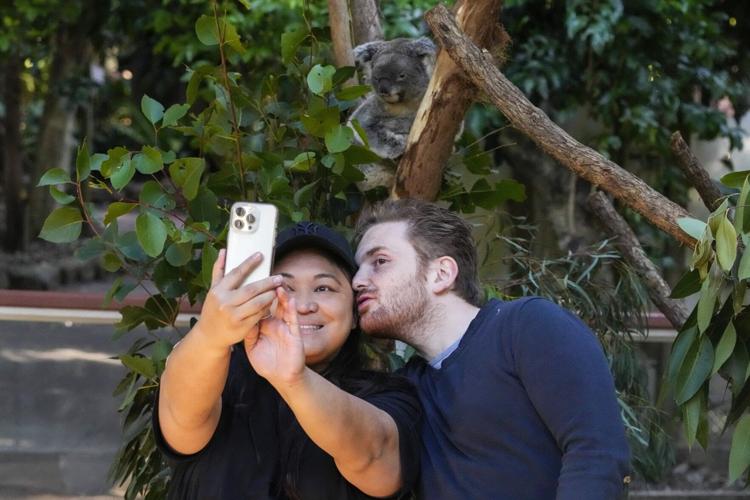
Visitors take a selfie with a koala at a koala park in Sydney, Australia, Friday, May 5, 2023. Australian scientists have begun vaccinating wild koalas against chlamydia in a pioneering field trial in New South Wales. The aim is to test a method for protecting the beloved marsupials against a widespread disease that causes blindness, infertility and death. (AP Photo/Mark Baker)
Crowther has been monitoring a population of koalas in northern New South Wales for more than a decade. In 2008, 10% of animals tested there were infected with chlamydia. Today that rate is 80%.
"It's been devastating — there's very, very low fertility," he said. "You hardly see any babies."
The other threats koalas face — including habitat destruction from land clearing and climate-enhanced wildfires — may increase their stress levels, weakening their immune systems and making them more susceptible to diseases including chlamydia, said Crowther.

A koala sits in a tree at a koala park in Sydney, Australia, Friday, May 5, 2023. Australian scientists have begun vaccinating wild koalas against chlamydia in a pioneering field trial in New South Wales. The aim is to test a method for protecting the beloved marsupials against a widespread disease that causes blindness, infertility and death. (AP Photo/Mark Baker)
Rebecca Johnson, now chief scientist at the Smithsonian National Museum of Natural History in Washington, D.C., previously led the Koala Genome Consortium in Australia. She said that seeing the effects of the disease up close was heartbreaking.
A necropsy of one koala with advanced chlamydia that was euthanized revealed "ovaries completely encased in cysts" and "intestines full of hard lumps of food, evidence that she couldn't properly digest food," recalled Johnson. "She was obviously infertile and in pain."
There are only a handful of other examples worldwide of scientists attempting to catch and inoculate endangered wildlife for conservation. In 2016, scientists began to vaccinate Hawaiian monk seals against a deadly strain of morbillivirus. Two and a half years ago, biologists in Brazil began to vaccinate golden lion tamarins against yellow fever.

A koala eats gum leaves at a koala park in Sydney, Australia, Friday, May 5, 2023. Australian scientists have begun vaccinating wild koalas against chlamydia in a pioneering field trial in New South Wales. The aim is to test a method for protecting the beloved marsupials against a widespread disease that causes blindness, infertility and death. (AP Photo/Mark Baker)
"Vaccination for wildlife is certainly not routine yet," said Jacob Negrey, a biologist at Wake Forest University School of Medicine. "But whether it should be used more often is a fundamental question that conservation biologists are really wrangling with right now."
The Smithsonian's Johnson said the benefits are likely to outweigh the risks for koalas. "Vaccination is an incredibly resource-intensive thing to do. Koalas live high up in trees," she said.
"But because the effects of chlamydia are so debilitating, I think it's totally worth it."
___
Photos: Koalas officially declared endangered in Australia
Australia Koala Habitat
Updated
Maggie the female koala climbs a tree with her joey at Taronga Zoo in Sydney, Australia, on Sept. 1, 2011. (AP Photo/Rob Griffith)
Australia Koala
Updated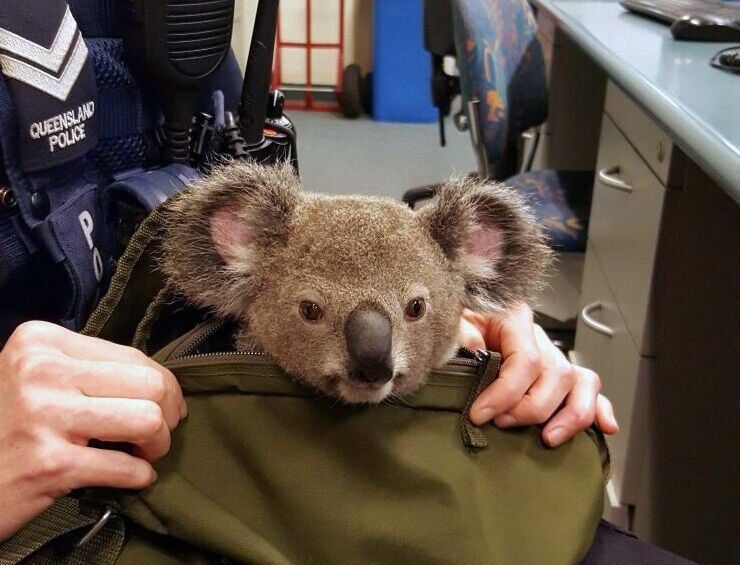
In this photo provided by Queensland Police Service and taken on Nov. 6, 2016, a koala looks out from a handbag at a police station in Brisbane, Australia. Australian police made an unusual find while searching the bag of a woman who was being arrested: a baby koala. Police in Brisbane said that when they asked the 50-year-old woman if she had anything to declare, she handed over a zipped canvas bag that she said contained a baby koala. The woman, who was arrested on "outstanding matters," said she found the male koala and had been caring for it.
Australia Wildfires
Updated
In this image made from video taken on Dec. 22, 2019, and provided by Oakbank Balhannah CFS, a koala drinks water from a bottle given by a firefighter in Cudlee Creek, South Australia. Thousands of koalas were feared to have died in a wildfire-ravaged area north of Sydney, further diminishing Australia's iconic marsupial.
Asia
Updated
Meghan, Duchess of Sussex, is seen next to a koala during a tour of Taronga Zoo in Sydney, Australia, on Oct. 16, 2018. (Dominic Lipinski/Pool Photo via AP)
Australia Fires Koalas
Updated
In this Dec. 20, 2019, photo provided by Adam Mudge, koalas sit inside a home in Cudlee Creek, South Australia, after being rescued from fires at a garden. Local firefighters assigned to protect a property from an approaching fire in South Australia helped a homeowner move koalas into her house to keep them safe from the flames. (Adam Mudge via AP)
Australia Stressed Koalas
Updated
In this Sept. 23, 2009 photo, head senior keeper Harley Everson returns a baby koala to its mother at the Sydney Wildlife World in Sydney, Australia, after he weighed and check the animal. A study on koalas found an unexpected consequence of habitat loss is a latent disease called chlamydiosis that already affects 50-90 percent of the animals. (AP Photo/Rob Griffith)
Australia Wildfires
Updated
In this image from a video taken Dec. 27, 2019, and provided by @bikebug2019, a koala drinks water, given by a cyclist in Adelaide, Australia. The cyclist was approached by the thirsty koala as a heat wave continued to grip the state. (@bikebug2019 via AP)
Baby Koala
Updated
A 9-month-old baby koala, left, ventures from his mother at the Cleveland Metroparks Zoo in Cleveland on May 7, 2010. (AP Photo/Amy Sancetta)
Germany Zoo
Updated
A koala relaxes on a eucalyptus tree on a sunny warm day at the zoo in Duisburg, Germany, May 22, 2017. Koalas are largely sedentary and sleep up to 20 hours a day. (AP Photo/Martin Meissner)
National Threatened Species Day
Updated
A koala, an arboreal Australian marsupial, clings to a tree on the grounds of Parliament House on the National Threatened Species Day in Canberra, Australia, Sept. 7, 2010. The National Threatened Species Day commemorates the day the last known Tasmanian tiger died in 1936, urging the people to conserve other threatened unique species in the country. (AP Photo/Mark Graham)
Asia
Updated
In this May 20, 2015, file photo, a koala sleeps in its enclosure at the Singapore Zoo. (AP Photo/Wong Maye-E)
Los Angeles Zoo
Updated
A 6-month-old koala hangs onto its mother April 14, 2011, at the Los Angeles Zoo. (AP Photo/Nick Ut)
Kevin Rudd
Updated
Australian Foreign Minister Kevin Rudd holds Karen, a 4-year-old koala, as he and Commonwealth foreign ministers, not in photo, visit Caversham Wildlife Park in Australia on Oct. 29, 2011. (AP Photo/Richard Polden, Pool)
Germany Zoo Koala
Updated
A male koala joey rides on his mother Goonderrah's back at the zoo in Duisburg, western Germany, on March 27, 2013. The little koala left his mother's pouch after six months for the first time. The Duisburg Zoo is one of the major breeding units for koalas in Europe. (AP Photo/Frank Augstein)
Singapore Zoo Koalas
Updated
A koala feeds on eucalyptus leaves in its new enclosure at the Singapore Zoo on May 20, 2015. (AP Photo/Wong Maye-E)
Germany Oracle Soccer Euro 2016
Updated
The male koala Oobi-Ooobi predicts Germany to be the winner of the Euro 2016 soccer match between Germany and Poland. At the Leipzig Zoo in Leipzig, central Germany, he took out the eucalyptus branch from the glass with the German flag. (AP Photo/Jens Meyer)
Germany Zoo
Updated
A young koala takes a ride on its mother Eora at the zoo in Duisburg, Germany, on Jan. 17, 2019. (AP Photo/Martin Meissner)
Koala
Updated
Maggie the female koala climbs a tree with her joey at Taronga Zoo in Sydney, Australia, Sept. 1, 2011. (AP Photo/Rob Griffith)
Queen Elizabeth II
Updated
Queen Elizabeth II, left, and Queensland Premier Anna Bligh, second left, view koalas named Nivea and Sprite that are held by wildlife officers Karen Nilsson, second right, and Jaqui Brumm, right, during a tour of Rain Bank, in Brisbane, Australia, on Oct. 24, 2011. The queen was on her first visit to Australia since 2006. (AP Photo/ Lyndon Mechielsen, Pool)
Germany Koala
Updated
A seven-month-old female baby koala holds onto a toy koala as she is weighed at Duisburg Zoo, Germany, on Dec. 21, 2011. The young koala left her mother's pouch for the first time, enabling a zookeeper to weigh her. (AP Photo/Frank Augstein)
Australia National Threatened Species Day
Updated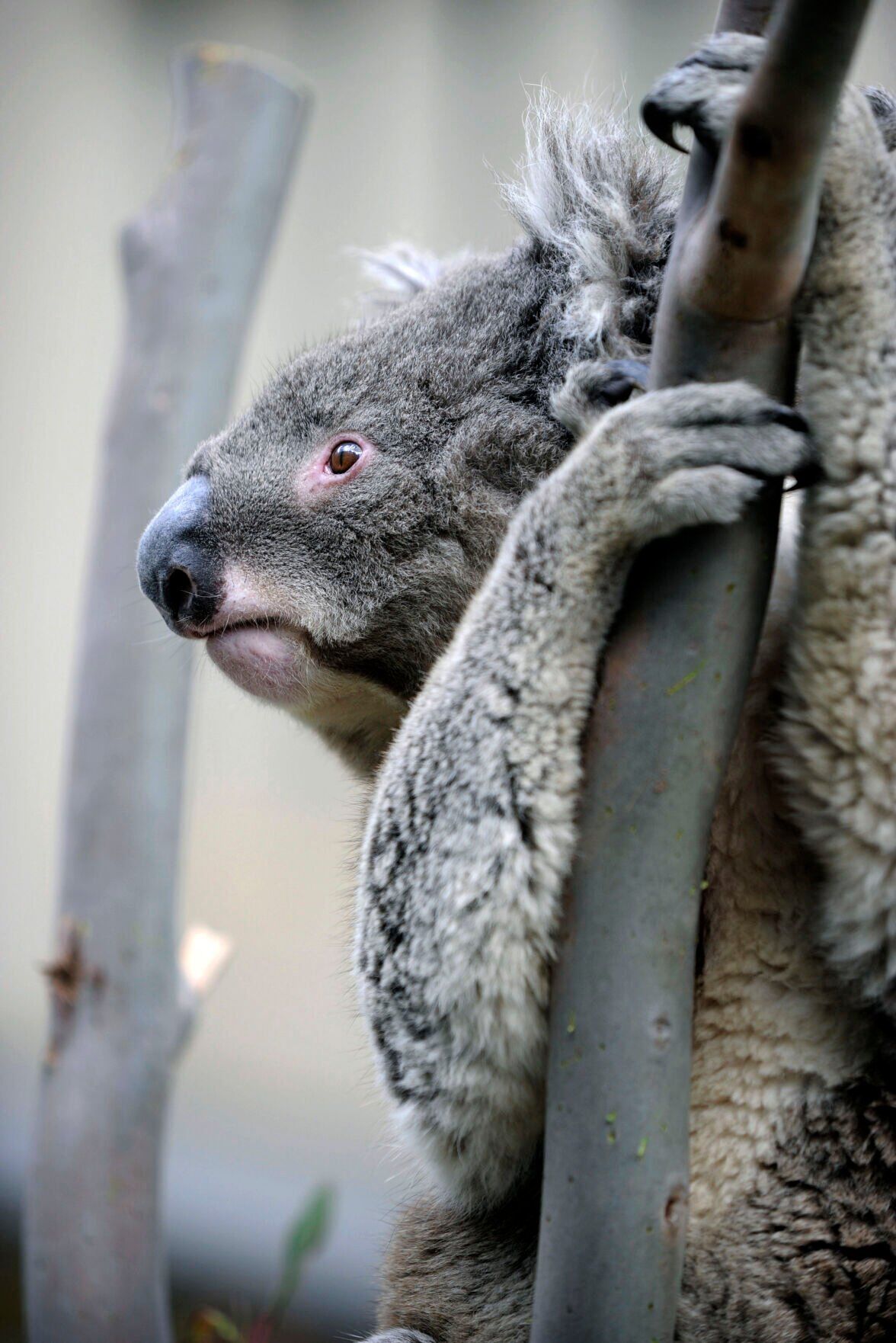
A koala clings to a tree on the grounds of Parliament House on the National Threatened Species Day in Canberra, Australia, on Sept. 7, 2010. The National Threatened Species Day commemorates the day the last known Tasmanian tiger died in 1936, urging the people to conserve other threatened unique species in the country. (AP Photo/Mark Graham)

