


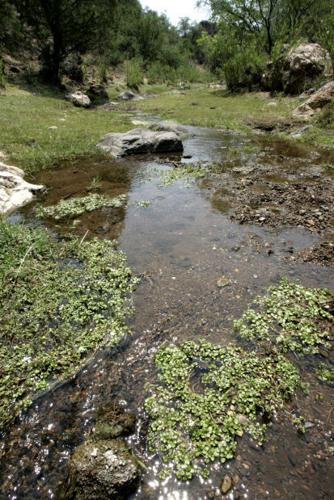
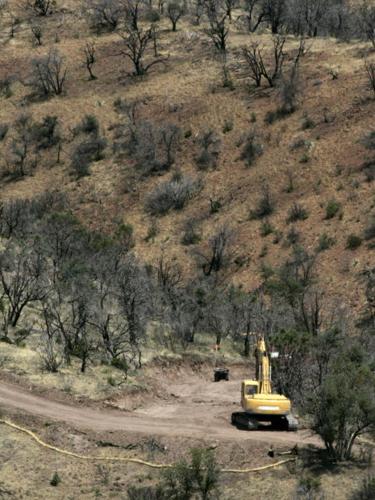

A proposed, $834 million silver mine in the Patagonia Mountains could deplete the region’s dwindling groundwater supplies and is likely to worsen existing acidic runoff into streams, says a new report from two opposition groups.
The report — blasted by the mining company but generally praised by the Patagonia town manager — says the mine could make a bleak local water situation due to drought worse. The proposed Hermosa Project would pump groundwater for a mine and processing plant for 18 years near Harshaw Creek and threaten the town’s water supply because the creek’s watershed supplies some of Patagonia’s drinking water, the report says.
It finds that the mine would also aggravate an existing problem of acidic runoff from past mining that has contaminated surface water. Also, a pit lake that would form after the mine is closed and its open pit abandoned would increase depletion of the aquifer due to evaporation, the report says.
Wildcat Silver Corp., the Vancouver, B.C. company proposing the mine, denounced the 43-page report as unsubstantial speculation. It said the report misuses data with misleading and false claims, but declined to be more specific on that.
The company noted that no studies have evaluated the mine area’s hydrology, much less whether its watershed is connected to the aquifer that supplies Patagonia’s water.
“The generation of any definitive statements based on those conclusions are unworthy of response. This report in question misuses data with misleading and false claims and the information is misrepresentative and selective ... .
“When a detailed independent report is completed that supplies meaningful data and accurate information, we will respond accordingly,” Wildcat Silver said in a written statement.
Forest service review
The opposition’s report comes as the U.S. Forest Service is reviewing the company’s plans to drill 48 holes on federal land to learn more about the mineral resources at the Southern Arizona site, six miles southeast of Patagonia. The service expects to decide on that proposal by October.
Approval of full-scale mining requires a federal environmental impact statement and review process that could take four to six years, the company said in a 2014 report to investors. If approved, Hermosa would be one of the world’s largest silver mines, said the company.
The environmental groups that produced the new report, the Patagonia Area Resource Alliance and Earthworks, wanted it out now, rather than waiting until the environmental impact statement is being prepared, said Pete Dronkers of Earthworks, the report’s principal author. By then, the company will have amassed more financial backing and it would be harder to change the scope of the public debate, he said.
“We didn’t want the community to wait to get all the relevant information,” said Dronkers, a Southwest circuit rider for the group.
While he doesn’t have a science degree, Dronkers said he has 10 years of experience working on environmental and science issues and has worked on several complicated mine proposals in Alaska as an activist for Earthworks. He noted that he didn’t attempt to conduct any original computer model research for the Hermosa report.
“A lot of the information I pulled together in the report isn’t that complicated,” he said. “It doesn’t require a fancy degree in geochemistry or hydrology. I’m relying on other peoples’ studies that already exist.”
Floyd Gray, a U.S. Geological Survey geologist in Tucson who was one of three outside experts to review the report, declined to comment on it, saying, “The conclusions are hypothetical. There is nothing we can do to comment on them. I reviewed the science in the document and the hypothetical I can’t control.”
He noted that his review was not like a standard peer review done for a scientific journal article — “it was an informal review or read.”
Another reviewer, Tom Myers, a private consulting hydrologist, said that he felt the study was OK overall, adding that he looked at the study’s specific details on the mine’s potential to “dewater” the aquifer and didn’t find anything wrong.
One reason for conducting a study like this one is to show that more formal computer modeling needs to be done now to show that the mine’s pumping won’t intercept recharging groundwater that is part of the town’s water supply, added Myers, who said he has reviewed 50 mining-related environmental studies and groundwater models.
“If you are intercepting drainage that goes into the town, it can absolutely affect the town. It may be a few years ... but it will eventually intercept water that goes to the town,” said Myers, who has worked for businesses, conservation groups and governments, and for Pima County on the proposed Rosemont Mine near Tucson.
Concerns called valid
Patagonia Town Manager David Teel said the report’s authors did “a lot of good work,” and that its concerns are valid, although it contained some inaccuracies, which he declined to specify.
“Our watershed includes much of that area by Harshaw Creek,” he said. “Pretty clearly, if they get approval, they will be digging very deep and certainly drawing down much of the Harshaw Creek flow.”
At the same time, it’s not known how much of Patagonia’s water supply comes from Harshaw versus the larger Sonoita Creek, of which Harshaw is a tributary, he said. Of the town’s water supply, it’s likely that Harshaw supplies “maybe 10 to 20 percent, not much larger,” he said.
The town is seeking money for a detailed study of the area’s watershed and hydrology.
USGS’ Gray said his agency did a study years ago that indicated the Red Mountain Range — where the mine would lie — contributes a “minor portion” of the water recharging the town’s well field and supplying Sonoita Creek.
This dispute over the mine’s impacts on water isn’t new. In an op-ed article published last March in the Weekly Bulletin, a community newspaper, Wildcat Silver vice president Greg Lucero criticized an earlier opinion piece by a mine opponent, Michael Stabile, that the mine was the biggest threat to the town’s water supply.
Lucero wrote that an Arizona Department of Water Resources study has found there’s no connection between the aquifer serving the town and the aquifer that would supply water to the silver mine. He said the two aquifers are at different elevations and get water from different sources.
Lucero wrote that Wildcat Silver “is a corporate citizen in good standing” that’s ready to work with Patagonia “to integrate and develop a long-term water supply plan, possibly from our aquifer.”
But at a public meeting in Patagonia about a month later, Greg Olsen, a U.S. Forest Service hydrologist, said the whole watershed is connected one way or another, the Bulletin reported.
“There is no steel wall between the two,” Olsen was quoted as saying. The Forest Service declined a request from the Star to confirm Olsen’s quote.

