




In an Amish farm community in Indiana, the childhood asthma rate is 5 percent.
In a community of genetically similar farmers in North Dakota, the rate is 15 percent.
That has University of Arizona researchers hopeful that they can create drugs that will prevent and treat the disease by studying the dust that collects in the homes and barns of those farms.
“I am very convinced that this area of research is going to produce significant results in asthma prevention and treatment. In the next 10-to-20 years, I can see some spectacular developments out of this,” said Dr. Fernando Martinez, director of the Arizona Respiratory Center.
Martinez, along with biologist Dr. Donata Vercelli and chemist and toxicologist Shane Snyder, head a team at the UA’s Bio5 Institute that is working to identify the substances that may afford protection from asthma for those Amish children.
They are collaborating with Johnson & Johnson Consumer & Personal Products and Janssen Biotech Inc. to turn that research into methods of treating or preventing asthma.
About 8 percent of Americans suffer from some form of asthma, with higher rates among children. There is treatment but no cure.
Vercelli, a professor of cellular and molecular medicine and associate director of the Arizona Respiratory Center, said she has already seen enough results with laboratory mice in this study to convince her she is on the right track.
“I’m a biologist and a mechanism seeker. For over a decade, I have been distrustful, intellectually, of studies that showed products from farms were protective against asthma.”
“Now we have a control and we are actually delivering results already. The impression we all have is one of extreme robustness.”
Scientists are always concerned with reproducing results. “This works every time,” she said.
The results are from mice who aspirate a cocktail of substances in that Amish farm dust that has proven protective.
The “control” is the dust gathered from a Hutterite farm community in North Dakota. It doesn’t produce a beneficial effect.
The Hutterites are genetically similar to the Amish group. Both migrated from Alpine Europe and live in closed communities where they intermarry and preserve their genetic similarities.
Unlike the Amish, however, the Hutterites use modern mechanized farming techniques that keep mothers and children out of the barns and in their more sanitary homes. They don’t live and work in proximity to their farm animals as the Amish do. Childhood asthma rates are three times higher among the Hutterites.
“The Hutterites are obsessively clean,” said Vercelli. “They wash their walls once a month. During pregnancy the women don’t go close to the animals. The Amish do; the women work until a couple days before childbirth.”
Health researchers have debated the “hygiene hypothesis” for years. It posits that a modern uptick in asthma and allergies is related to the increasingly sterile environment into which children are born and in which they develop.
Early exposure to bacteria and other organic substances in the environment, it is thought, help children build immunity to disease.
That hypothesis was bolstered in the 1990s when scientists in Europe found widely divergent rates of asthma in genetically similar groups in Switzerland. Urban children were far more likely to develop asthma than their country cousins.
Dr. Mark Holbreich, an Indianapolis allergist who downplays his role in the current study as its Amish “dust collector,” had observed the same phenomenon 25 years ago when he volunteered his services to Amish farm communities about 150 miles north of Indianapolis.
When the farm families came to his free clinics to find out which allergens were causing their sniffles and rashes, he found them nearly allergy free.
The basic scratch tests used to discover allergy triggers usually yield positive results for 45 percent of the tested triggers, he said. Among the Amish, it was 7 percent.
Holbreich suspended his clinics. He wasn’t needed. This population, for all intents and purposes, didn’t have allergies.
He continued to accompany his wife, Dr. Amy Shapiro, a pediatric hematologist who worked within the community to treat a genetic disposition toward hemophilia.
The couple cultivated friendships that enable Holbreich to visit and collect dust.
Holbreich said the Amish have as little contact as possible with the outside world, but told him: “If there is something within our community that can better the world in some way, we’re happy to do it.”
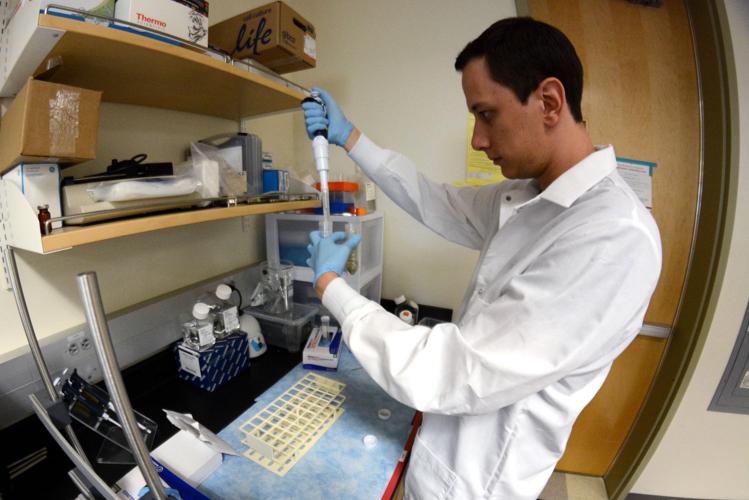
The dust samples, gathered from homes and barns in both communities, are analyzed in a lab run by Snyder at the UA’s Keating Bio5 Research Building.
Snyder is a professor in the UA Department of Chemical and Environmental Engineering.
He devotes much of his research time to finding “emerging contaminants” in wastewater — remnants of prescription and over-the-counter drugs that enter the wastewater stream undetected.
He said the dust study is a nice “twist” for his team, which is usually “looking for negative things.”
“The students are excited. They’re working on a remedy for asthma,” he said.
Snyder has a personal interest in the research. His own asthma improved when he moved West, but he still packs an inhaler when he returns to his childhood home in Pennsylvania.
Snyder describes his lab as “the funnel” for Vercelli’s work. He concentrates the farm dust and provides her lab with blindly labeled samples for testing with mice.
He can also selectively remove substances, using an array of sophisticated and customized mass spectrometers to separate molecules by mass. That allows the team to narrow in on the protective elements in the farm dust, said Snyder.
Fernandez said Vercelli is looking for a “pin in a very big haystack” — there are thousands of different substances in the dust and tens of thousands of protein-coding genes in the human genome.
But the task is not as huge as it otherwise would be. Having a genetically similar control group narrows the search, Vercelli said.
The answers, when they come, will not be simple, said Vercelli and Fernandez.
In decades of study, following asthma sufferers through their lives since 1980, Martinez has come to think of asthma as a variety of diseases, not a single malady. The causes, he said, are a mix of genetic disposition and environmental influences.
He doesn’t expect to find a silver bullet that will cure all forms of asthma, but an arsenal of remedies that can be applied on a case-by-case basis in a coming age of personalized medicine.

