



New and expectant mothers experiencing mental health and substance use disorders will soon have an additional level of support with the rollout of a Tucson-based helpline.
The Arizona Perinatal Psychiatry Access Line will connect providers across the state with specialists. Primary care physicians, OB/GYNs, pediatricians, family medicine doctors, physicians’ assistants and nurses will all have round-the-clock access to experts who can help them diagnose and determine the best next steps of treatment for their patients.
The helpline, free to use, is scheduled to launch June 1 and is funded through a $1.6 million grant from the Arizona Health Care Cost Containment System, the state’s Medicaid system.
It was created by perinatal psychiatrists Dr. Saira Kalia and Dr. Kathryn Emerick, who work as clinicians and professors at the University of Arizona College of Medicine.
It’s focusing on perinatal patients but will support women along the entire reproductive health spectrum, from premenstrual to peri-menopausal, Kalia said.
There’s a big need for a tool like this in Arizona, where the 915 psychiatrists aren’t enough, she said.
“There are counties in Arizona that have no psychiatrist at all. Our ratio in Arizona is one psychiatrist to 8,000 people,” Kalia said. “There’s this limited pool of psychiatrists and then within that, there are even fewer who are trained in reproductive psychology. That makes it really, really challenging to provide good, evidence-based care, or any care.”
With the launch of the helpline, staffed primarily by Kalia and Emerick, with support from an additional four or five psychiatrists, Arizona will become the 20th state to have this type of consultation line.
Maternal mortality rate
Kalia became interested in women’s reproductive mental health when she was a medical student, saying her status as a Pakistani immigrant piqued her interest.
“Women’s health is not exactly prioritized in third-world countries, let alone women’s mental health, so part of what I wanted to do was (go) somewhere I could train in women’s mental health. So this sort of work is a lifelong passion and drive,” Kalia said.
In addition to her work as a perinatal psychiatrist, she also works as the associate training director for the UA’s psychiatry residency program. She said very few programs teach women’s reproductive mental health or offer fellowships, meaning it’s not woven into regular psychiatric training.
For the last six years, Kalia has been running the women’s reproductive mental health track and teaching the program residents.

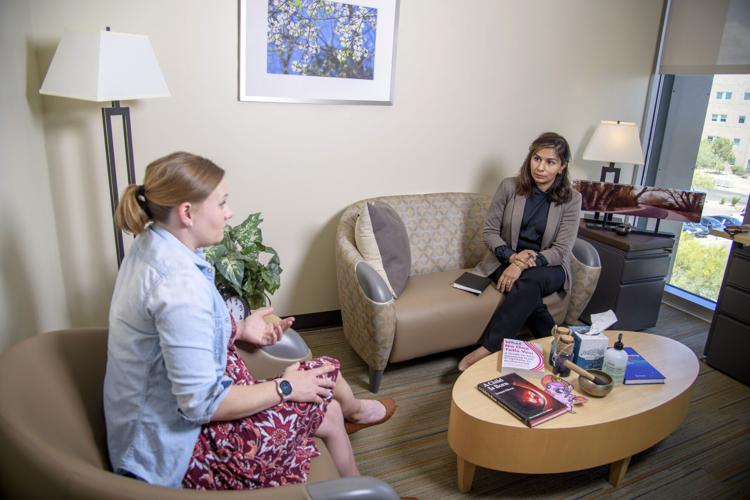
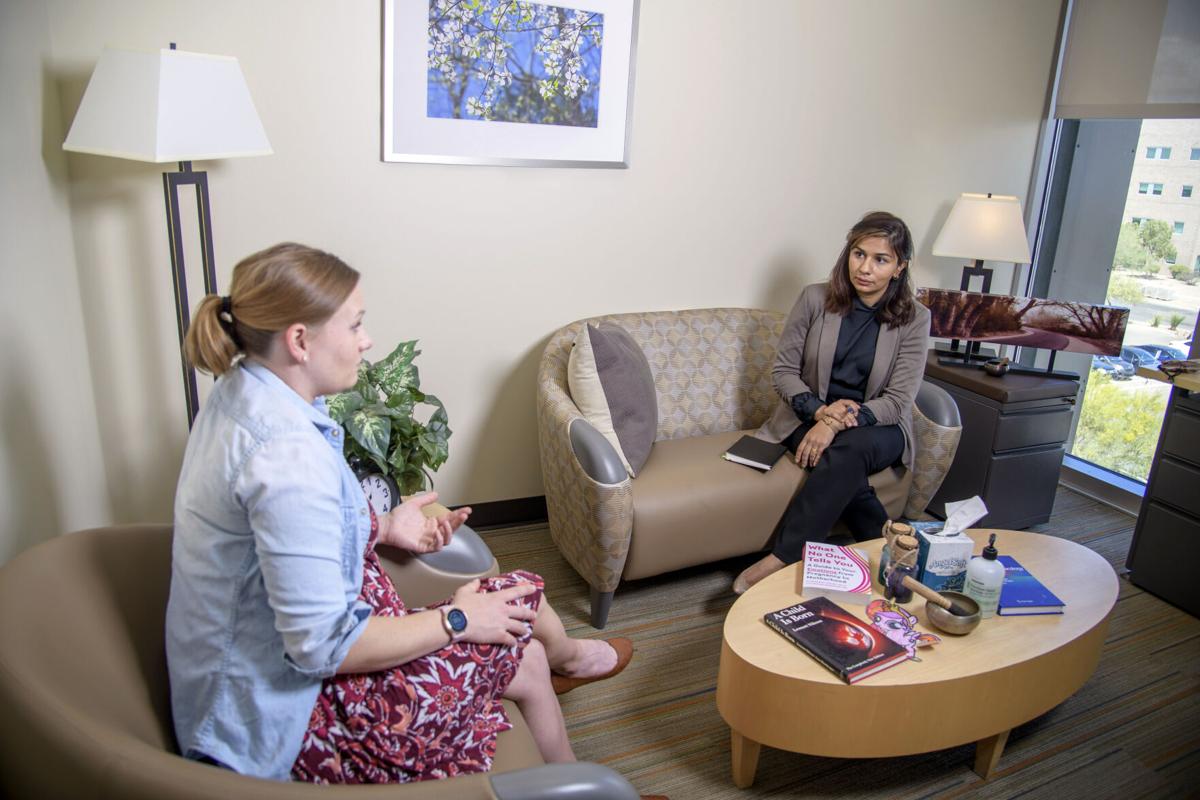
Perinatal Psychiatrists and APAL Directors Saira Kalia, MD, and Kathryn Emerick, MD. The University of Arizona Health Sciences, Noelle Haro-Gomez
In early 2022, she realized that despite all the training she’d done, it wasn’t doing much to move the needle when it comes to reducing the burden of perinatal mood and anxiety disorders and maternal mortality rate.
Each year, approximately 70 women die during or within 365 days after pregnancy in Arizona, of which 15 to 20 deaths are pregnancy-related cases, meaning those women would not have died if they had not been pregnant, according to the helpline’s website.
Perinatal mood and anxiety disorders are the leading cause of complications in pregnancy and childbirth and affect at least 15,000 women per year in Arizona.
With 80% of people with postpartum mood or anxiety disorders never receiving treatment, that equates to up to 12,000 women in the state whom Kalia says will never get the reproductive health care they need.
In March 2022, the Arizona Department of Health Services released a report showing that 98% of pregnancy-related deaths involving mental health and substance use were preventable.
“That’s gut-wrenching. That’s when we were like, ‘Let’s do this,’” Kalia said.
More babies born with drug exposure
Lisa Grisham has been a neonatal nurse practitioner for 23 years. She currently works in Banner-University Medical Center Tucson’s Family Centered Neonatal Abstinence Syndrome Program with babies who have been exposed to drugs or medication before birth, a population Grisham has seen steadily increase over the years.
On Thursday, seven of the 35 babies in Banner’s neonatal intensive care unit were being treated for neonatal abstinence syndrome, with symptoms that include trembling or extreme shakiness, too much or high-pitched crying, sleep problems, tight muscle tone, poor feeding and sucking, vomiting and diarrhea and fever or unstable temperature.
The program involves treating baby and mother and involving family members in the baby’s care while they are in the hospital.
“We recognize that to get the baby better, you need to also get the mother better,” Grisham said.
Grisham and her colleagues try to learn from and connect with specialists in the community, but when they need answers on clinical shifts, they need those answers fast. She called the creation of the Arizona Perinatal Psychiatry Access Line invaluable.
“They know I’m a provider, they know I have an educated background and want to help moms but don’t have these tools,” she said of Kalia and others. “I can call them and get the answers I need to connect moms to the resources she needs, whether that be treatment, counseling or something else.”
Grisham said that while the hospital has social workers on staff, they aren’t around 24/7 and aren’t always available. The helpline will help supplement those services.
With a five- or six-fold increase of babies born with neonatal abstinence syndrome between 2009 and 2023, Grisham called the need for a service like this greater than ever.
She said a lot of moms want to participate in the program and help their babies. Families in the program stay with their babies, hold and feed them. A family’s participation reduces their baby’s length of stay, and mothers are able to start treatment of their own.

“Some of the moms are already in treatment (when they give birth,) which is fabulous, but many of the moms are not because either they’re afraid or they don’t know where to go,” Grisham said. “I always say it’s never too early (to seek treatment,) but it’s also never too late.”
Managing preventable conditions
In addition to offering telephonic support to providers, Kalia and others will also track information and data.
They’ll collect information about reported signs and symptoms; socioeconomic status, race and ethnicity of patients; the county in which they reside; and whether they’re on commercial insurance or Medicaid.
This will allow organizers to connect with insurance providers and educate them about ways to effectively manage these types of preventable conditions.
They’ll also offer free in-person and online training based on various providers’ needs, including assessments, medication management, diagnostic techniques and more.
“I can say, ‘I’m guiding you through this, please do it,’ but they might be like, ‘I’m still not comfortable doing it’,” Kalia said. “We can come. We’ll educate, we’ll do training, we’ll do clinical consultation, whatever they need. And hopefully between all of those pieces, we’ll take some of the pieces off.”
Kalia and Emerick looked first to Massachusetts, the site of the first program of this type, the Massachusetts Child Psychiatry Access Program for Moms.
“But I realized, their state is so different. The state of Massachusetts you can’t compare Arizona to in terms of how they practice medicine,” Kalia said.
Washington state more resembles Arizona in terms of size, rural areas and birth count.
After reviewing programs in other states, Kalia and others researched local resources and needs. They tested the helpline with a soft release, leaning into relationships with local providers to help test out the service.
The June launch will be half-time as they test bandwidth and see how large the education component needs to be.
They’re also compiling a county-based map on their website of maternal health resources.
Direct patient care is next goal
The goal is to expand the helpline program to involve direct patient care, which is offered in several states.
Kalia hopes that in a year or so, they’ll be able to offer to step in for providers who don’t feel comfortable diagnosing or treating a patient. They could provide consultation and recommendations, and the provider could continue care. She calls that Phase 2 and is writing the pitch for funding it now.
“That would help so much in building the providers’ trust in us, in that we’ve actually seen the patient and we’re sending them back,” Kalia said. “But that requires a significant bandwidth.”
Kalia said it’s crucial to support women’s mental health during pregnancy and beyond and help reduce the stigma around these disorders and about seeking help and support.
“I can’t say that we’ll launch this line and if we’re starting to see an improvement, it’s directly connected, but we can track things like, do providers feel more comfortable and are we sort of building that capacity within our providers?” Kalia said. “As that improves, then we can see the results.”
American moms have shared how much time they would like for maternity leave. Buzz60’s Keri Lumm shares the results of a new study conducted by OnePoll on behalf of SurePayroll.

