


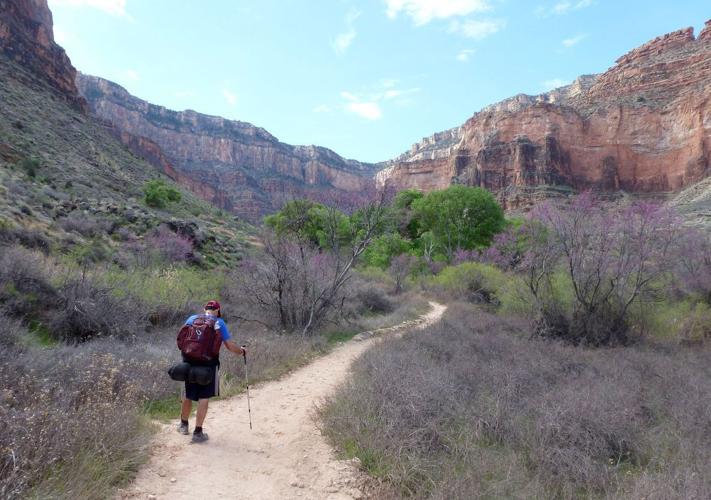

The sun was just starting to cast deep shadows into the crevasses of the Grand Canyon as a group of five young men trudged up Bright Angel Trail. The group of guys from California was doing well despite being soaked by an afternoon rainstorm, an insignificant hiccup considering they admitted to having barely researched the hike before heading down seven hours earlier.
The guys, loaded with hefty packs, made it down the 4.8 miles to Indian Garden and back up OK, but along the way they saw several people supplied with just a couple of small water bottles and others hiking in flip flops and dresses, Chris Rayos said.
The group started hiking again but not before unanimously warning that the way up is deceivingly difficult compared to the way down.
Despite decades of attempts by Grand Canyon National Park to fine-tune its message about the dangers of hiking to the bottom of the canyon, visitors still regularly attempt the trip without adequate preparation, knowledge or supplies, park employees said. It means that the canyon’s emergency response crews consistently receive hundreds of calls for help each year — 1,600 in 2014 alone — and in most years report the death of at least one hiker in the Grand Canyon.
Already this year, two people have died of heat-related causes while hiking through the canyon’s depths.
As the director of the park’s Preventive Search and Rescue Program, C.J. Malcolm’s job is to coordinate hiker assistance and education to reduce the risk that visitors will get into a situation where emergency response is needed.
Malcolm keeps a wealth of statistics about search and rescue operations and hiker interactions, but he admits that even years of data paint an incomplete picture of why canyon deaths keep happening and why the number of search and rescue calls, after declining to a low of about 300, has been stuck there for the past decade or so.
Although this year’s increased visitation may seem like one logical cause of more calls and a busier schedule for emergency responders, Malcolm said that actually hasn’t been the case.
Hiker assists are down this year, he said, and anecdotally his staff and volunteers are saying it seems slower down on the trails.
There is a stronger relationship between rates of backcountry permits issued and search and rescue operations, Malcolm said. There is also a striking correlation between emergency responses and temperatures inside the canyon. According to three years of data, when the temperature at Indian Garden goes above 95 degrees, hiker assists increase 70 percent, Malcolm said.
Another persistent statistic sticks out as well. Of the approximately 100,000 hikers the PSAR program makes contact with each year, the staff and volunteers give a “preventive message” — something like “you really shouldn’t be hiking to the river in Tevas” — to 25,000 to 30,000 of them, he said.
“That means 25 to 30 percent of our population is coming out here unprepared and that’s probably being generous,” Malcolm said.
Malcolm is full of stories about hikers who have no idea what they’re getting into. People will ask where the nearest bus stop is when they are down on Bright Angel Trail, he said.
That’s despite the park’s diligence about posting bright red signs warning about temperature differences, elevation gains and serious health consequences.

