


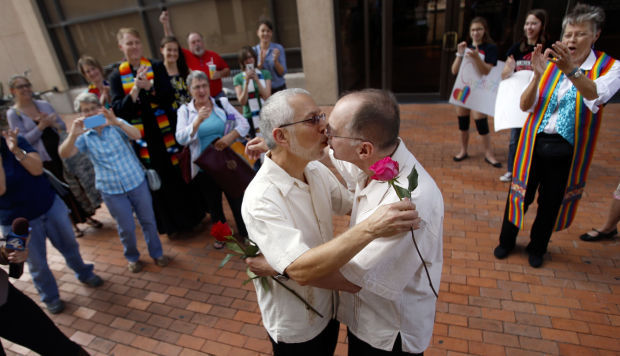
PHOENIX — In an broadly worded majority opinion on same-sex marriage, Justice Anthony Kennedy said laws against gay nuptials are no more defensible than since-voided statutes banning interracial marriage and marriage by prisoners.
“The reasons marriage is fundamental under the Constitution apply with equal-force to same-sex couples,” he wrote in the 5-4 ruling.
Friday’s ruling — while technically dealing with challenges to laws in other states — affirms last year’s decision by a federal judge that overturned the decision by Arizona voters in 2008 to define marriage as solely between one man and one woman.
It also voided even older measures adopted by the state Legislature about who can wed.
Friday’s ruling, by extension, also means Arizona has to recognize same-sex marriages previously performed in other states.
Less clear, however, is how it affects other Arizona laws that reserve special privileges for opposite-sex couples.
For example, one law dealing with adoption spells out that if all other relevant factors are equal, the state should give preference to “a married man and woman” versus a single adult. But Josh Kredit, legal counsel for the Center for Arizona Policy, said the Supreme Court ruling does not mean that law is now invalid and that Arizona has to provide equal treatment for all married couples.
“That would assume that the only reason for the law was because it was because they were married and not specifically because it was a man and a women,” Kredit said.
“The Legislature passed the law that says that, all things being equal we think that, as the social science shows us, children do best with a married mom and dad,” he explained. “It’s the Legislature saying, ‘We don’t think moms and dads are interchangeable.’”
But Jennifer Pizer, attorney for Lambda Legal Defense and Education Fund, said Friday’s ruling should effectively make such laws invalid.
“There really should not be any serious dispute . . . about whether families headed by same-sex couples deserve the same respect,” she said. Pizer said the ruling “should allow us to move forward without lots of secondary disputes.”
That question of the need for a mom and a dad played out in the debate at the court.
Chief Justice John Roberts said in his dissent that heterosexual marriage came about not because of a societal decision to exclude gays but “to meet a vital need: ensuring that children are conceived by a mother and father committed to raising them in the stable conditions of a lifelong relationship.”
He said procreation occurs through sexual relations between a man and a woman. And if a child is conceived, its prospects “are generally better if the mother and father stay together rather than going their separate ways.”
Kennedy, however, said that logic falls apart as no state conditions marriage on the desire or promise to procreate.
“The constitutional marriage right has many aspects, of which childbearing is only one,” he said.
There’s a more pressing question: Now that the court has determined gays have a constitutional right to wed, can businesses refuse to provide services at such nuptials.
Last year a majority of Arizona lawmakers approved SB 1062 to expand the rights of business owners to cite their own religious beliefs to let them refuse service to anyone. Proponents cited a New Mexico case in which that state’s high court ruled a commercial wedding photographer could not refuse to take pictures of a same-sex wedding.
It did not become law because then-Gov. Jan Brewer vetoed it, calling it a solution in search of a problem that does not exist in Arizona.
In a prepared statement, current Gov. Doug Ducey said he hopes Arizonans “will engage constructively as we comply with the requirements of the law based on this ruling.”
But Ducey did not address — and press aide Daniel Scarpinato would not answer — whether the governor believes there is now a need for an Arizona law to protect business owners.
Aaron Baer, spokesman for the Center for Arizona Policy, said his organization, which pushed SB 1062, is studying the ruling.
“There might be need to add protections in there to look at what we can do in state law to ensure people of faith are protected,” he said.
Kennedy wrote that nothing in Friday’s ruling disturbs the rights of religious organizations and individuals to teach their own principles, including that same-sex marriage is not to be condoned.
Similarly, Arizona has no laws prohibiting discrimination based on sexual orientation. But Pizer said she believes the wording in Kennedy’s ruling will help extend the reach of existing federal civil rights laws that prohibit discrimination based on race, color, national origin, religion and gender.
“(Friday’s) decision speaks of the equal dignity in the place that LGBT people have in our society and the harms and the unjustifiable exclusions and discrimination of past generations,” she said. “All of that analysis and language should be helpful in addressing the array of questions that we still have.”

