

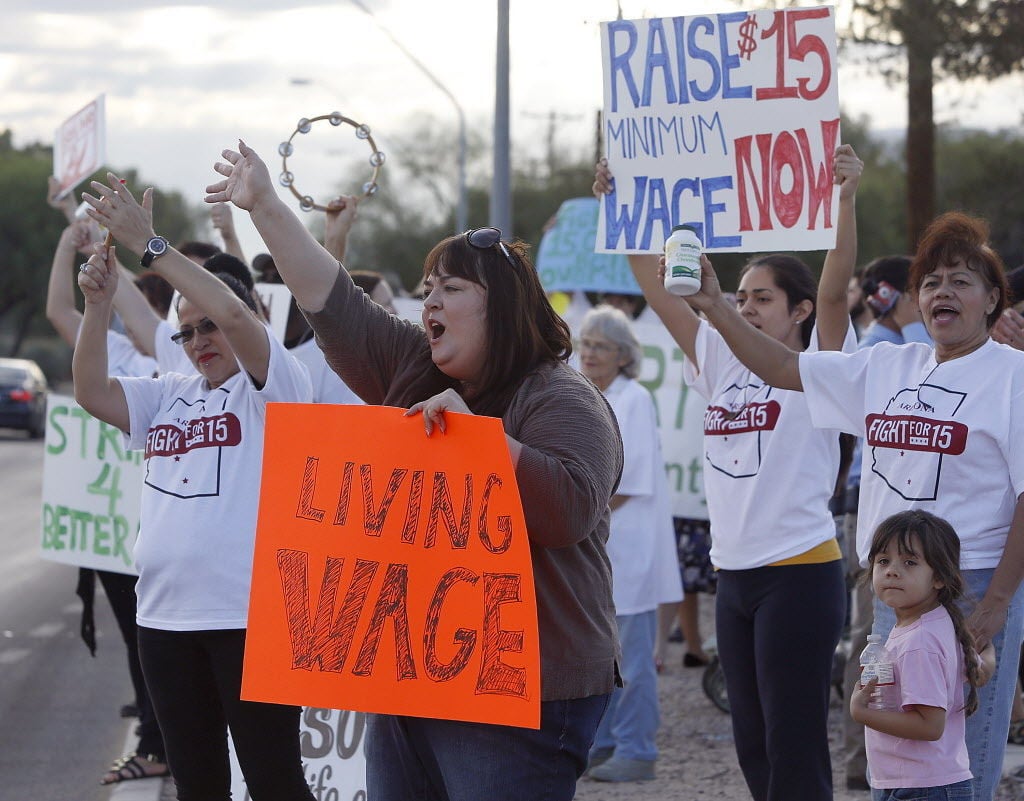
PHOENIX — Republican lawmakers agreed Thursday to ask voters to increase the state’s minimum wage — but in a way that businesses want.
HCR 2014, given preliminary Senate approval, would require employers to pay their workers at least $9.50 an hour by 2020. By contrast, the current voter-approved law, with annual inflation adjustments, might have boosted the current $8.05 minimum to perhaps close to $9.
It’s not that GOP lawmakers think higher wages are a good idea.
“The underlying principle, that we use the force of government to force other people to pay a certain wage to their employees, is very, very distasteful to me,” said Sen. Sylvia Allen, R-Snowflake.
“When we get down here and we determine because we have the force of law behind us that we can take from one person and give to another person what is not ours, it’s a principle that is morally flawed,” she said. “But I understand the reason why we have to do it.”
That reason is the business community, led by the Arizona Restaurant and Hospitality Association, believe a $9.50 wage is ultimately better than what they have now.
The biggest objection to the 2006 voter-approved measure is it allows cities, towns and counties to enact an even higher minimum wage than the state requires. An initiative drive is under way in Flagstaff to require employers there to pay at least $15 an hour by 2021; similar measures are being weighed in other communities.
The measure would pre-empt such local options, essentially asking voters to override what they approved in 2006.
The restaurants also want to tinker with another provision of the 2006 measure that says workers who earn tips can be paid $3 an hour less than the minimum. The measure that now awaits a roll-call vote alters that to require that tipped workers be paid just 65 percent of the minimum, a figure that Sen. Martin Quezada said could mean a decrease in what they are paid now.
There’s something else at work, too.
HCR 2014, if it gets final Senate and House approval, would be placed on the November ballot. It would then compete with a separate initiative drive to create a $12 minimum wage by 2020 — one that neither pre-empts local options nor alters the formula for tipped workers.
“This amendment is just a cynical attempt to undermine another ballot measure that is going on,” Senate Minority Leader Katie Hobbs, D-Phoenix, said of the measure, which she said will pass if it gets the necessary signatures to put it on the ballot.
Arizona had no minimum wage prior to 2006, with employers subject only to what is required in federal law, a figure that can be changed only through an act of Congress. That was $5.15 an hour.
The measure approved by voters that year set a $6.75 minimum wage for Arizona, with annual increases to match inflation.
The result is now a state wage of $8.05 an hour, compared to the current $7.25 federal figure.
Steve Chucri, executive director of the restaurant group, said his organization has pretty much accepted the situation. What it cannot accept, he said, is that local option.
But since the current law — and that option — was approved by voters, it cannot be altered by the Legislature.
That means the only way to eliminate it is to put it back on the ballot. And that’s exactly what the Republicans have agreed to do.

