

Few Arizona residents will notice any immediate change to the availability of water at the start of this new year as steep cuts begin to be imposed on the amount of water the state can draw from the Colorado River, experts say.
But that does not mean they can relax. State and federal water officials expect more cuts will be required in 2023, as they struggle to keep drought-ravaged Lake Powell and Lake Mead from falling to critically low levels.
And it’s anybody’s guess as to when and how those additional cuts will take effect, they say.
“If there’s one thing water managers really like, it’s certainty,” said Tom Buschatzke, director of the Arizona Department of Water Resources. “And 2023 seems to be anything but.”
That uncertainty is felt on the local level as well. Phoenix Water Resources Management Adviser Cynthia Campbell said the most recent projections show that Lake Mead and Lake Powell could drop below the point where the Hoover and Glen Canyon dams can produce hydroelectric power.
“It’s very bad,” Campbell said. “There’s no way to mince words about this ... if we’re going to save the functionality of Hoover Dam and Glen Canyon Dam, there’s going to have to be, by necessity, a significant decrease in demand on the river.”
Those cuts would be in addition to reductions already imposed by the U.S. Bureau of Reclamation, which manages the dams and the water that passes through them.
The bureau last summer announced that the lakes had fallen to Tier 2A levels, triggering previously agreed-upon cuts to water supplied to states in the lower basin of the Colorado River, beginning on Jan. 1.
Arizona will see the steepest cuts, with the state set to give up 592,000 acre-feet of water — the amount of water is takes to cover an acre to a depth of 1 foot — in 2023. Mexico would lose 104,000 acre-feet, Nevada would lose 25,000 acre-feet and California would not give up any of its water yet.
Most of the cuts in Arizona will be felt by farmers, with agriculture one of the biggest users of water in the state and one of the lowest priorities for delivery.
But Reclamation has already called on the seven states in the Colorado River Basin to find an additional two million to four million acre-feet to cut in the coming years, as Lake Powell and Lake Mead fall to the lowest levels since they were filled.
Campbell said that Phoenix is actively preparing for even the worst-case scenario, finding ways to continue providing water, but it will take some help from residents. That means people will have to start thinking about conservation in their daily lives, from making their homes more water-efficient to getting rid of lawns and pools.
“We’re also making sure we’re ready to deliver alternate supplies and make our customers aware of what they can do to be as efficient as they can,” Campbell said.
Colorado River basin states have been planning for years for water restrictions. But Reclamation has said that if the first months of 2023 are particularly dry, Lake Powell levels could drop below 3,490 feet, the minimum level at which the dam can produce electricity. In the worst case, both lakes could fall to the point at which water can no longer flow through the dam, a condition known as “dead pool.”
The bureau stressed that it will do everything in its power to maintain water levels needed for power production and water flow, either by limiting water deliveries to states, by prioritizing Lake Powell over Lake Mead by transferring water from one to the other, or both.
Noe Santos, the Bureau of Reclamation’s river operations manager for the Lower Colorado Basin, said the agency will begin releasing less water from the reservoirs in 2023. Most users will only feel the changes in winter and summer months, he said, when less water overall is pumped because agricultural demand is lower.
One step that some Arizona cities and tribes have already taken to protect reservoir levels is to store some of their water allotment in the lakes. Phoenix is part of that group, having already stored 30,000 acre-feet in 2022 and volunteering to store an additional 30,000.
But Buschatzke said there are concerns across the state, especially among tribal governments, that such goodwill could end up hurting them in the end.
“No one wants to put their water on the table when there’s a chance it could be cut anyway by the mandatory cuts the federal government is considering,” he said.
Those concerns are amplified for tribes that have long fought to have their claims to Colorado River water recognized, and now worry that water could disappear before they ever get a chance to see it.
Campbell said all Arizonans will be stressed in the next three to five years, with water likely to become more expensive as the supply continues to dwindle.
If residents can come together and become more efficient water users, she said, there is hope that the city and state can comfortably adapt. But she stressed that difficult changes are in store, adding that she has been using the “Serenity Prayer” as way to look at the coming years.
“To accept the things you cannot change, and change the things you can,” Campbell recited. “We have to accept the fact that this is going to happen.”
Longtime Arizona Daily Star reporter Tony Davis explains what "dead pool" means as water levels shrink along the Colorado River.
Photos: The receding waters of Lake Powell, Glen Canyon National Recreation Area

Tom Wright hikes past the beached marker for Willow Canyon where it joins with the Escalante River, Glen Canyon National Recreation Area, Utah.

A big horn sheep stands with the moon as a backdrop, looking over Fiftymile Creek, Glen Canyon National Recreation Area, Utah.
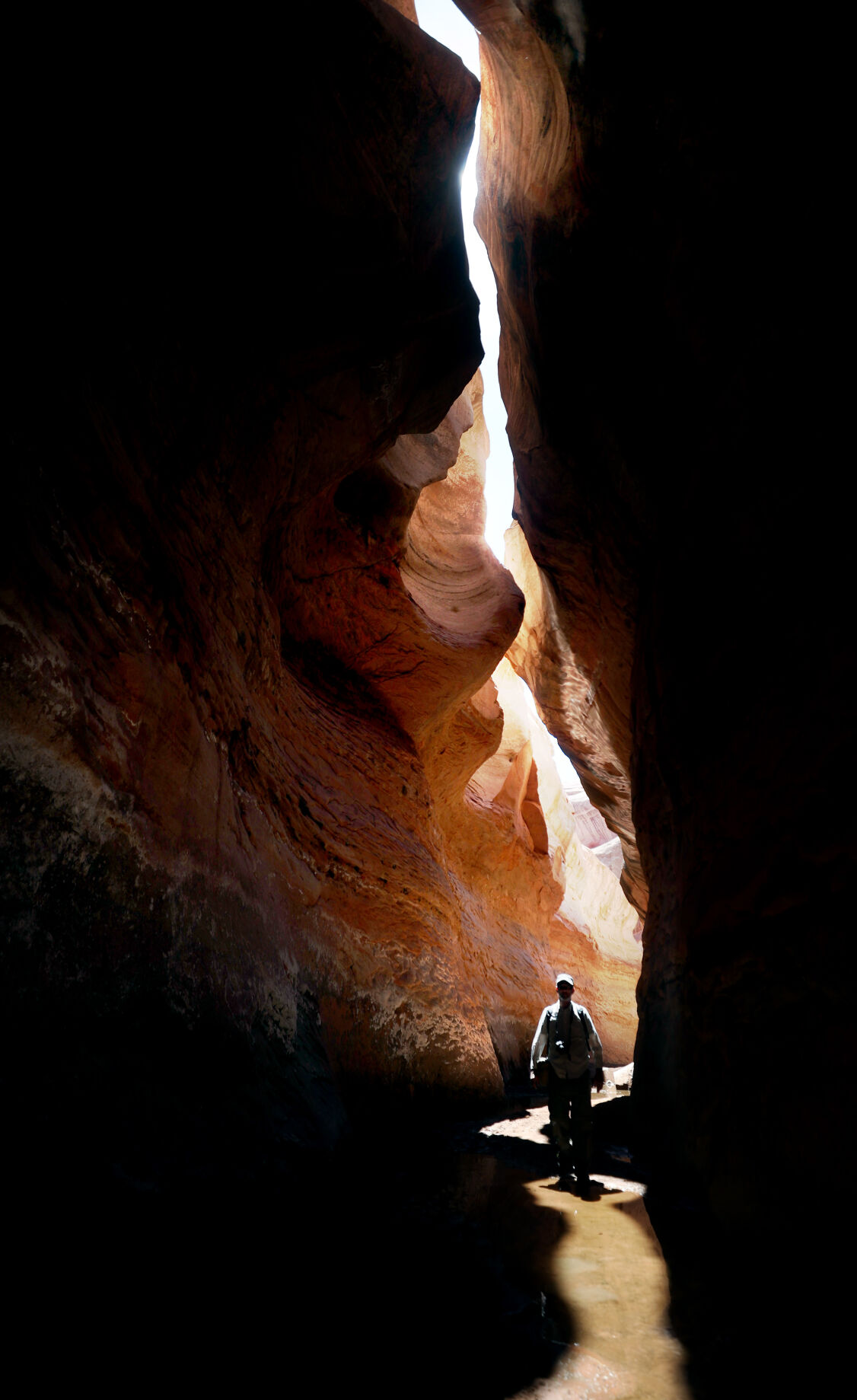
Tom Wright walks through the shaft of light peeking through the narrow openings of the formation called the Subway in Fiftymile Creek, accessible since the waters of Lake Powell have fallen dramatically.

A narrow sliver of sky is visible overhead through the narrow opening of the formation called the Subway, Fiftymile Creek, accessible since the waters of Lake Powell have fallen dramatically.

The dark streaking, called Desert Varnish, is from the seepage of oxidation in the rocks, and is beginning to erase the "bathtub ring", the lighter colored marks left by the waters of Lake Powell on canyon walls, Fiftymile Creek, Glen Canyon National Recreation Area, Utah.

The remains of a small boat, underwater for years, reemerges due to receding water levels of Lake Powell in the Glen Canyon National Recreation Area, Utah.
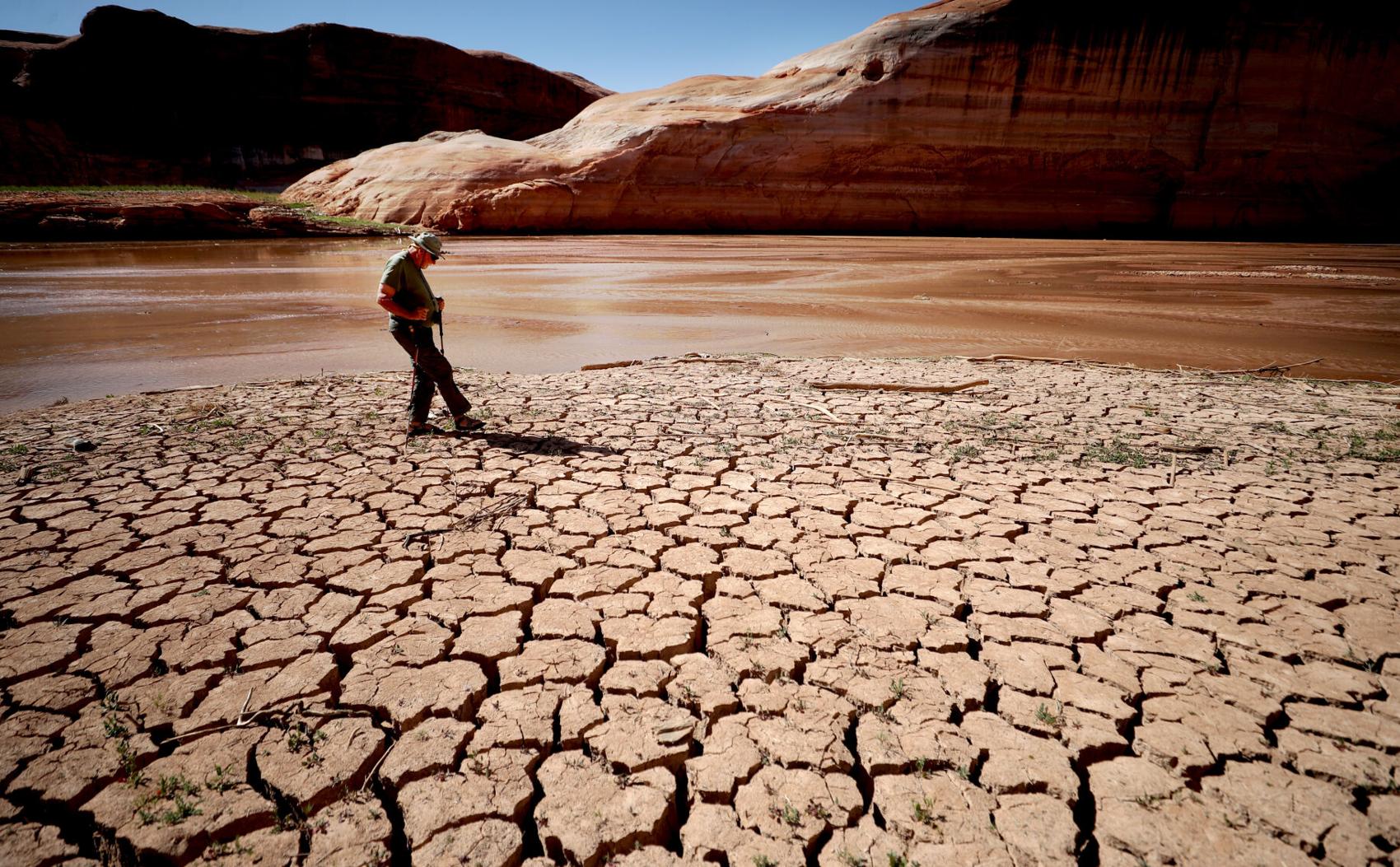
Frank Colver makes his way over the dried and cracking silt left where the Escalante River joins Lake Powell, Glen Canyon National Recreation Area, Utah. The receding water of the lake has the river cutting through the decades of accumulated silt to form a delta where it meets the lake.

A warning buoy sits high and dry far from the end of the closed public boat ramp at Bullfrog Bay, Glen Canyon National Recreation Area.

A line of tires that were once breakwaters at Bullfrog Bay Marina are now stranded on the rocky landscape high above the current water levels at the Glen Canyon National Recreation Area, Utah.
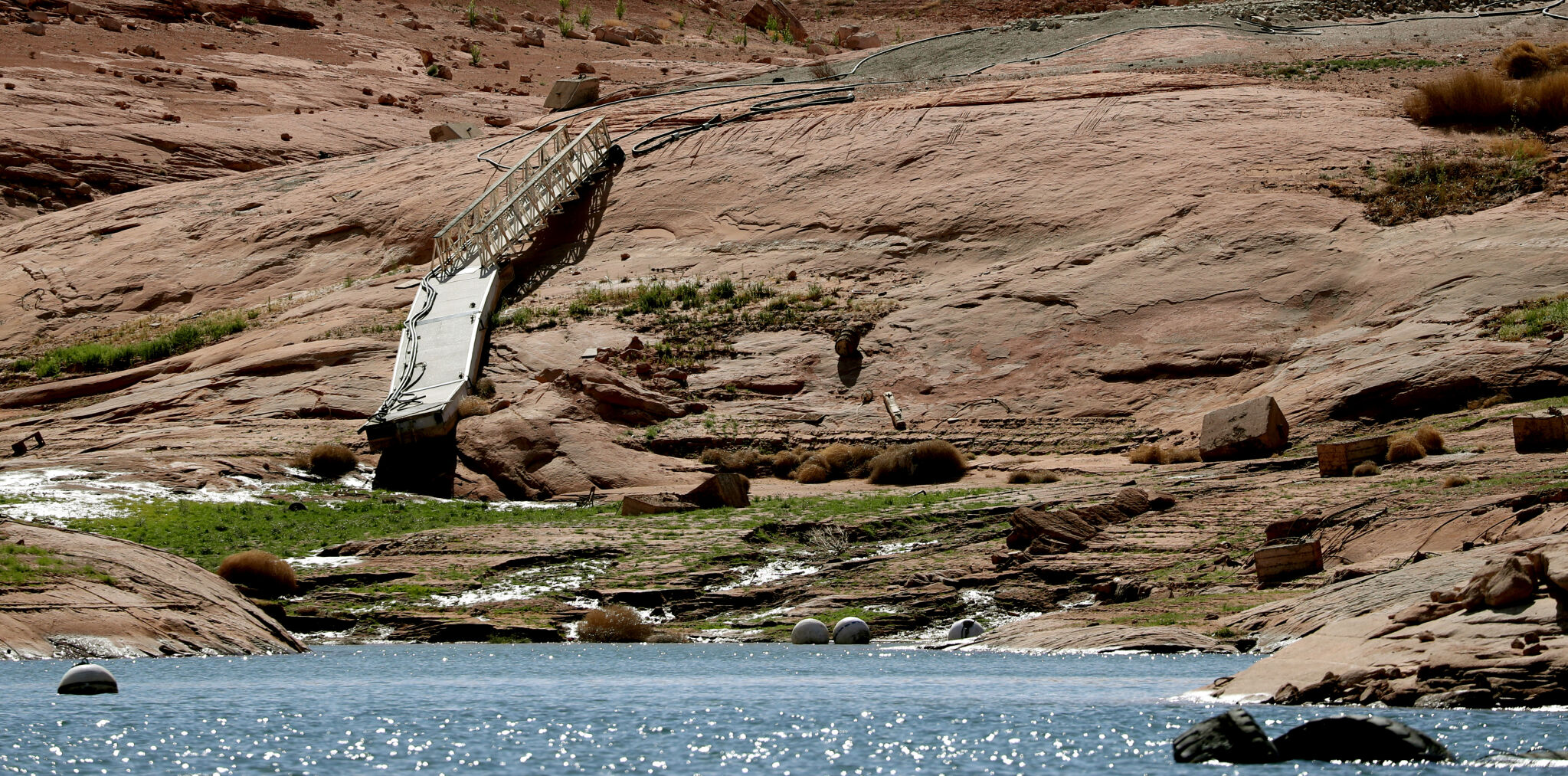
A pedestrian ramp lies well above the water levels at Bullfrog Bay in the Glen Canyon National Recreation Area, Utah.

A stranded wakeless zone buoy sits on the cracking silt outside the new shores of the Bullfrog Bay Marina, Glen Canyon National Recreation Area, Utah.

The end of the ferry ramp ends well short of the new water levels of Bullfrog Bay on the Glen Canyon National Recreation Area, Utah.

An early riser watches the sun come over the low waters of Bullfrog Bay Marina, Glen Canyon National Recreation Aria, Utah. The lighter colored areas on the canyon wall mark previous water levels.

A group of river rafters drift west on the current of the San Juan River outside Mexican Hat. The San Juan feeds Lake Powell.

The tops of a few cottonwood trees begin to poke out of shrunken water of Lake Powell, Fiftymile Creek, Glen Canyon National Recreation Area, Utah.

The remaining large water craft and house boats are crowded together in one of the last areas of water deep enough to support them at Wahweap Mariana, Glen Canyon National Recreation Area, Page, Ariz.

The waters of Lake Powell are twenty to thirty feet below the end of the public boat ramp at Wahweap Mariana, Glen Canyon National Recreation Area, Page, Ariz. Personal non-powered craft still use the ramp to unload, but must be carried up and down the banks to reach the water.

A view north from the Wahweap Marina Overlook show the shrunken waters around the marina in Glen Canyon National Recreation Area, Page, Ariz.

The underside of Gregory Natural Bridge, passable for the first time in almost 50 years, over the Fiftymile Creek, Glen Canyon National Recreation Area, Utah.

The moon rises over Gregory Natural Bridge, passable for the first time in almost 50 years, over the Fiftymile Creek, Glen Canyon National Recreation Area, Utah.

The exposed penstocks (intakes to the power turbines) on Glen Canyon Dam in the Glen Canyon National Recreation Area, Page, Ariz. The water level is at its lowest since 1967, when the dam was still being initially filled.

A group of sightseers get a look at the Glen Canyon Dam during a boat tour of Lake Powell, Glen Canyon National Recreation Area, Page, Ariz.

A small fishing boat ties up on the breakwater just outside the intakes for the Glen Canyon Dam, Glen Canyon National Recreation Area, Page, Ariz.. The penstocks (water intakes to the power turbines) are revealed for the first time since 1967 when the Lake Powell was being filled.

Swimmers and bathers use the jagged shores of the newly exposed banks of Lake Powell just above the Glen Canyon Dam, Glen Canyon National Recreation Area, Page, Ariz.

The Glen Canyon Bridge lies in front of electrical towers with feeder lines rising from the hydroelectric plant in the Glen Canyon Dam, Page, Ariz.

Glen Canyon Dam from Glen Canyon Bridge, Page, Ariz.

Small power boats on the Colorado River head upstream just below the Glen Canyon Dam, Page, Ariz.

Wade Quilter walks through the remains of cottonwood and Russian olive trees washed down and joined with silt to form a natural dam where Willow Canyon joins with the Escalante River, Glen Canyon National Recreation Area, Utah,

The remains of a big mouth bass lay in the silt just above where the Escalante River joins Lake Powell, Glen Canyon National Recreation Area, Utah.

The formation known as The Cathedral in the Desert on Clear Creek, Glen Canyon National Recreation Area, Utah. The re-emergence of the formation is drawing sightseers after being submerged for some 50 years.

Tom Wright feels the water oozing from the rocks in the formation known as Cathedral in the Desert on Clear Creek, Glen Canyon National Recreation Area, Utah. The re-emergence of the formation is drawing sightseers after being submerged for some 50 years.

Frank Colver takes a quiet moment and plays a handmade flute near the waterfall in the formation known as Cathedral in the Desert on Clear Creek, Glen Canyon National Recreation Area, Utah. The re-emergence of the formation is drawing sightseers after being submerged for some 50 years.

Jake Quilter walks down the newly cut banks of Clear Creek just outside Cathedral in the Desert, Glen Canyon National Recreation Area Utah. The sand is silt left behind by the receding waters of Lake Powell.

The tops of cottonwood trees that used to be under a hundred feet of water in Lake Powell are visible again in Clear Creek, Glen Canyon National Recreation Area, Utah. The deep water preserved the remains of the trees.

Boaters have to zig-zag through the rocks emerging due to receding waters of Lake Powell, Glen Canyon National Recreation Area, Page, Ariz.

Several images combined for a panoramic view of the Colorado River where it runs through the what once was Hite Marina in the Glen Canyon National Recreation Area, Utah.

A couple of sightseers take in the view from Hite Overlook over the Colorado River and the closed Hite Marina, Glen Canyon National Recreation Area, Utah.

Lone Rock, jutting out of the dry bed, would usually be surrounded by Lake Powell but is now well clear of the water, Glen Canyon National Recreation Area, Utah.

Tires that used to hold the lines well below the surface of Lake Powell are suspended over the water at Antelope Point Marina, Ariz.

Sightseers twenty or thirty feet above get photos of the low water levels of Lake Powell from the public boat ramp at Antelope Point Marina, Ariz.

The pedestrian access ramp ends abruptly twenty feet over the new Lake Powell surface at Antelope Point Marina, Ariz.

The entrance to the pedestrian access ramp of the Antelope Point Marina is taped off after being cutoff from the docks due to receding waters of Lake Powell.

